Visa’s South Korea push shows how stablecoin payment rails are moving toward bank-and-exchange distribution
Visa has paired a Korean bank partnership with a separate deal involving Upbit operator Dunamu, giving its stablecoin platform exposure to both banking and exchange distribution in one of Asia’s busiest digital asset markets. That combination points to remittances, settlement and wallet reach as the next competitive layer in stablecoin infrastructure.
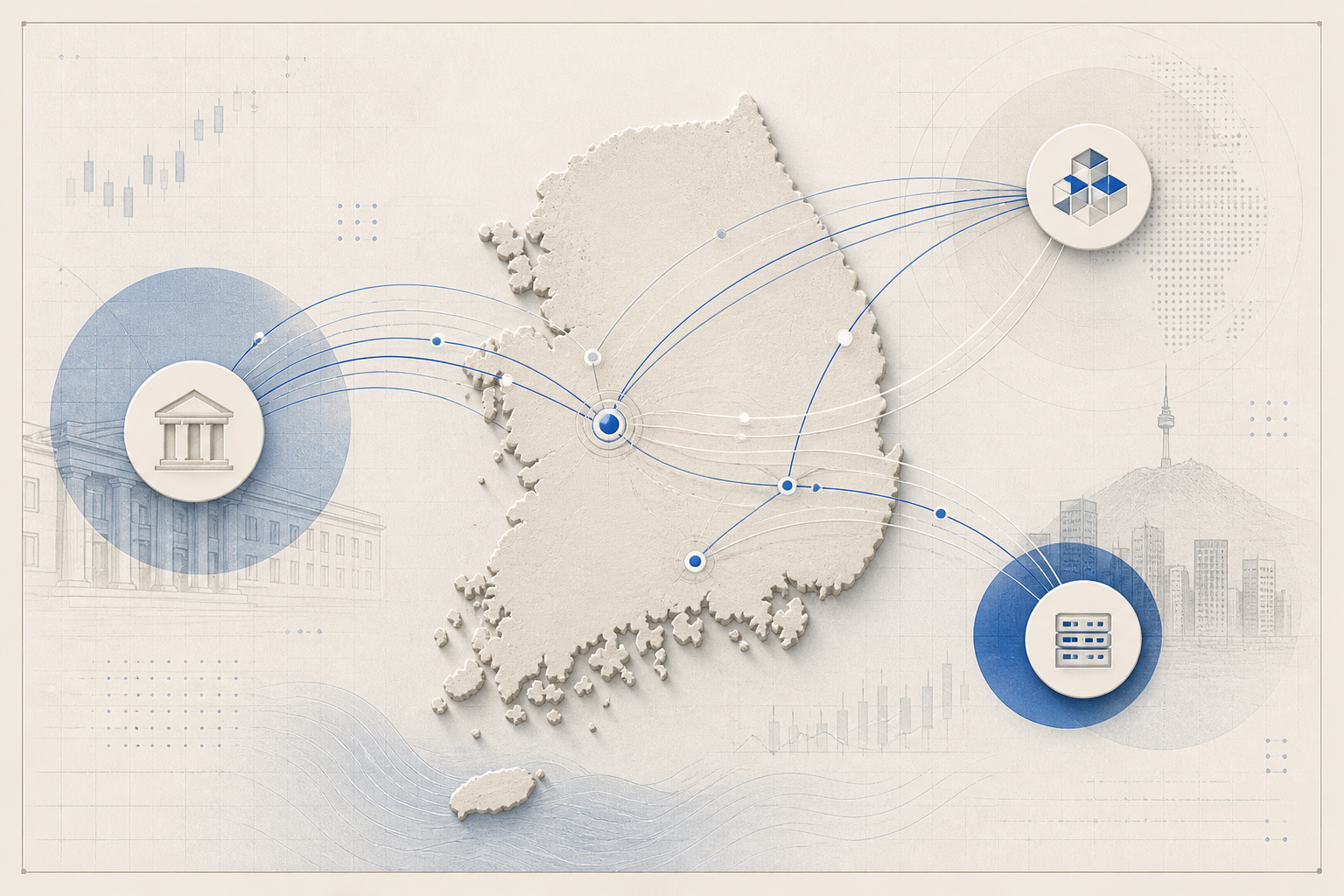
Visa's latest move in South Korea is notable less for a single announcement than for the shape of the network it is building. Within the same week, the payments company was tied to one partnership with Shinhan Financial Group and another with Dunamu, the operator of Upbit. Taken together, the two relationships suggest Visa is trying to position its stablecoin stack across both sides of digital money distribution: regulated banking infrastructure on one side and one of the region's largest crypto access points on the other. For the RWA market, that is a stronger signal than a one-off pilot because it points to how institutional payment rails may be assembled market by market.
The Dunamu arrangement was described as a strategic partnership focused on stablecoin payments, global remittances and AI-driven commerce. Prior coverage of Visa's platform rollout helps explain why that matters. Earlier this month, Visa introduced the Visa Stablecoin Platform as a beta product for financial institutions, fintechs and crypto-native firms that want to mint, redeem, hold and transfer stablecoins inside a controlled operating environment. The platform launched with support for Open USD and included wallet-as-a-service tooling plus transaction controls such as dual approvals. In other words, Visa is not trying to become the issuer of the money itself; it is trying to own orchestration, operational rails and risk-managed access around that money.
That strategy looks much more powerful when paired with distribution partners that already control customer flow. Shinhan brings regulated banking balance sheets, domestic payments credibility and potential future issuance pathways if Korean stablecoin rules continue to evolve. Dunamu brings exchange liquidity, wallet reach and a strong position in South Korea's digital-asset market through Upbit. A stablecoin platform connected only to banks can struggle to gain user distribution quickly, while a platform connected only to crypto venues can struggle to win institutional trust. Visa appears to be closing that gap from both directions at once.
South Korea is also a particularly important testing ground because the country is not approaching stablecoins as a purely crypto-market story. Recent reporting around Hana Financial's roughly 1 trillion won investment for a 6.55% stake in Dunamu showed that local financial groups increasingly view exchanges, remittance infrastructure and tokenization initiatives as connected strategic assets rather than separate experiments. That transaction followed earlier cross-border remittance collaboration involving Hana and Dunamu, and it reinforced the idea that Korean incumbents want a foothold in whichever stack eventually handles wallet distribution, foreign-exchange conversion and settlement for digital money products.
The Shinhan side of the story adds another layer. Separate reporting this week said Shinhan intends to use the Visa Stablecoin Platform to verify issuance, remittance and redemption workflows, while also exploring a local business model around stablecoin activity in Korea. Visa was also linked to Singapore's BLOOM initiative, which is aimed at settlement involving regulated stablecoins and tokenized deposits. That matters because it shows the company is not isolating retail payments from institutional settlement. It is connecting card settlement, treasury movement and cross-border rails into the same product family, which is exactly the direction RWA infrastructure has been moving over the past year.
For asset tokenization, the significance is straightforward. The value of onchain treasuries, funds and securities does not depend only on issuance technology or secondary-market access. It also depends on whether the associated cash leg can move through trusted, always-on payment rails with predictable compliance controls. Visa's Korean expansion suggests major payments networks see stablecoins as an operations and distribution problem, not just a settlement experiment. The more those networks can plug stablecoin flows into banks, exchanges and wallet providers simultaneously, the more plausible it becomes that tokenized assets will settle through systems that feel familiar to institutions while still operating on newer rails.
The next question is whether these partnerships turn into meaningful production volume or remain strategically useful proofs of concept. Korea's regulatory path is still developing, and public details on token choice, issuance structure and rollout timing remain limited. But even with those caveats, the pattern is clear: stablecoin infrastructure is no longer being built only by crypto issuers and chain-native middleware. Global payment incumbents are now competing for the control layer that connects issuance, wallets, settlement and merchant or remittance distribution. Visa's two-part Korean push qualified as strong RWA-relevant news because it shows where that contest is heading and why the distribution stack around digital dollars is becoming a core part of the tokenization story.