Stablecoin Rulemaking Shifts Toward Wallets, Redemptions and Secondary-Market KYC
U.S. regulators are moving from broad stablecoin legislation to a harder operational question: who has to identify the customer once a dollar token leaves the issuer and starts moving through wallets, exchanges and redemption rails.
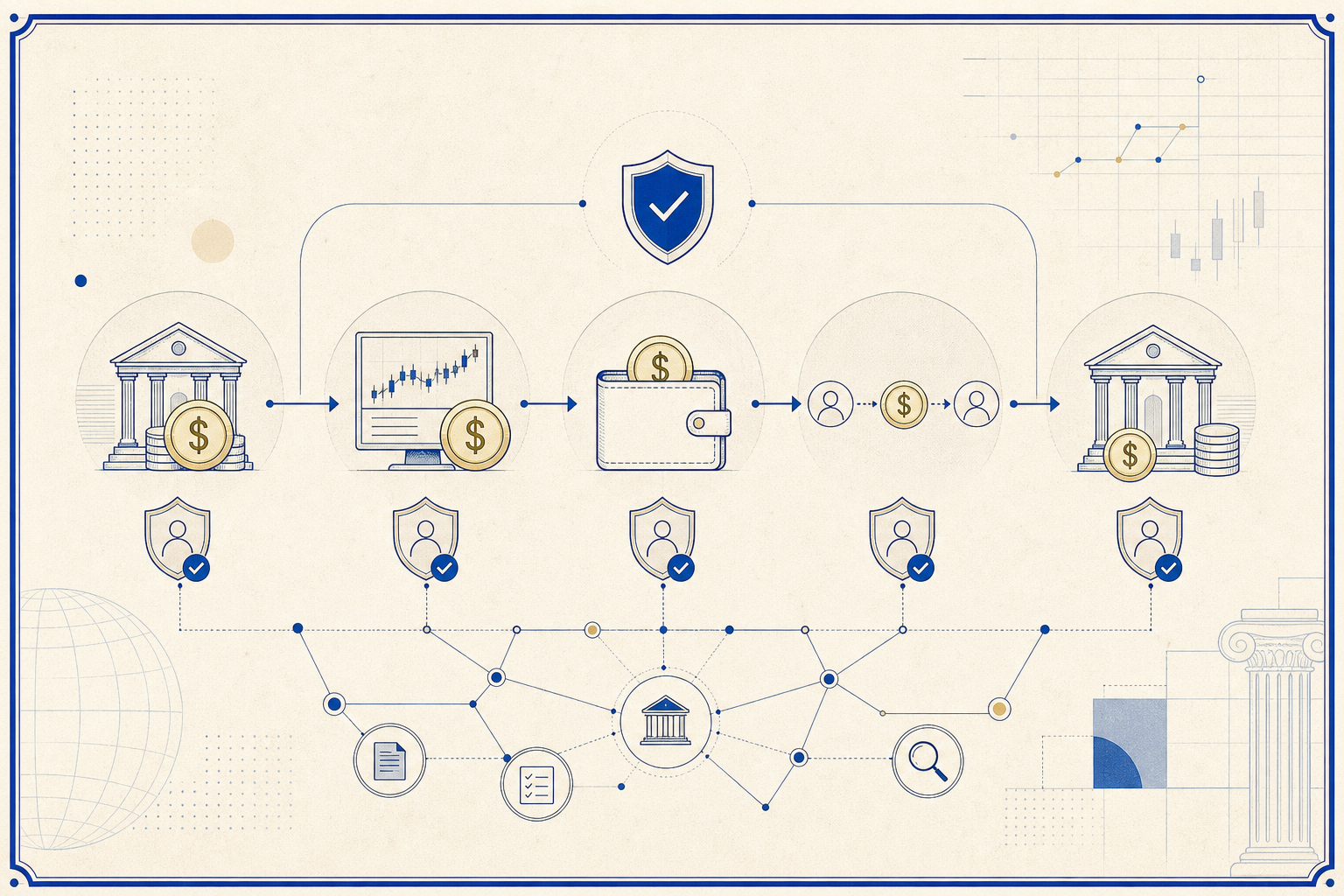
The next phase of U.S. stablecoin policy is turning away from the headline question of whether issuers will be allowed and toward a more technical one that could shape how payment tokens actually circulate: who has to know the customer at each point in the lifecycle. That issue moved closer to center stage after the comment period closed on the proposed customer identification program rule for permitted payment stablecoin issuers, a joint rulemaking led by FinCEN alongside the Federal Reserve, FDIC, OCC and NCUA. For the market, the significance is straightforward. The compliance perimeter around issuance, transfers, custody and redemption will influence how frictionless stablecoins feel in practice, especially when tokens move beyond the issuer’s own front door.
The proposed rule, published in June in the Federal Register, would require permitted payment stablecoin issuers to maintain a written customer identification program that fits their size, business model and risk profile. In plain terms, regulators are applying a familiar bank-style identity framework to a product that can be minted for one customer and then circulate across many others without any direct contact with the issuer. The proposal therefore spends meaningful time on the definitions of “account,” “customer” and “digital asset service provider,” because those definitions determine when an issuer’s obligations begin, when they end, and when another intermediary may be the party with the real compliance responsibility.
That boundary matters because secondary-market stablecoin activity does not look like a standard deposit relationship. A token can leave an issuer, pass through custodial wallets, trading venues, merchant flows and peer-to-peer transfers, and only later reappear for redemption. Regulators appear to recognize that reality. The current proposal is framed around the issuer’s own customer relationships rather than an expectation that an issuer must identify every downstream token holder the moment the token changes hands. That distinction preserves the possibility of open circulation while still requiring stablecoin issuers to operate with bank-grade onboarding and records for the customers they actually serve directly.
Industry responses show where the hard implementation questions remain. In its August 21 comment letter, America’s Credit Unions backed the proposal’s principle-based and risk-based approach, but asked regulators to clarify the treatment of redemption-only relationships, custodial and non-custodial wallets, exchange-mediated transactions, smart contracts and the use of digital identity or verifiable credential tools. That is an important signal because it reflects how banks and credit unions are thinking about stablecoin compliance at an operational level. The issue is no longer just whether onchain dollars need KYC; it is which institution must perform it, what can be relied upon from another institution, and whether the rules can accommodate modern identity tooling rather than forcing every participant into duplicative manual onboarding.
Redemption is the sharpest edge of the debate. Once a holder who acquired a stablecoin in the secondary market approaches the issuer directly to cash out, the relationship starts to resemble a traditional financial account even if the issuer had no earlier visibility into that holder. A strict reading would push issuers toward full onboarding before redemption, effectively creating a second compliance gate at the end of a token’s journey. A looser reading could let another regulated intermediary carry more of that burden if it already controls the customer relationship. The policy choice here is consequential: too much repetition turns stablecoins into a stack of overlapping KYC checks, while too little clarity risks leaving gaps in sanctions screening, recordkeeping and accountability.
The proposal also has implications for market structure. Large issuers, bank subsidiaries, custodians and exchanges will all want explicit rules on when one institution can rely on another’s identity work. Without that, every redemption rail and stablecoin distribution channel becomes more operationally expensive to launch. It is not difficult to see why the market cares. Stablecoins are increasingly being used not only for crypto trading but also for treasury movement, merchant settlement, cross-border transfers and wallet-based consumer payments. If compliance obligations are mapped cleanly across issuers and intermediaries, regulated dollar tokens can circulate with less legal ambiguity. If the map stays fuzzy, product design will bend toward closed loops and higher-friction redemption models.
For RWA markets, this is more than a stablecoin policy footnote. Tokenized funds, onchain payments and digitally native brokerage flows all depend on settlement assets that regulators and institutions can trust. A workable final rule would help define how U.S.-linked stablecoins can remain programmable and transferable without losing the controls expected in conventional finance. The immediate takeaway is that Washington is moving from broad authorization to infrastructure detail. That detail will decide whether the next generation of compliant stablecoin products behaves like an open payments layer with regulated gateways, or like a series of tightly fenced issuer silos connected by repeated identity checks.