South Korea maps a three-stage route from tokenized funds and bonds to onchain securities settlement
South Korea’s next security-token push is no longer just about legal recognition. The FSC is sequencing product scope, market plumbing and eventual stablecoin-linked settlement into a phased capital-markets rollout that could put a major Asian market on a credible path toward onchain securities infrastructure.
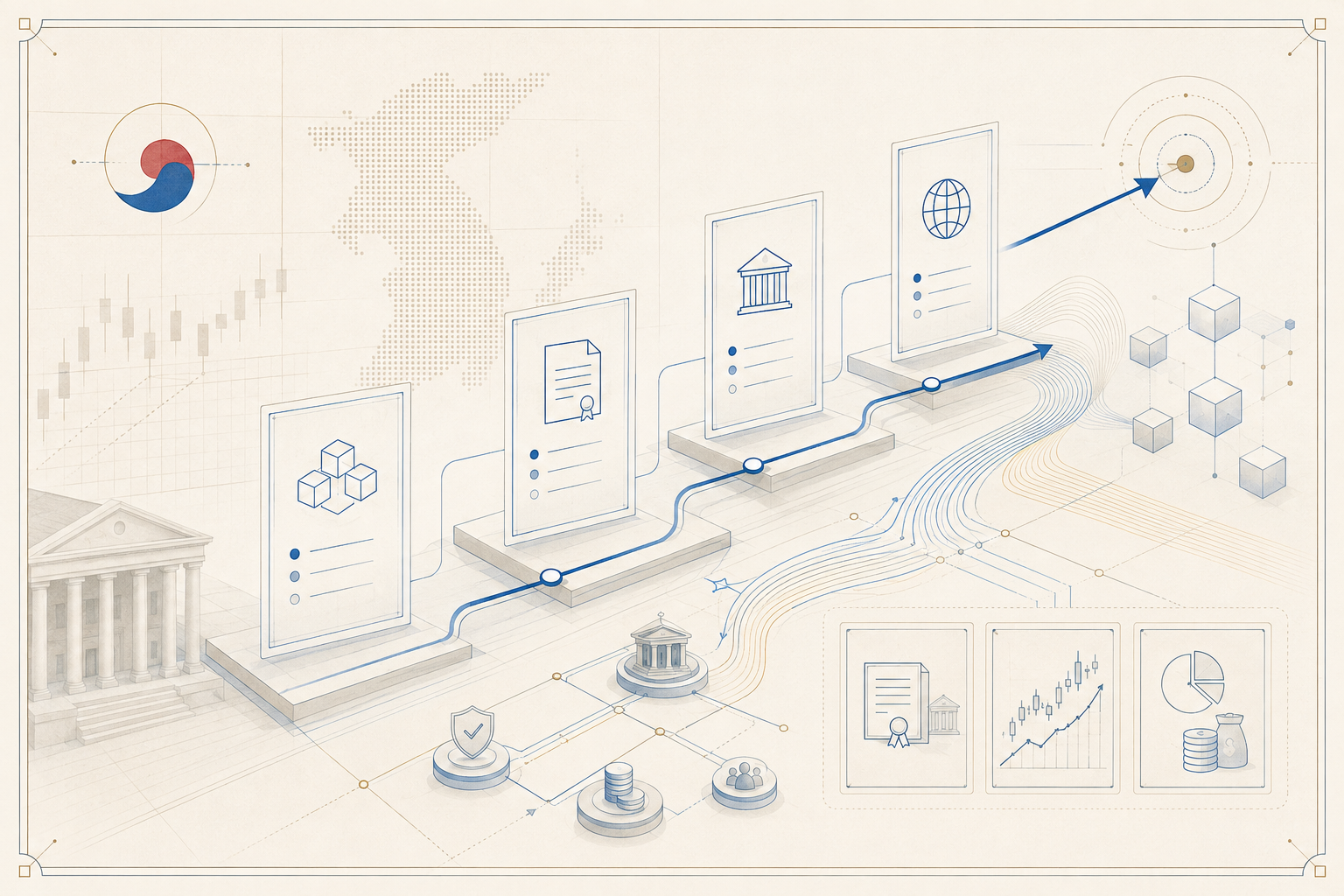
South Korea has moved its tokenized-securities agenda out of the conceptual stage and into a more operational market-structure plan. The Financial Services Commission’s latest roadmap points to a phased rollout that starts when amended securities legislation takes effect on Feb. 4, 2027, then broadens product coverage over time before eventually aiming for onchain settlement tied to stablecoins. That matters because the country is no longer talking about tokenization only as a narrow innovation sandbox. It is laying out how tokenized stocks, bonds and funds could be introduced inside the mainstream securities framework, with a sequence that acknowledges both legal readiness and infrastructure constraints.
The legal base for that shift was established in January, when South Korea’s National Assembly passed amendments to the Act on Electronic Registration of Stocks and Bonds and the Financial Investment Services and Capital Markets Act. In the FSC’s own description of those changes, distributed ledgers can be recognized as securities registries, and tokenized securities are treated as securities rather than as a regulatory gray zone. That distinction is critical. It means the token wrapper does not remove a product from ordinary securities law, disclosure duties or licensing requirements. Instead, the state is trying to adapt the existing capital-markets regime so issuance, custody, transfer and investor protection rules can still apply when ownership records move onto blockchain-based infrastructure.
The first implementation phase is deliberately narrow. Based on the regulator’s roadmap and corroborating local coverage, the initial launch window is expected to focus on institutional private money market funds, private bonds, certain trust-structured unlisted shares and publicly offered fractional investment securities. Existing brokers and securities firms would be able to participate under current authorizations rather than through an entirely new token-securities license. That approach lowers the policy burden for the initial launch, but it also signals the regulator’s view that tokenization is becoming another delivery format for familiar financial instruments, not a separate parallel market built outside the supervised securities perimeter.
Infrastructure design is where the roadmap becomes more substantive than a headline about “stocks on blockchain.” South Korea is not attempting a one-step migration of the whole securities system onto a new ledger. Reporting around the FSC plan indicates that participating firms will need to build their own distributed-ledger systems and connect them to the Korea Securities Depository, preserving the central role of market infrastructure while letting issuers and intermediaries modernize the recordkeeping layer. The phased model also appears to carry investor-guardrail logic: some reported limits on subscription size and over-the-counter net purchases suggest regulators want issuance and secondary trading to scale only after operational, disclosure and settlement mechanics have been tested in a controlled product set.
This rollout is also the product of a longer policy build. In March, the FSC launched a public-private consultative body on security tokens and said its work would span technology and infrastructure, issuance, circulation, and payment and settlement. That structure matters because tokenized securities programs usually fail when governments treat them as a single legal change rather than a coordinated redesign across registries, intermediaries, distribution channels and cash settlement. South Korea’s sequencing suggests the opposite instinct: get the legal amendments in place, organize the market around implementation workstreams, connect participants to the depository layer, and only then expand into broader public-offering and payment use cases.
The most ambitious part of the roadmap is the third phase, where stablecoin-linked onchain settlement enters the picture. The appeal is obvious. If the security leg and the cash leg can settle on the same ledger, delivery-versus-payment becomes more programmable and settlement windows can compress well beyond traditional T+1 or T+2 workflows. But this is also where the biggest policy dependency sits. Multiple reports note that South Korea is still working through its stablecoin framework, with broader digital-asset legislation and central-bank oversight questions not yet fully resolved. In practice, that means the securities-token plan can advance before the final settlement architecture is complete, but full end-to-end onchain capital-markets flows will still depend on how the country defines permissible payment tokens, oversight boundaries and interoperability with banking rails.
For the broader RWA market, South Korea’s roadmap is notable because it treats tokenization as capital-markets infrastructure, not just as distribution theater. A phased approach that starts with funds, bonds, unlisted and fractionalized products, keeps the depository in the loop and reserves stablecoin settlement for a later stage is more credible than promising an overnight switch to fully onchain securities trading. If execution matches the policy intent, South Korea could become one of the clearer examples of how a major jurisdiction moves from legislative approval to actual production pathways for tokenized securities. The near-term takeaway is not that every security in the country is about to trade onchain. It is that one of Asia’s most important financial markets has now drawn a practical route for getting there.