South Korea puts tokenized securities on a defined 2027 regulatory track
South Korea’s financial regulator has moved from roadmap to rule text for tokenized securities, setting capital, ledger, OTC trading and retail-limit standards before a February 2027 launch window. The proposal gives banks, brokerages and issuers a more concrete path for putting stocks, bonds, funds and fractional claims onto regulated digital ledgers.
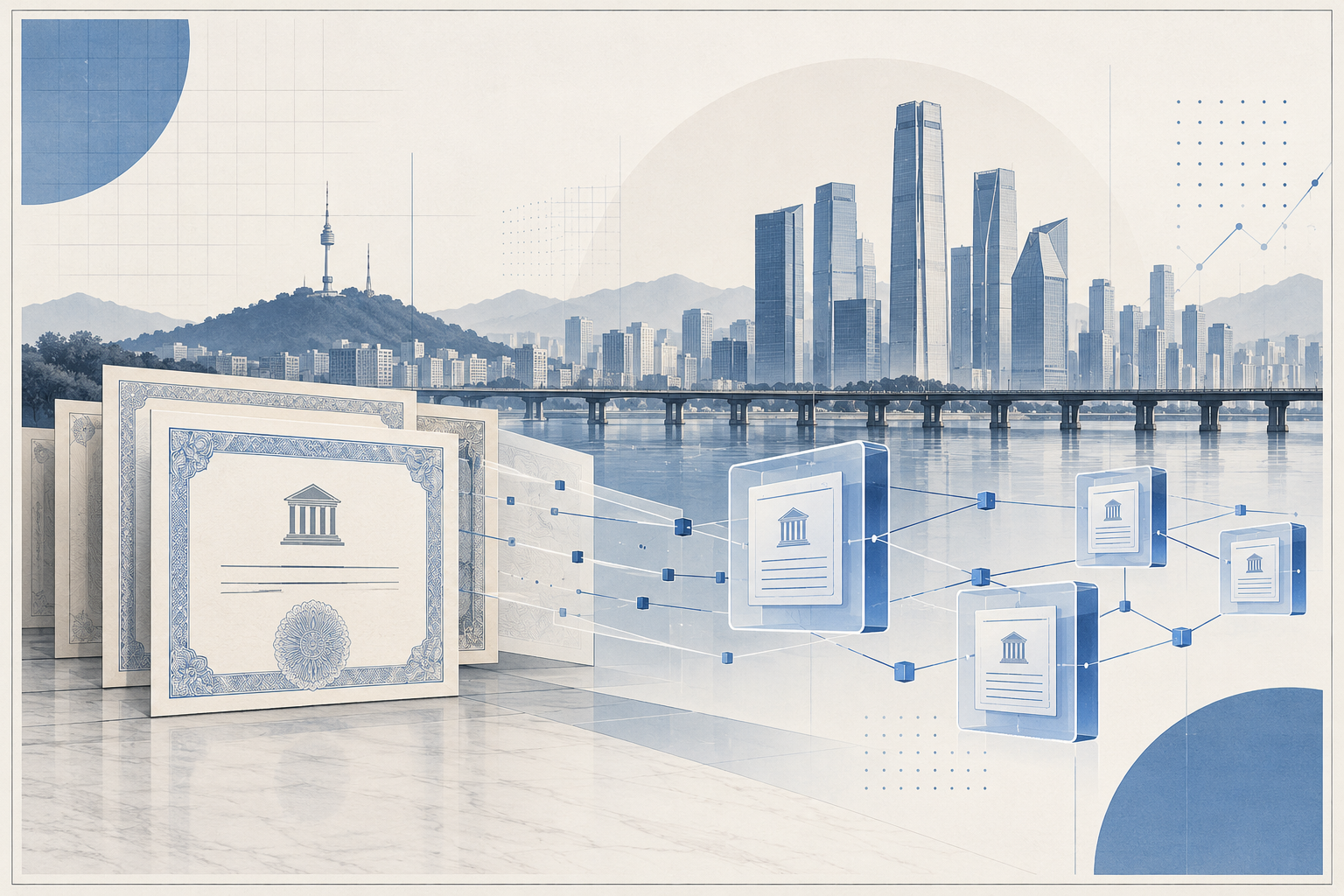
South Korea is turning its tokenized-securities agenda into operating rules, giving market participants a clearer view of how digital issuance and secondary trading are expected to work when the country’s revised framework takes effect in February 2027. The Financial Services Commission has proposed subordinate-regulation changes under the capital-markets and electronic-registration regimes, moving the market from policy direction toward implementation detail.
The proposal matters because it treats tokenized securities as part of regulated securities infrastructure rather than as a separate crypto experiment. The eligible universe is broad: traditional stocks, bonds and funds would be able to circulate in tokenized form, alongside certain fractional investment securities such as non-monetary trust beneficiary certificates and investment contract securities. That framing gives the project direct relevance to capital markets, not only to niche blockchain issuance.
A central design choice is the link between distributed ledgers and existing securities-registration infrastructure. The FSC says ledgers used for tokenized securities should be shared across at least two account-management entities, including issuer account-management entities, together with the Korea Securities Depository. It also says users should not be directly charged a fee simply for use of a distributed ledger, a detail that signals the ledger is being treated as market plumbing rather than as a discretionary product feature.
The proposed issuer-account-management rules are also more concrete than earlier policy language. Companies that issue tokenized securities and directly manage customer accounts would need at least KRW4 billion, or roughly $2.8 million, in equity capital. They would also need dedicated staffing: at least one account-management professional, one internal-control professional and two technology professionals. For an RWA market that often talks about disintermediation, South Korea’s approach is notably institutional: direct issuer account management is permitted, but only with capital, compliance and technology capacity around it.
Trading rules are developing in parallel. The FSC plans an additional over-the-counter exchange licensing unit for debt securities, supplementing existing categories for unlisted stocks and non-monetary trust beneficiary certificates. The regulator’s stated rationale is that retail trading in debt securities could grow once those instruments are tokenized. To contain risk, retail investors would face an annual net-purchase cap of KRW100 million on each OTC exchange.
Those details build on the FSC’s September roadmap, which laid out a phased rollout. The first phase begins from February 2027 and focuses on privately pooled money-market funds, institutional bonds, trust-structured unlisted stocks and publicly offered fractional investment securities. Later phases could expand tokenization to all publicly offered securities and, eventually, connect onchain payments infrastructure to stablecoins. The regulator has left the timing of later stages flexible, depending on the first phase, industry technology adoption and stablecoin legislation.
For tokenization builders, the message is mixed in a useful way. The proposal does not create an open-ended permission slip for any issuer to place securities onchain, but it does give regulated firms a visible checklist: eligible instrument types, ledger-sharing expectations, issuer-account requirements, OTC licensing boundaries and retail-protection limits. That checklist could make vendor selection, custody design, registrar integration and broker workflows easier to budget and test ahead of the 2027 date.
The most important implication is that South Korea is putting tokenization inside securities law and post-trade infrastructure before asking the market to scale. That may slow some speculative issuance, but it should make institutional adoption more durable if the final rules survive consultation largely intact. The public comment period runs from October 2 to November 11, after which the revisions are expected to move through approval before taking effect alongside the amended laws on February 4, 2027.