South Korea is moving tokenized securities from pilot concept toward market infrastructure
South Korea’s financial regulators have shifted tokenized securities from a niche fractional-investment discussion into a phased capital-markets buildout that explicitly covers stocks, bonds, funds and, eventually, onchain cash settlement. The roadmap matters because it treats tokenization as market plumbing rather than a marketing layer.
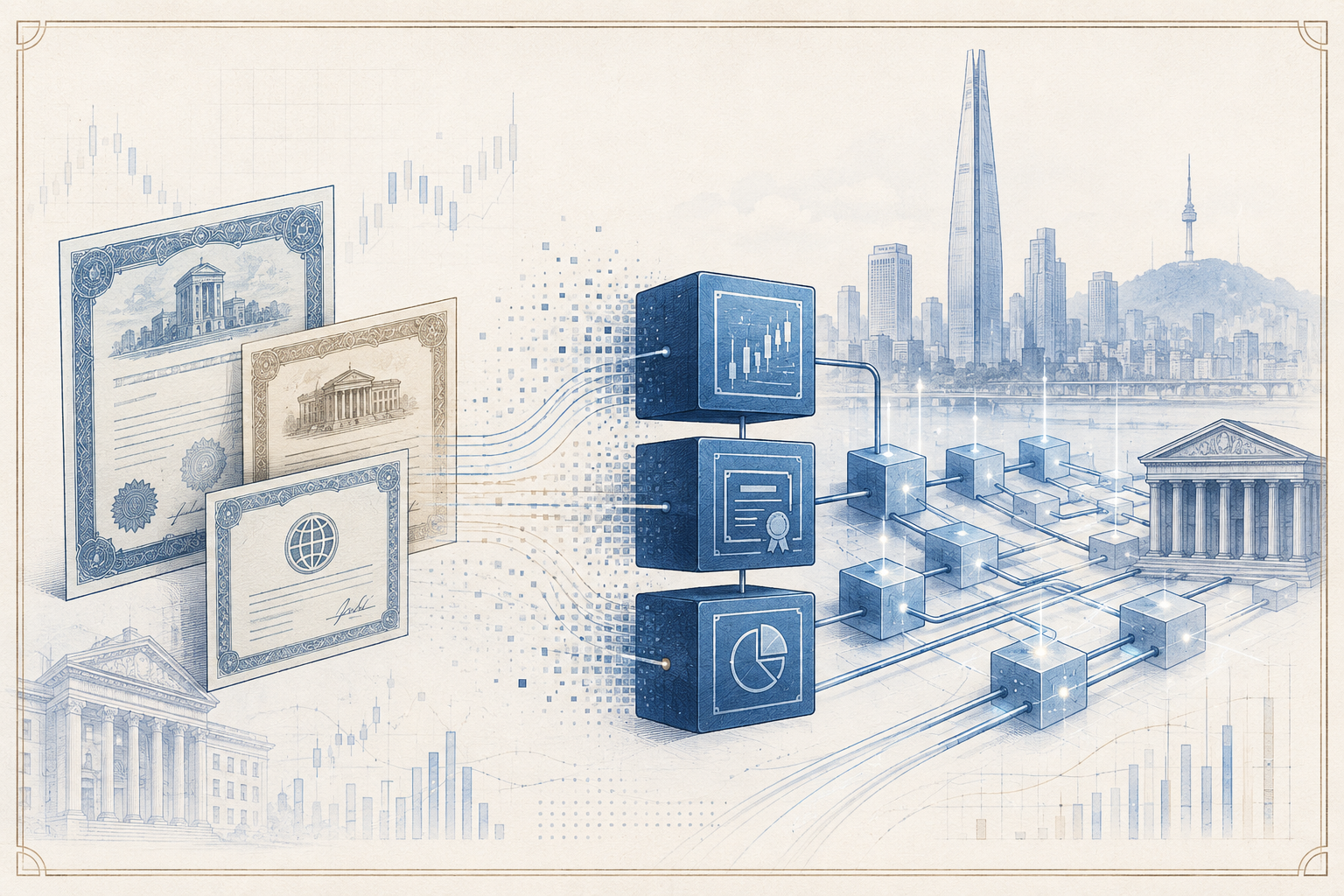
South Korea’s latest tokenized-securities roadmap is notable less for the headline promise of blockchain-based finance and more for how specifically regulators are now trying to wire the concept into capital-market infrastructure. In a Sept. 4 policy release, the Financial Services Commission said the country will pursue a staged buildout for tokenized issuance and trading that starts when the revised electronic-securities framework takes effect on Feb. 4, 2027. The plan goes well beyond earlier discussions around fractionalized alternative assets: it now explicitly spans institutional private money-market funds, private bonds, unlisted shares structured through trust arrangements and public fractional-investment products, with later phases intended to broaden the universe further.
That is an important shift in framing. For much of the past several years, tokenized securities in South Korea were often discussed through the narrower lens of so-called piece-investment products, where investors buy slices of assets such as real estate interests or other nontraditional claims. The FSC is now drawing a cleaner distinction between the economic content of a security and the technical form in which that security is issued and recorded. In the regulator’s description, tokenized securities are not a separate asset class so much as securities issued and circulated through a distributed-ledger-based account system. That distinction is what allows the roadmap to expand from experimental products into mainstream capital-markets instruments.
The sequencing is also more concrete than a generic innovation statement. The first phase, tied to the February 2027 legal effective date, prioritizes areas where rights management and operational complexity are more manageable: institution-only private MMFs, privately placed bonds, unlisted shares handled through a trust-based structure and public tokenized fractional-investment securities. The second phase would broaden infrastructure toward public-offering securities where technically feasible, while the third phase contemplates connecting tokenized securities to onchain settlement using stablecoins or similar digital cash instruments. Regulators were careful not to lock dates onto the later phases, making clear that expansion depends on system stability, market demand, technical readiness and the legal treatment of stablecoins.
That measured approach has been building for months. In a May 15 meeting of the public-private tokenized-securities consultative group, the FSC said it was already examining detailed design choices across issuance, distribution and infrastructure, including whether tokenization should extend beyond novel investment products into shares, bonds and money-market funds. A June 23 capital-markets infrastructure meeting then linked tokenized-securities work to a broader modernization agenda alongside shorter settlement cycles, longer trading hours and more digital post-trade systems. Taken together, those meetings show that Seoul is trying to position tokenization inside a wider effort to redesign market access and market plumbing rather than treat it as a standalone crypto policy file.
The market-structure choices are just as important as the product scope. The roadmap says existing securities intermediation licenses should generally be able to cover tokenized-securities handling within the scope of already authorized business lines, instead of forcing an entirely separate licensing stack for every participant. At the same time, regulators are trying to preserve investor-protection guardrails around over-the-counter venues, retail trading limits and issuer-operated account management. That balancing act matters because tokenization tends to stall when every new workflow requires a parallel legal perimeter, but it can also lose credibility quickly if rights, custody and transfer rules become ambiguous.
There are still meaningful constraints embedded in the plan. For unlisted shares, the initial model appears to rely on trust structures rather than a full immediate migration of all shareholder rights onto a native distributed-ledger stack. For public-market tokenization, the FSC referenced pilot-style testing inspired by programs associated with major U.S. exchanges, with the Korea Exchange expected to play a central role in validating listed-equity models before any broad rollout. And for onchain settlement, the regulator explicitly acknowledged that interoperability between tokenized-securities ledgers and stablecoin ledgers remains a technical and policy question, not a solved deployment detail.
From an RWA perspective, that makes South Korea one of the more serious jurisdictional case studies to watch. The roadmap does not promise overnight migration of public markets onchain, and it does not pretend that tokenization alone resolves liquidity, disclosure or investor-protection issues. What it does do is set out a regulator-backed path for moving from isolated tokenized products toward a more unified digital capital-market architecture. That is the part with strategic significance. If securities issuance, transfer, servicing and settlement can be gradually reworked inside a single supervisory framework, tokenization stops being a product experiment and starts becoming a market-operations story.
For RWA builders and institutions, the practical implication is that South Korea is testing the same question now surfacing across other advanced markets: which parts of the securities stack should be tokenized first, under what controls and with which settlement asset. The answer emerging from Seoul is incremental but ambitious. Start where rights are simpler and counterparties are more sophisticated, build operational confidence, run exchange-centered pilots for more complex instruments and only then connect the system to native onchain cash rails. That is a slower narrative than the usual tokenization hype cycle, but it is also a far more credible blueprint for how public-market infrastructure could actually move.