SoFi and Payward link bank settlement rails with Kraken liquidity in a stablecoin and prime-brokerage push
SoFi and Payward are stitching together bank-grade dollar settlement, a bank-issued stablecoin listing and institutional crypto execution in one partnership. The deal matters because it moves always-on money movement closer to a regulated, multi-venue operating model.
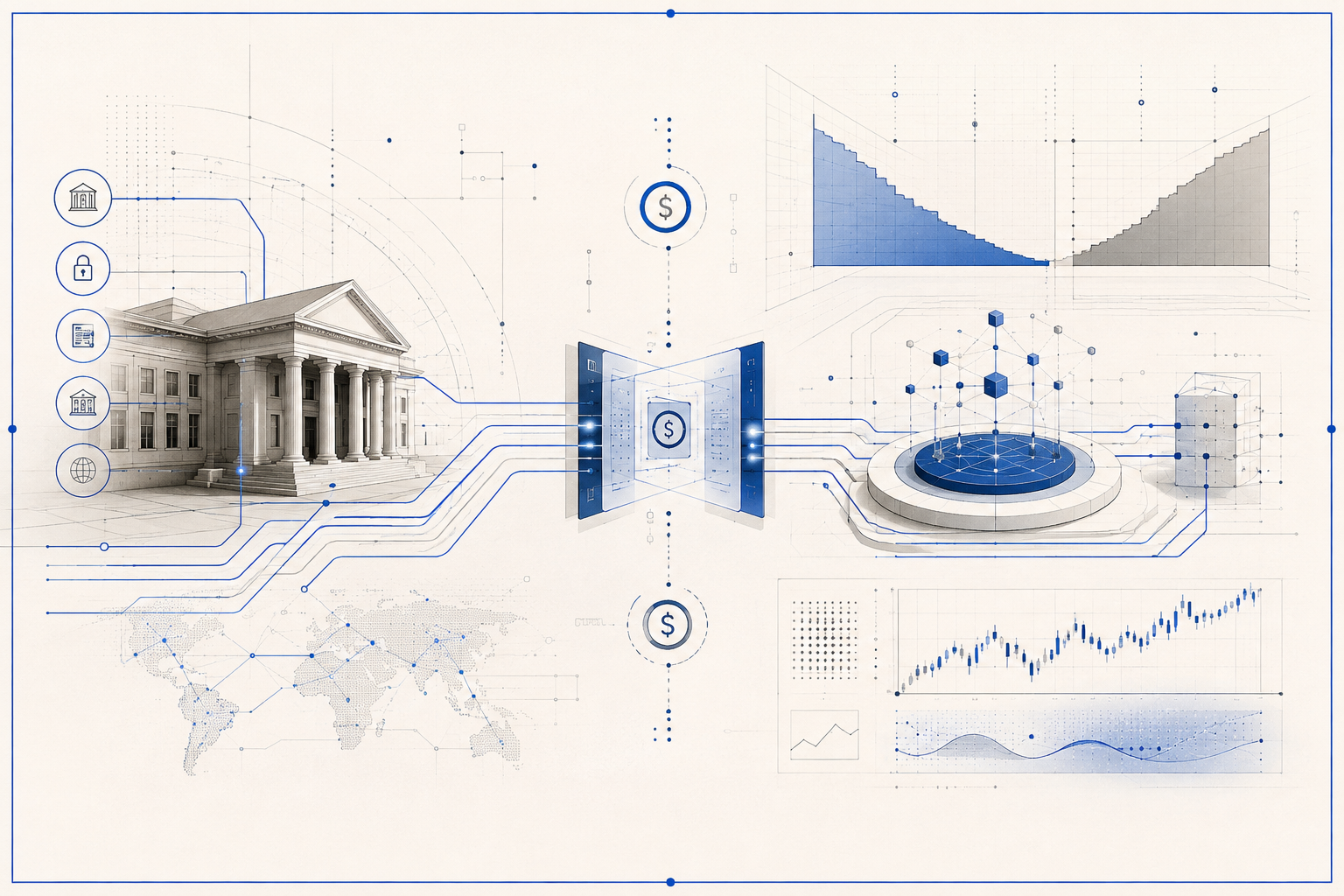
SoFi and Payward are trying to solve a structural mismatch that has defined digital asset markets for years: crypto venues run continuously, but dollar settlement and banking infrastructure still switch off on weekends, holidays and most hours outside the traditional business day. Their new partnership is notable because it does more than add another exchange listing or another treasury product. It combines a nationally chartered bank, an always-on settlement network, a bank-issued stablecoin and a prime-brokerage execution layer in one operating stack. That makes it one of the clearest recent examples of a bank and a crypto platform trying to narrow the gap between market hours and money movement.
Under the announced arrangement, Payward will join the SoFi Exchange Network, or SEN, and SoFiUSD will be listed on Kraken’s multi-asset platform. SoFi also plans to route digital asset order flow through Kraken Prime, which is Payward’s institutional trading and custody business. In practical terms, that means the partnership has three distinct parts. First, Payward gets access to SoFi’s real-time dollar settlement infrastructure. Second, SoFi’s bank-issued stablecoin gains a larger distribution surface inside Kraken. Third, SoFi gains broader digital asset execution through a prime-broker model instead of depending on a narrower single-venue setup.
The settlement element is arguably the most important piece for the RWA and stablecoin market. SoFi said Payward’s participation in SEN will allow institutional clients to clear and settle U.S. dollar transactions around the clock, rather than waiting for conventional banking windows. That matters because the operational friction in tokenized markets is often not the token itself but the fiat leg around it. If firms can move dollars and collateral in real time while market venues remain open, they can reduce idle balances, shorten response times during volatile periods and operate with less fragmentation between treasury, trading and custody teams.
The stablecoin leg also deserves attention. SoFiUSD is framed as a bank-issued stablecoin tied directly to a regulated banking platform rather than a standalone crypto-native issuer. Listing it on Kraken gives the token a clearer path into trading, payments and treasury workflows where users already expect continuous access. The structure does not automatically make SoFiUSD systemically important, and the market still needs to see actual adoption, liquidity depth and redemption behavior. But the design direction is important: banks increasingly want tokenized dollars to function as distribution-ready financial products rather than closed-loop internal experiments.
Kraken Prime’s role shows how this partnership reaches beyond a simple stablecoin launch. Kraken’s own explanation of the arrangement says smart order routing will let SoFi access pricing and market depth across multiple venues in real time. That turns the relationship into a best-execution and liquidity story as much as a payments story. For a retail-facing financial app like SoFi, that approach could improve execution quality without forcing the company to become a full exchange operator across every venue it wants to touch. It also shows how prime brokerage is becoming a bridging layer between consumer financial apps and institutional-grade crypto market structure.
There is also a competitive signaling effect here. Banks, fintechs and exchanges have spent the last two years testing tokenized deposits, stablecoins and treasury settlement rails, but many projects remained siloed. This deal is more integrated. It connects fiat settlement, tokenized dollars, end-user distribution and institutional execution under a single commercial relationship. That does not eliminate the regulatory, compliance and risk-management work required to scale these services, especially if they are used cross-border over time. Even so, it suggests the next phase of stablecoin competition may be less about issuing another dollar token and more about controlling the workflow that surrounds issuance, liquidity and settlement.
For RWA Trails, the takeaway is that the boundary between stablecoin infrastructure and broader real-world-asset plumbing is getting thinner. Stablecoins only become durable market infrastructure when they plug into real cash management, regulated banking access and reliable execution venues. SoFi and Payward are effectively betting that users and institutions want those pieces bundled together instead of patched together through several providers. If the partnership translates into measurable volume and client usage, it will be a useful case study in how traditional financial rails and onchain dollar instruments are converging into a single always-on operating model.