Shinhan Tests a Won-Denominated Tokenized Fund Stack on Solana
Shinhan Asset Management has teamed up with the Solana Foundation, Etherfuse and Orca to test issuance and distribution of a Korean-won tokenized fund. The project is notable because it focuses on local-currency fund plumbing, compliance readiness and secondary-market liquidity before South Korea's new tokenized-securities regime takes effect.
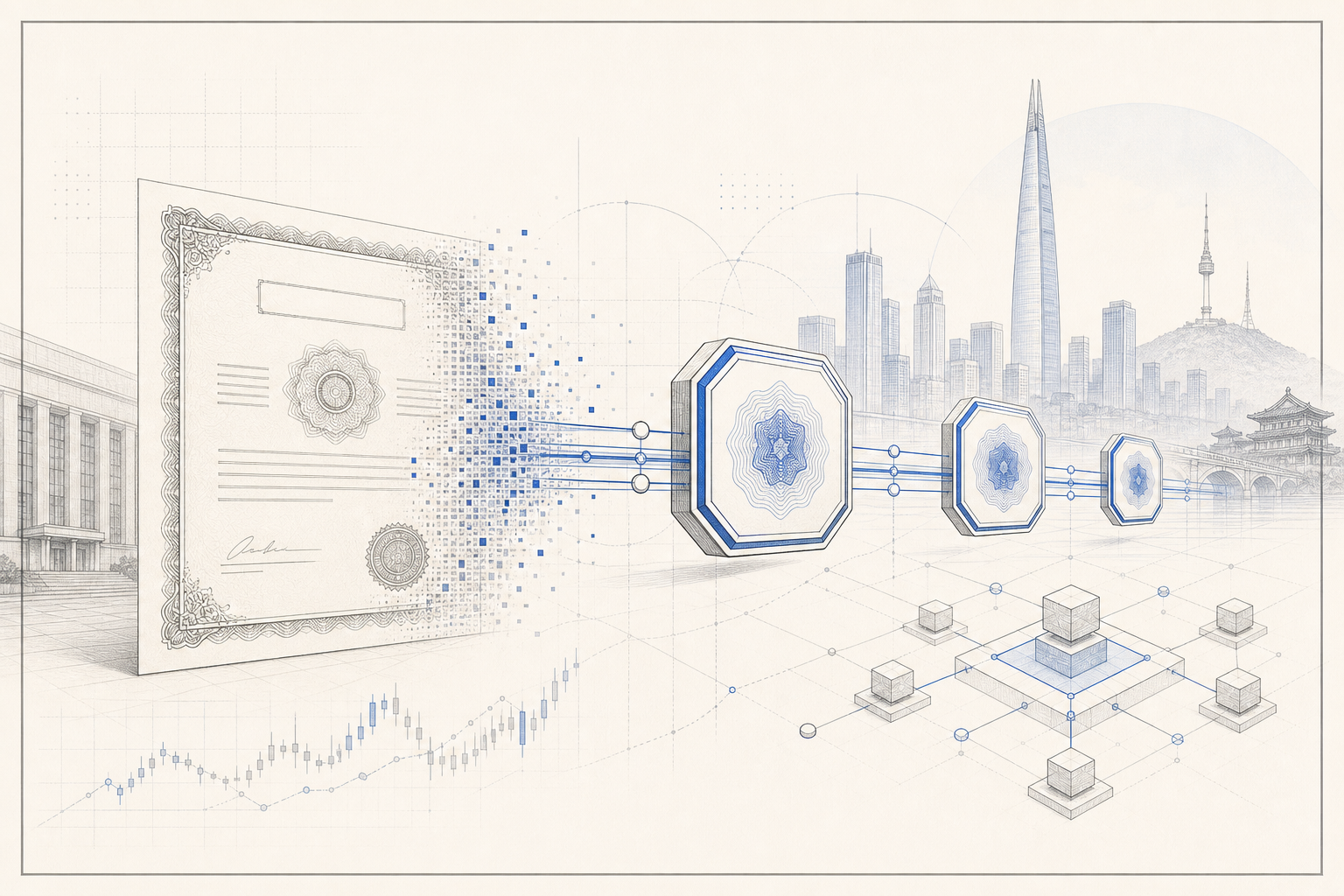
South Korea's push toward tokenized securities is moving from legal preparation into product design, and Shinhan Asset Management is now putting a concrete structure on the table. The firm said it has signed a four-party memorandum of understanding with the Solana Foundation, Etherfuse and Orca to run a proof of concept for a Korean-won-denominated tokenized fund. That makes this more than another generic tokenization pilot: the participants are testing how a regulated local-currency fund could be issued, distributed and supported with onchain liquidity before the country's new security-token framework comes into force.
The setup matters because it shifts the tokenization conversation away from dollar-only wrappers and toward domestic capital-markets products. According to Shinhan's disclosed structure, overseas institutional investors would buy a won ultra-short-term bond fund managed by Shinhan, and those holdings would then be issued in tokenized form. Shinhan said the design takes cues from BlackRock's BUIDL, but the local currency angle is the differentiator. If tokenized funds remain concentrated in dollar instruments, the market may scale technically while still missing how pensions, treasuries and regulated savings products actually operate across Asia and other non-dollar jurisdictions.
The proof of concept is also unusually explicit about the operational work required to make a tokenized fund credible. The parties said they will examine know-your-customer and anti-money-laundering controls, security audits, blockchain operating procedures, regulatory compliance and onchain liquidity design. That last point is important. A tokenized fund that can be issued but not efficiently distributed or traded remains a recordkeeping exercise rather than a market product. By bringing Orca into the structure alongside Solana infrastructure and Etherfuse's issuance and compliance tooling, Shinhan appears to be testing not only token creation but also how secondary-market functionality could fit inside a compliant launch path.
The timing lines up with a real regulatory window. In January, South Korea's National Assembly passed amendments establishing a legal framework for security token offerings, and those changes are scheduled to take effect on Feb. 4, 2027. The Block also reported that South Korea's Ministry of Finance and Economy launched a separate deposit-token pilot in April for official-duty expenses, showing that tokenized financial infrastructure is being explored across multiple layers of the Korean system. The practical implication is that large institutions no longer need to guess whether tokenized securities will have a policy lane in Korea; they now need to decide whether their issuance, compliance and distribution stacks will be ready when that lane opens.
Shinhan's scale gives the experiment more weight than a startup-led sandbox. Shinhan Asset Management reported roughly 133.6 trillion won, or about $96.6 billion, in assets under management as of August 2026. That means the project is coming from a manager with balance-sheet relevance inside Korea's financial system, not from a peripheral digital-assets vehicle. If the pilot produces a workable template, it could give other Korean managers a roadmap for launching tokenized bond or cash-like fund products aimed at offshore investors without waiting until the last minute to solve legal review, custody, operating controls and liquidity design.
The partner mix is not random either. Etherfuse said the four firms plan to verify each stage of the process, from Korean and international compliance requirements through foreign-exchange controls and liquidity design. Its own write-up frames the opportunity as bringing tokenized funds into non-dollar markets rather than simply extending existing U.S. Treasury products. Etherfuse also said it launched tokenized Korean Treasury bond products earlier this year with Shinhan Securities as custodian and later made those instruments tradeable and liquidity-provider eligible on Solana via Orca. Taken together, that suggests this latest project is building on prior experiments in Korean sovereign assets rather than starting from a blank slate.
Solana's role is equally strategic. The network has been positioning itself as infrastructure for what it calls internet capital markets, with tokenization, institutional payments and high-throughput settlement now core parts of its enterprise pitch. For Shinhan, that means the proof of concept is not just about putting a fund share onchain; it is about choosing a settlement environment that can support always-on distribution, deeper DeFi connectivity and lower-friction servicing if regulators permit those features. For the wider RWA market, the more important signal is that a major Korean asset manager is treating tokenization as a local-currency capital-markets buildout, not merely as a way to mirror a U.S. product offshore.
If the pilot succeeds, the near-term result may not be an immediate retail launch but something more durable: a regulator-legible operating model for won-denominated tokenized funds. That would matter because the next stage of RWA growth is unlikely to come only from adding more dollar funds to more chains. It will come from proving that regulated managers can bring domestic fixed-income products onchain in their own currencies, with controls, custody and liquidity designed from day one. Shinhan's new project is one of the clearest signs yet that Korea wants to be part of that next phase rather than simply import it.