SEC Opens a Five-Year Test Lane for Tokenized U.S. Stocks
The SEC’s temporary innovation exemption gives qualifying tokenized-stock venues a defined path to test permissioned AMM trading without registering as national securities exchanges. For RWA markets, the order moves tokenized equities from offshore experimentation toward a supervised U.S. market-structure pilot.
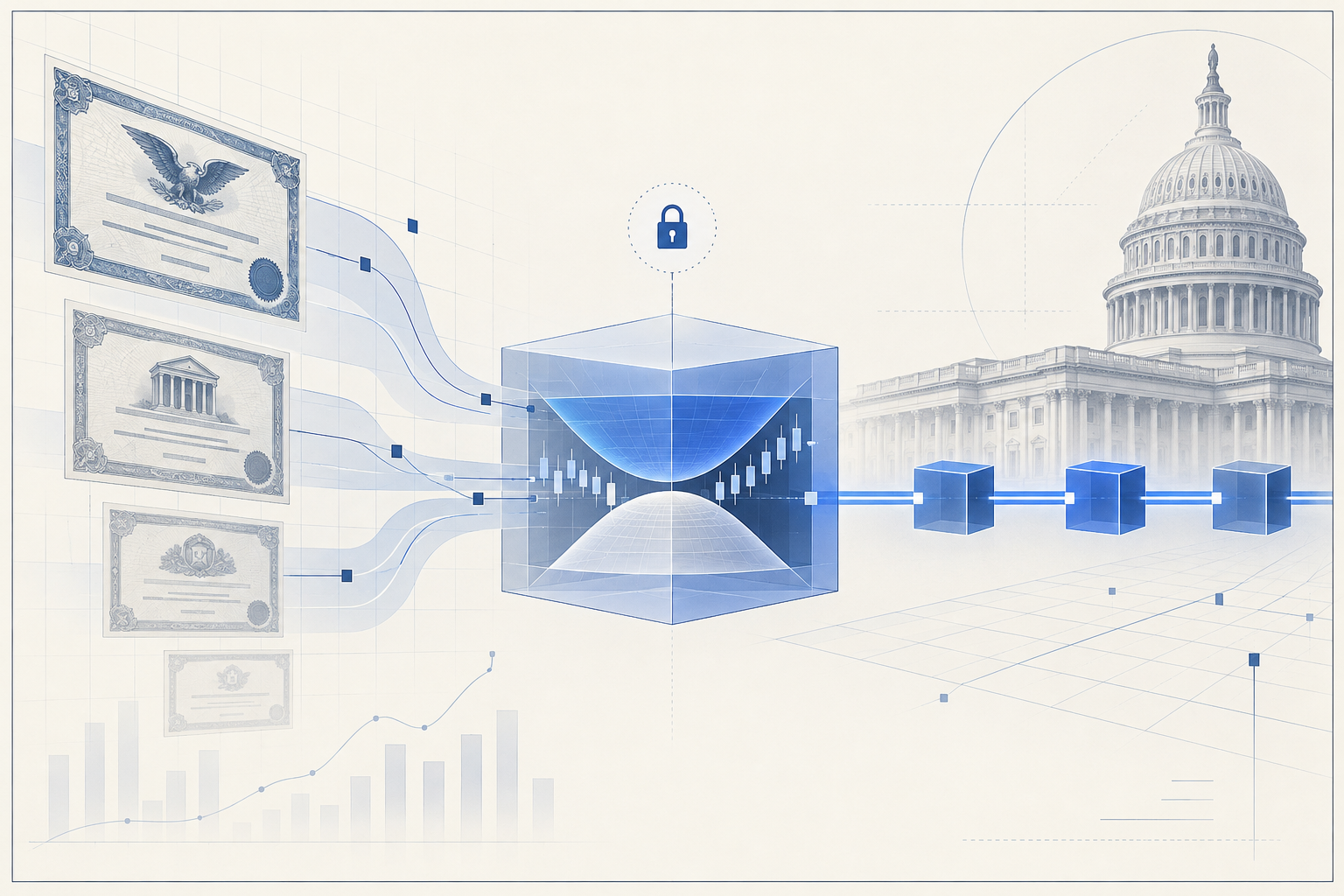
The U.S. Securities and Exchange Commission has created a temporary exemption for tokenized versions of National Market System stocks, giving qualified venues a five-year window to test onchain secondary trading under specific constraints. The order is narrow, conditional and open for public comment, but it is still a meaningful shift: the regulator is no longer treating tokenized equities only as a theoretical policy issue. It is defining a limited market structure in which the mechanics can be observed in production.
The exemption applies to Tokenized Securities Venues, or TSVs, that trade tokenized NMS stock through permissioned automated market makers and liquidity pools. In practice, that means the blockchain venue can use AMM-style execution while operating inside a permissioned environment, rather than opening the model to unrestricted public-market participation. The SEC said the relief is temporary and conditional, and that tokenized NMS stocks traded through a TSV will be subject to limits on both the number of symbols and the trading volume.
The core legal point is the relief from the Exchange Act definition of an exchange for the covered activity. That matters because many tokenized-equity proposals have struggled with the gap between crypto-native execution models and the registration obligations that govern U.S. securities markets. By carving out a supervised test lane, the Commission is trying to let market participants experiment with onchain execution and settlement logic without immediately forcing the full exchange-registration stack onto every pilot.
The order also draws a line between tokenized shares intended to carry stock-like rights and synthetic products that merely reference a public company’s share price. That distinction has become more important as brokerages, offshore platforms and crypto venues experiment with stock tokens that vary widely in holder rights, issuer structure and redemption mechanics. For RWA infrastructure builders, the policy signal is that tokenized equity products will be judged not just by the asset they track, but by the legal rights, market controls and investor protections attached to the token.
The SEC framed the action as an innovation exemption rather than a permanent rule. Chairman Paul Atkins said the Commission is seeking to facilitate onchain trading of certain tokenized stocks while it evaluates whether additional changes are needed. Jamie Selway, director of the Division of Trading and Markets, described the approval as a milestone for opening capital markets to tokenized securities and said staff is prepared to work with parties interested in operating a TSV.
For tokenization markets, the most immediate impact is not likely to be a sudden flood of retail trading. The order is designed around permissioned venues, trading limits and public feedback. Its importance is that it gives institutions a more concrete U.S. reference model for testing tokenized stock liquidity, AMM design, custody workflows and compliance controls. That could help separate regulated tokenized-equity infrastructure from the more loosely structured stock-token products that have circulated outside traditional market rules.
The exemption also creates new questions for operators. Venues will need to show how identity controls, token rights, settlement finality, corporate actions, liquidity-provider obligations and investor disclosures work together. The five-year duration is long enough to support serious pilots, but short enough to keep the Commission’s leverage over the shape of the market. Public comments could influence whether the model expands, tightens or becomes the basis for a more durable tokenized-securities framework.
The practical takeaway is that tokenized stocks now have a more explicit regulatory test path in the United States. The order does not settle every issue around custody, issuer consent, market data or national-market integration, and it does not make every stock token acceptable. But it gives RWA builders a clearer benchmark: future tokenized-equity products will need to look less like offshore wrappers and more like securities-market infrastructure that can operate onchain without abandoning the safeguards of public markets.