SEC tokenized-stock pilot puts onchain market infrastructure back in focus
The SEC’s new innovation exemption gives tokenized U.S. stock trading a narrow federal test lane. For RWA markets, the important signal is not unlimited rollout, but a clearer path for compliant settlement, custody and broker infrastructure to prove itself in production.
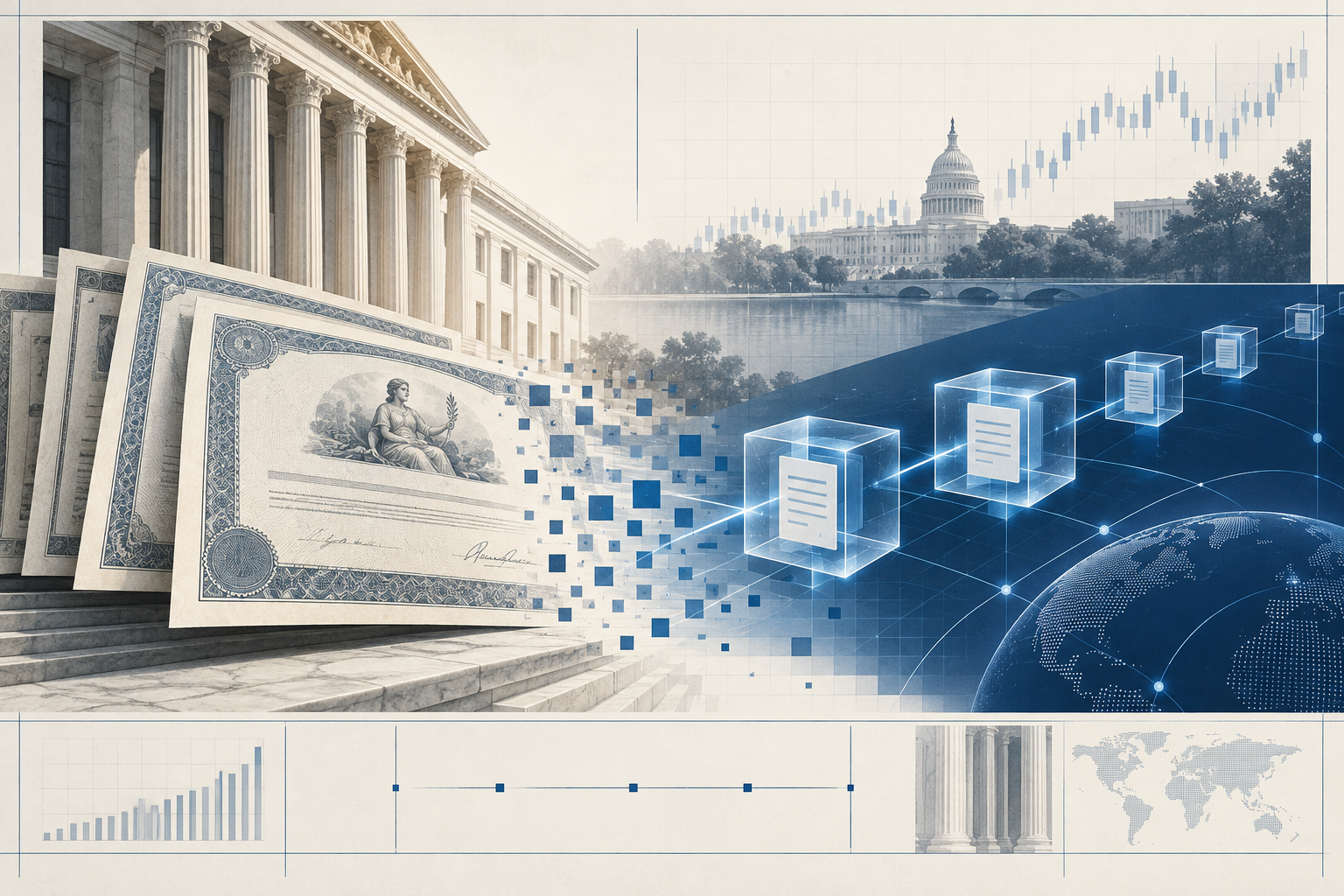
The U.S. Securities and Exchange Commission has opened a limited path for tokenized stock trading, creating one of the clearest federal test cases yet for public-market assets moving onto blockchain rails. The agency’s Sept. 17 innovation exemption is framed as temporary and conditional, but it gives brokers, custody providers, stablecoin issuers and market-infrastructure firms a practical way to test how onchain securities could operate inside a regulated perimeter rather than outside it.
The exemption matters because tokenized equities have often lived in a legal gray zone: technically possible, commercially attractive, but difficult to scale without clarity on investor rights, market access and venue obligations. Under the SEC’s announced approach, qualifying tokenized National Market System stocks may trade through automated market maker-style systems on public blockchains for a five-year period. The framework also calls for tokens to preserve core shareholder economics, including dividends and voting rights, instead of becoming synthetic price wrappers with weaker claims on the underlying security.
That distinction is central for real-world asset markets. The next phase of tokenization is less about proving that a share price can be represented onchain and more about proving that the surrounding market functions can be made reliable: issuance controls, transfer restrictions, custody, settlement, corporate actions, disclosures and auditability. If a tokenized stock cannot map cleanly back to the shareholder rights attached to the underlying equity, it may trade like a useful derivative, but it will not answer the harder question institutions care about: whether public securities can be distributed and settled with the same protections investors expect in traditional markets.
Analysts quickly pointed to Coinbase, Robinhood and Circle as companies positioned near the center of that test. Coinbase has custody, exchange and tokenization infrastructure that could become more valuable if regulated stock tokens move beyond closed experiments. Robinhood has already pushed stock-token products internationally and would have an incentive to adapt those products toward rights-preserving structures if U.S. rules allow. Circle’s role is different but still relevant: tokenized securities markets need dependable cash legs, and dollar stablecoins such as USDC are likely to be evaluated as settlement and collateral rails wherever trading is designed to run continuously.
The exemption also appears intentionally constrained. Trading caps, limits on the number of available stocks, issuer opt-outs and technical conditions are designed to keep the program from becoming an uncontrolled substitute for national exchanges. That protects incumbent market structure while still giving the SEC a supervised data set on investor behavior, liquidity formation, operational failures and settlement performance. In practice, the most important output may be the rulemaking evidence the pilot creates, not the trading volume it captures in the first year.
For tokenization builders, the message is that regulatory design is starting to converge with product design. It is no longer enough to issue a token and call it equity exposure. The systems that win institutional confidence will need to show how investor rights are represented, how transfer-agent and broker-dealer responsibilities are handled, how market abuse controls work, and how cash settlement remains resilient when blockchain activity runs outside standard market hours. Those details are where RWA products move from demos to capital-market infrastructure.
There are still meaningful open questions. Public blockchain settlement can improve transparency and operating hours, but it also introduces smart-contract risk, wallet-security risk, chain congestion and questions about finality during market stress. Investor protection rules were built around intermediated markets, and adapting them to programmable venues will require more than a temporary exemption. Issuers will also need comfort that tokenized representations do not fragment liquidity or create confusing parallel versions of their shares.
Even with those limits, the SEC action is a major signal for the RWA sector. Tokenized stocks are not being treated only as offshore experiments or crypto-native wrappers; they are being tested as possible market infrastructure under direct regulatory supervision. If the pilot can demonstrate that shareholder rights, settlement integrity and investor protections survive the move onchain, it could become a template for broader tokenized funds, credit instruments and other regulated assets.