Hana Bank’s Euroclear Bond Shows Digital Issuance Moving Into Global Settlement Rails
Hana Bank issued a $100 million five-year foreign-currency digital bond through Euroclear’s distributed-ledger market infrastructure. The transaction matters because it links tokenized bond issuance to the account and settlement plumbing institutional investors already use.
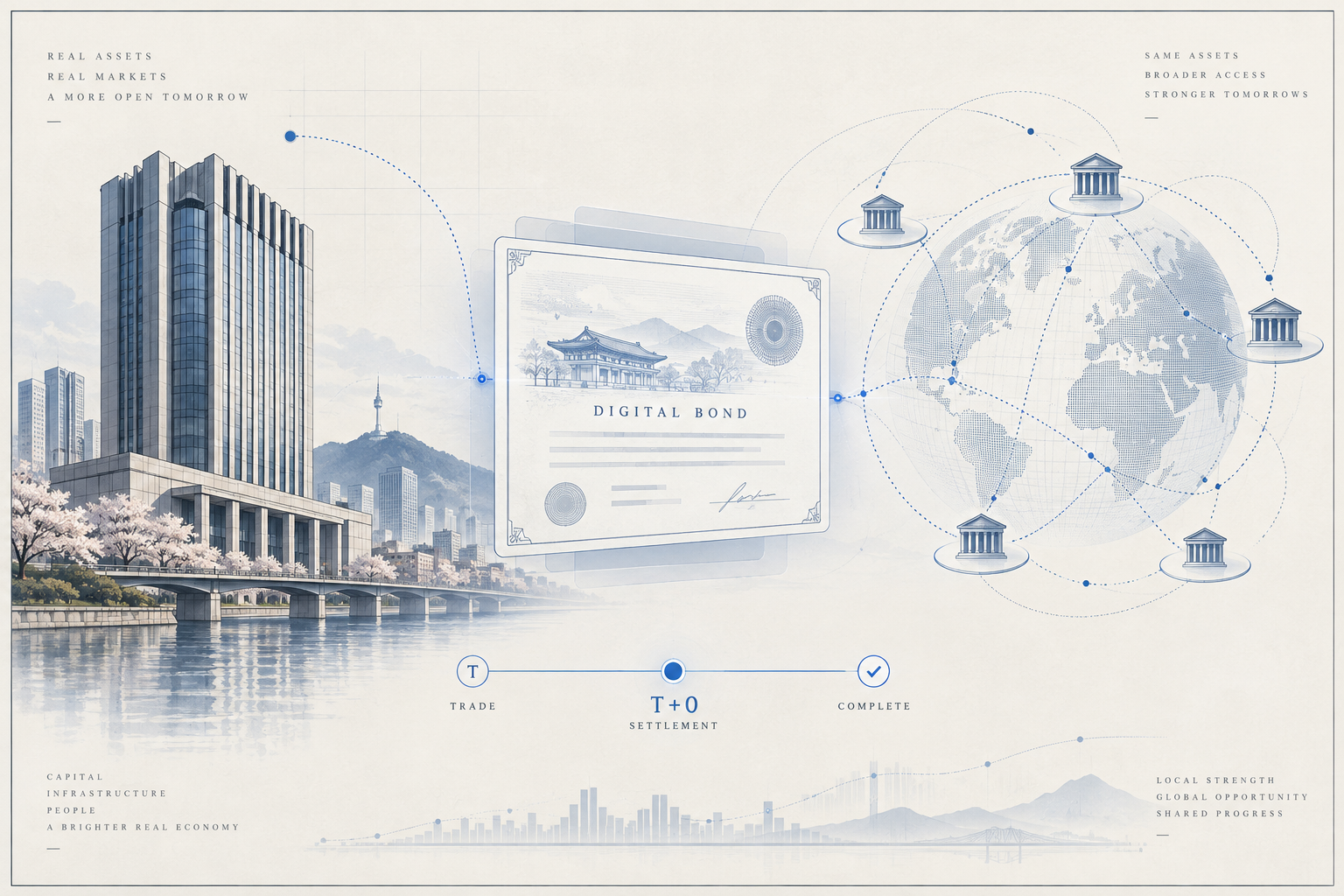
Hana Bank has pushed South Korea’s digital-securities market a step closer to production infrastructure with a $100 million five-year foreign-currency bond issued through Euroclear’s blockchain-based market platform. The transaction is notable less for its size than for its venue: a major Korean bank used an international central securities depository’s distributed-ledger infrastructure for issuance, registration and settlement rather than confining the experiment to a domestic sandbox or a closed proof-of-concept environment.
The reported bond process compressed what is normally a multi-day issuance workflow into same-day settlement. In conventional cross-border bond markets, allocation, registration, cash movement and securities settlement can involve several intermediaries and typically settle over a period measured in business days. In this case, the bond was processed on Euroclear’s Digital Financial Market Infrastructure, allowing the issuance date and settlement date to line up on a T+0 basis.
That distinction is important for real-world asset markets because the operational problem in tokenization is rarely just creating a digital representation of a bond. The harder question is whether the tokenized instrument can plug into trusted custody, investor-account and settlement systems without forcing institutions to rebuild their operating stack. Euroclear’s role gives the Hana transaction a different profile from smaller bilateral tokenization pilots: it tests distributed-ledger issuance inside infrastructure that already sits close to global securities flows.
Euroclear’s digital-securities work has been developing for several years. Its platform was used in 2023 for a World Bank-linked digital bond issuance, establishing an early example of a high-grade issuer using a central securities depository model for blockchain-based securities. Hana’s use of the same infrastructure extends that template into Korean bank issuance and shows how the model can travel across jurisdictions when the instrument still needs to remain compatible with existing investor access and post-trade controls. That continuity matters because many institutional investors evaluate digital securities through familiar questions: who records ownership, how cash moves, where assets are safekept and whether the security can be handled inside existing risk systems.
The timing also lines up with South Korea’s broader tokenized-securities roadmap. Korean policymakers and financial institutions have been preparing a framework intended to bring security tokens and digital securities closer to regulated capital-market channels. A live foreign-currency bond issued by a large domestic bank through global post-trade infrastructure gives that policy conversation a concrete reference point: tokenization can be positioned as settlement modernization, not only as a new distribution wrapper. It also gives domestic issuers a way to study how offshore investors might interact with Korean digital securities when custody and settlement are anchored in an internationally recognized post-trade institution.
For issuers, the immediate appeal is operational. Same-day settlement can reduce funding uncertainty, lower reconciliation burden and make cash-and-security delivery easier to coordinate. For investors, the larger benefit is potentially continuity: if digital bonds can be held or traded through familiar accounts and platforms, adoption becomes less dependent on specialized crypto-native onboarding. That is the gap many RWA products still struggle to close, especially in markets where legal title, custody treatment and secondary-market settlement are more important than headline token mechanics. It is also why infrastructure choices can matter as much as asset selection: a bond token that cannot settle cleanly with regulated investors is unlikely to become a deep institutional market.
The Hana transaction does not mean tokenized bonds have reached broad secondary liquidity, nor does it resolve the legal and market-structure questions each jurisdiction still needs to answer. But it is a strong signal that bank-issued digital securities are moving from isolated demonstrations toward recognizable capital-markets plumbing. For RWA builders, the lesson is clear: the next competitive edge may come from integrating tokenized instruments with trusted settlement systems, not from tokenization alone.