GENIUS Act turns stablecoin domicile into a product and distribution decision
The U.S. stablecoin framework is pushing issuers to choose their regulatory home with far more precision. Under the GENIUS Act, charter choice, distribution design and reserve oversight now sit on the critical path for growth.
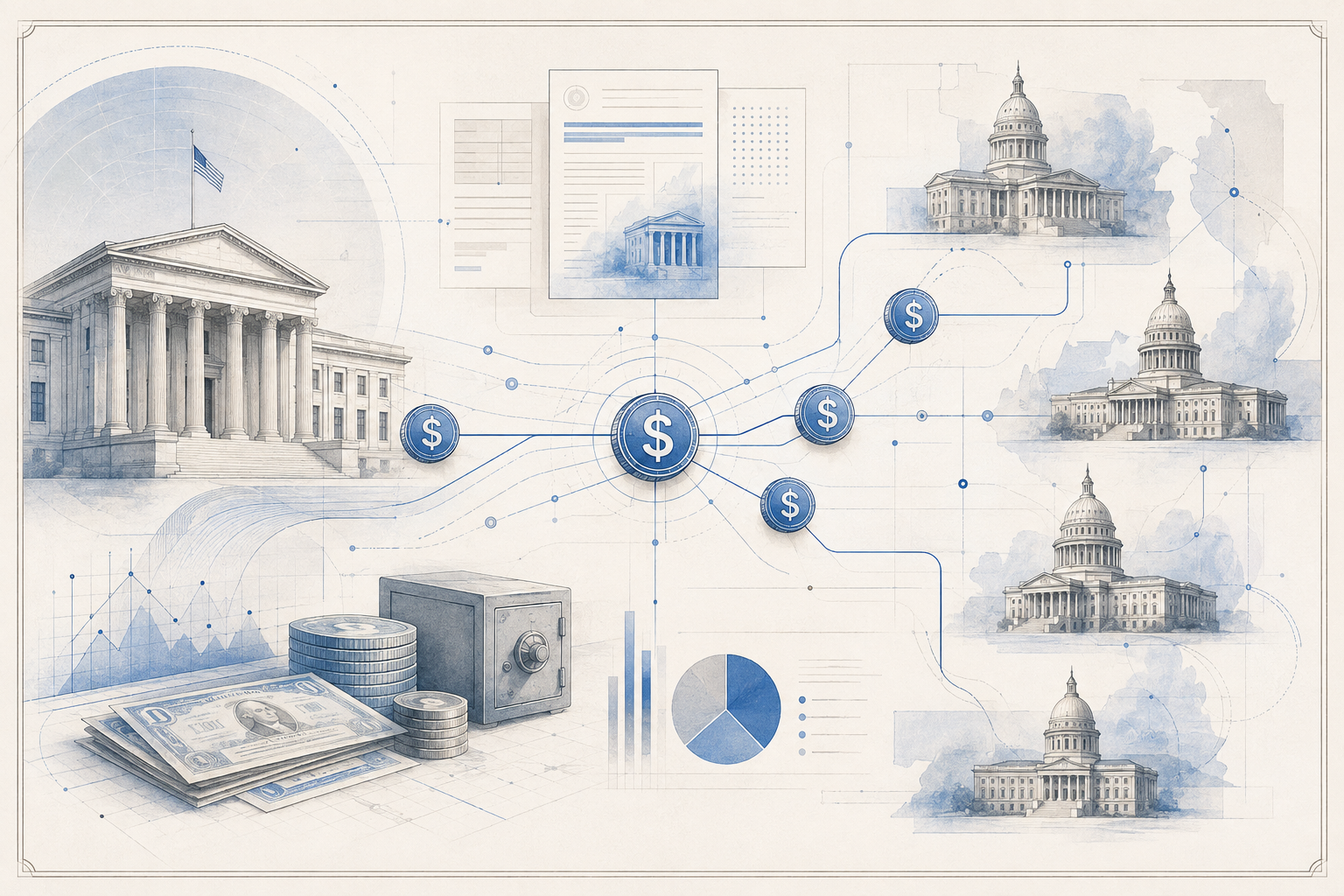
The U.S. stablecoin market is moving into a more operational phase, and one of the biggest decisions for issuers is no longer branding, yield or chain support. It is domicile. As the GENIUS Act’s framework comes into focus, stablecoin issuers that want U.S. distribution are being pushed to decide whether they should build under a federal approval path, operate through a state regime that can pass federal review, or avoid the market entirely. That choice reaches well beyond legal paperwork. It shapes how reserves are overseen, how tokens are minted and distributed, how banking partners evaluate the business and how quickly an issuer can expand once usage starts to scale.
The change matters because the statute does not treat all issuer structures the same. The enrolled text of the GENIUS Act defines a permitted payment stablecoin issuer as a U.S.-formed entity that is either a bank subsidiary approved to issue, a federal qualified payment stablecoin issuer, or a state qualified payment stablecoin issuer. For nonbank issuers, the federal route runs through the Comptroller, while the state route is available only if a state regime is judged substantially similar to the federal framework. The act also sets a hard size threshold for that option: state-qualified issuers can use the state path only while consolidated outstanding issuance is no more than $10 billion. That turns regulatory home selection into a scaling question from day one, not a cleanup item for later.
The state pathway is not automatic. Under the same law, Treasury must establish broad principles through notice-and-comment rulemaking to determine whether a state framework is substantially similar to the federal one. After that, a state payment stablecoin regulator has to submit its regime for certification to the Stablecoin Certification Review Committee, whose members are the Treasury Secretary, the Federal Reserve chair or delegated vice chair for supervision, and the FDIC chair. In other words, an issuer cannot simply pick a friendly state, assume equivalence and proceed with confidence. Its operating jurisdiction needs a framework that can survive federal scrutiny on reserves, governance, supervision and enforcement capacity.
That is why distribution architecture is becoming inseparable from charter strategy. A stablecoin may look identical at the wallet layer, but the practical question is who issues it, under what supervisory standard, and how the token reaches users. If an issuer expects to serve exchanges, market makers, fintech apps and corporate treasuries around the clock, its compliance stack has to support that footprint from the first mint. The more a product is designed for national payments, 24/7 settlement and institutional treasury use, the harder it becomes to treat regulation as a back-office issue. A stablecoin’s legal home now influences counterparties’ risk committees, banking access and the credibility of redemption promises just as much as its technical rails do.
Current issuer positioning shows why this matters. Circle’s USDC product page presents the token as a regulated digital currency built for rapid global payments and 24/7 financial markets, and says it is available in more than 185 countries and backed 100% by highly liquid cash and cash-equivalent assets. PayPal’s PYUSD materials make a similar point from a commerce angle, describing a dollar-backed token for transfers, merchant payments and cross-border activity inside a large consumer network. Paxos, which issues PYUSD, goes further in its own product materials, stating that issuance and reserves for PYUSD are subject to oversight by the Office of the Comptroller of the Currency and that reserves are held 100% in U.S. dollar deposits, Treasuries and cash equivalents. Those disclosures show that issuer structure and supervisory posture are already part of the product itself.
The strategic consequence is that the market may split into distinct issuer classes. Large operators that expect national distribution and fast balance-sheet growth have an incentive to pursue the most durable federal path they can secure, even if that route is heavier upfront. Smaller entrants may still prefer a state regime if it offers a faster launch and lower organizational friction, but only if that state framework wins certification and leaves a believable path beyond the $10 billion ceiling. That could produce a stablecoin landscape where reserve composition is increasingly standardized, but go-to-market models diverge sharply depending on regulator, customer base and how directly an issuer wants to plug into bank and capital-markets infrastructure.
For the broader RWA stack, that matters because stablecoins are no longer just crypto cash wrappers. They are the settlement layer for tokenized funds, onchain treasury products, exchange collateral flows and cross-border treasury operations. If issuer domicile determines which products can scale cleanly in the United States, then stablecoin regulation will influence far more than payments. It will shape which tokenized asset platforms can onboard institutions, how quickly issuers can add redemption channels, and which names become trusted settlement standards for the next wave of onchain finance. The industry has spent years debating which chain will win distribution. The next decisive contest may be over which regulatory home gives dollar tokens the clearest path to scale.