Canada’s largest banks move tokenized deposits from policy debate to shared payments build
Six major Canadian banks are jointly exploring CAD tokenized deposits, giving the country’s deposit-taking institutions a coordinated path into programmable payments. The work lands days after OSFI clarified that tokenized deposits are not legally distinct from traditional deposits.
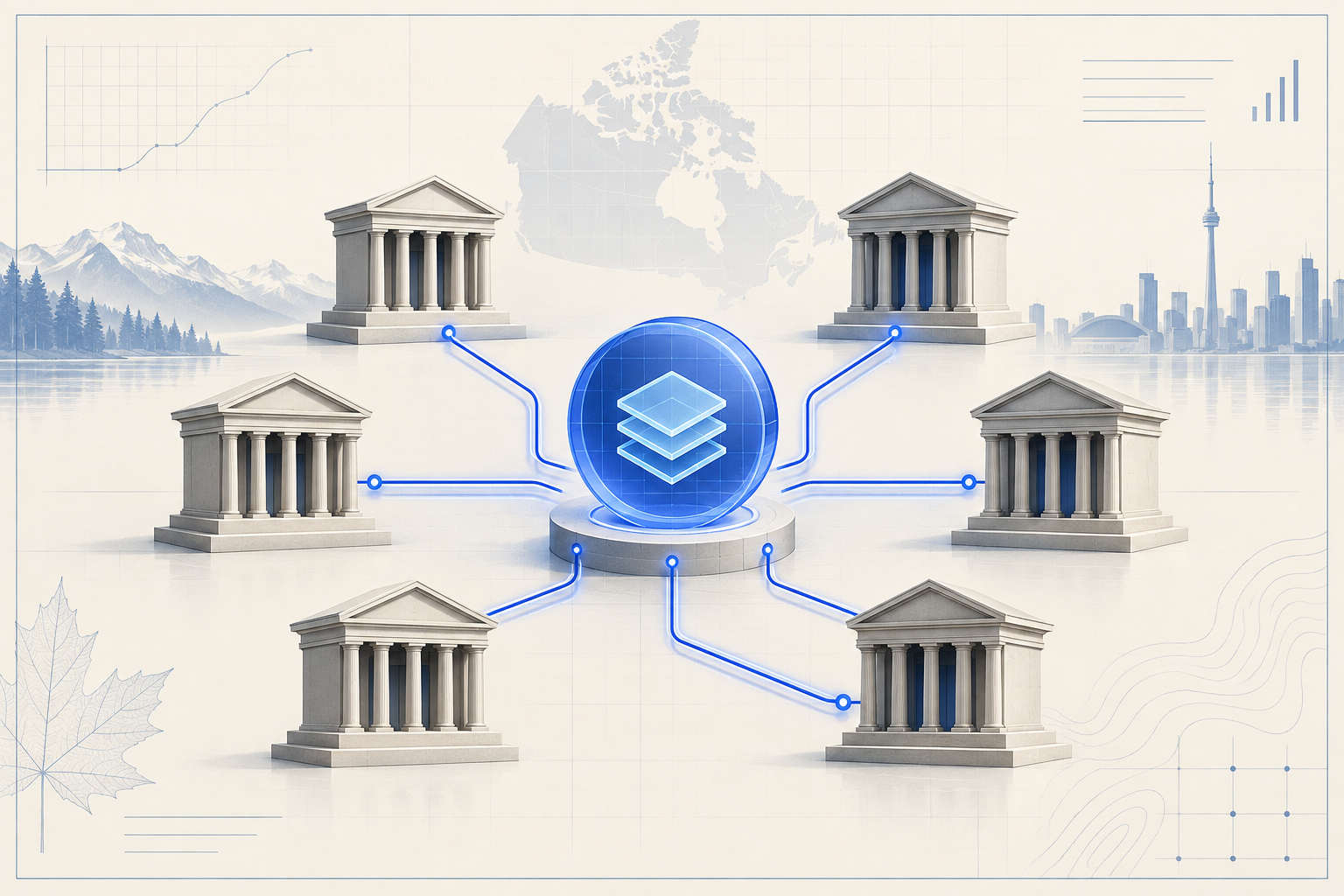
Canada’s largest banks are turning tokenized deposits into a coordinated infrastructure project rather than a set of isolated pilots. Bank of Montreal, CIBC, National Bank of Canada, RBC, Scotiabank and TD Bank Group are jointly exploring a Canadian-dollar digital money system, beginning with tokenized deposits that could move across financial institutions with faster settlement and more programmable payment logic.
The initiative is notable because it starts inside the regulated banking perimeter. Tokenized deposits are digital representations of commercial bank deposit claims, not free-standing private stablecoins. That distinction matters for banks, regulators and corporate users because the instrument remains tied to the balance sheet of a deposit-taking institution while using token-style infrastructure to transfer value and embed rules into payments.
The participating banks framed the first phase around efficient movement of tokenized deposits among Canadian financial institutions. Longer term, they expect the system could connect with other emerging digital-asset initiatives and potentially include additional deposit-taking institutions. In practical terms, that sequencing keeps the project focused on interbank interoperability before it expands into a broader market utility.
The timing is important. On September 10, Canada’s Office of the Superintendent of Financial Institutions said it takes a technology-neutral view of federally regulated financial institutions’ permitted activities and stated that tokenized deposits are not legally distinct from traditional deposits. OSFI also emphasized that institutions remain responsible for complying with technology, cyber-risk and third-party-risk guidance, and should engage supervisors before launching novel products.
That regulatory clarification gives banks a cleaner lane to experiment without collapsing tokenized deposits into the same category as fiat-backed stablecoins. Stablecoins are typically liabilities of a non-bank issuer or specific issuing entity, backed by reserves and designed to circulate outside conventional deposit systems. Tokenized deposits, by contrast, keep the bank-deposit relationship intact while changing the rails on which deposits can be represented, moved and settled.
Canada is also building a separate federal framework for fiat-backed stablecoins. That regime is expected to require covered non-bank issuers to register with the Bank of Canada, hold at least one-to-one reserves in high-quality liquid assets and provide redemption at par. It also restricts issuers from presenting covered stablecoins as deposits or as insured by a public deposit insurance system. The result is an emerging two-track model: bank-issued tokenized deposits on one side, reserve-backed stablecoins on the other.
For corporates and financial-market participants, the bank-led path could matter most in payment flows that need legal certainty, account-based relationships and existing compliance controls. Programmable deposits could support conditional settlement, automated treasury operations, delivery-versus-payment workflows and faster reconciliation while preserving familiar bank obligations. Those are incremental but meaningful changes for institutions that want blockchain-style functionality without leaving regulated bank money.
The project remains exploratory, and the banks have not announced production volumes, a launch date or a technical architecture. The hard questions now are interoperability, privacy, resilience, participant eligibility and how tokenized deposits would interact with payment systems, stablecoins and market-infrastructure providers. Still, the joint approach signals that Canada’s largest banks see digital money as shared financial plumbing, not just a product feature for individual institutions.
For the RWA market, the move strengthens the bridge between tokenized assets and tokenized cash. Securities, funds and other real-world assets can only settle efficiently if the payment leg becomes as programmable and reliable as the asset leg. Canada’s banks are not claiming that endpoint yet, but they are putting the deposit side of that architecture into motion.