Bullish expands into GPU-backed credit as USD.AI adds a $100 million stablecoin facility
Bullish has provided USD.AI with a $100 million stablecoin debt facility tied to loans secured by GPU hardware, pushing one more corner of real-world credit onto programmable rails. The structure matters because it combines identifiable physical collateral, onchain liquidity and secondary market support around a yield-bearing token.
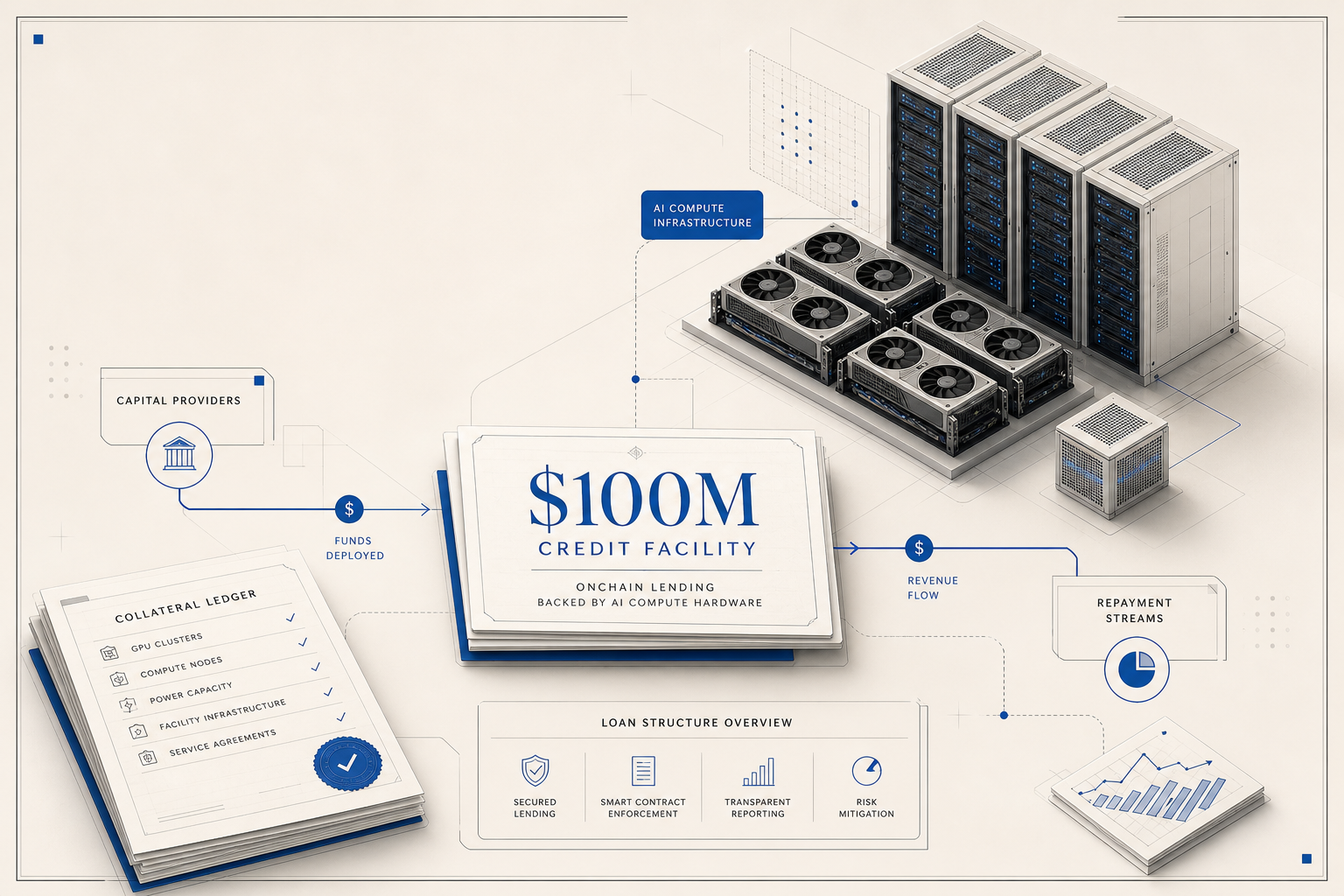
Bullish is moving deeper into real-world credit infrastructure with a new $100 million stablecoin facility for USD.AI, an onchain financing platform built around loans secured by AI computing hardware. The arrangement, announced Aug. 28, gives USD.AI additional balance sheet capacity to fund GPU-backed borrowers while giving Bullish a more direct role in a market that sits at the intersection of tokenized credit, stablecoin liquidity and demand for scarce compute assets. In practical terms, the deal is less about another exchange treasury allocation and more about using crypto-native capital markets to finance tangible equipment with measurable enterprise value.
Under the announced structure, the facility will be used to extend credit to AI infrastructure operators, with the underlying GPU hardware serving as the primary collateral rather than the borrower’s wider corporate assets. That distinction is important for RWA markets because it narrows the underwriting focus to a specific productive asset base. GPU fleets are expensive, depreciating but revenue-generating pieces of equipment, which makes them closer to financeable industrial collateral than to the unsecured lending structures that dominated earlier crypto credit cycles. If the model works, it shows how tokenized funding rails can move beyond treasuries and payment tokens into operating-asset finance.
USD.AI’s own materials suggest this is not a pilot built around a single headline number. The company’s June market recap said it had already originated a $98.1 million loan backed by 2,304 Nvidia B300 GPUs for Duos Edge AI, and that a separate $34 million facility tied to 768 Nvidia B200 GPUs for NexGen Cloud had moved from escrow to funded status. The same recap also said the platform had crossed $20 million in cumulative yield and launched a separate $100 million sUSDai liquidity facility with Fluid to deepen onchain markets. Taken together, those disclosures show a platform trying to build both sides of the book at once: real-world loan origination on one side, and tradable token liquidity on the other.
Bullish is not arriving cold. In September 2025, Bullish Capital disclosed a $4 million investment in USD.AI and described the company as an onchain platform for AI infrastructure financing. That release framed the opportunity as a way to connect stablecoins and tokenization to one of the most capital-intensive buildouts in global technology. Bullish also said at the time that USD.AI had already secured $250 million in private beta deposits and was targeting a market where financing, not demand, could become the bottleneck. The new debt facility is therefore a continuation of an existing strategic bet, but with a more operational role in funding and distribution rather than venture exposure alone.
Another part of the announcement that deserves attention is Bullish’s plan to list USD.AI’s sUSDai across multiple trading pairs and support it with dedicated market making. Secondary liquidity is often the weak link in tokenized credit products: a platform can originate loans, but the market stays thin if investors cannot enter or exit efficiently. By pairing warehouse-style lending capacity with exchange distribution, Bullish and USD.AI are trying to compress origination, collateral management and liquidity support into a tighter loop. That does not remove credit, servicing or liquidation risk, but it does address one of the recurring structural problems in RWA markets, where assets exist onchain yet remain operationally difficult to trade around.
The collateral itself also makes this story notable. Nvidia hardware has become a financing target because it sits close to enterprise cash flow: operators deploy GPUs into inference, training and cloud capacity contracts that can generate relatively visible revenue streams. USD.AI’s homepage currently markets the platform as a fully backed synthetic-dollar system for AI buildout, and when accessed today it showed roughly $492 million in total deposits alongside live deposit and expected yield metrics. Those figures are company-reported and should be read as platform disclosures rather than third-party audits, but they indicate the business is already positioning itself as a scaled credit marketplace instead of a concept-stage protocol.
For RWA watchers, the bigger signal is that the definition of tokenized collateral keeps widening. Treasury bills and money market funds remain the deepest part of the market, but equipment-backed loans, receivables and other productive assets are becoming more common as platforms search for higher-yield niches with clearer real-economy linkage. GPU fleets fit that pattern unusually well because they are standardized, monitorable and central to a spending cycle that many institutions already understand. That makes them easier to explain to both crypto-native lenders and traditional allocators than more experimental token structures tied to speculative cash flows.
The open question is whether this segment can scale without importing the same maturity, pricing and transparency problems that have hurt prior private credit booms. Hardware-backed lending still depends on borrower performance, collateral maintenance, remarketing values and robust liquidation pathways if things go wrong. Even so, Bullish’s facility for USD.AI stands out as a substantive example of tokenized finance being used to fund physical productive assets rather than just wrapping financial claims for distribution. If more platforms can prove the underwriting, liquidity and servicing stack around assets like GPUs, RWA markets may gain one of their clearest paths yet into non-sovereign, cash-flow-linked credit.