Bottomline and Chainlink are testing whether bank messaging can become a usable gateway into tokenized settlement
Bottomline’s reported partnership with Chainlink matters less as a crypto headline than as a bank-workflow experiment: keep ISO 20022 and Swift-era operations intact, but let settlement logic extend onto blockchain rails. If that model sticks, tokenized cash and asset flows become easier for incumbent banks to adopt without rebuilding their front-end systems.
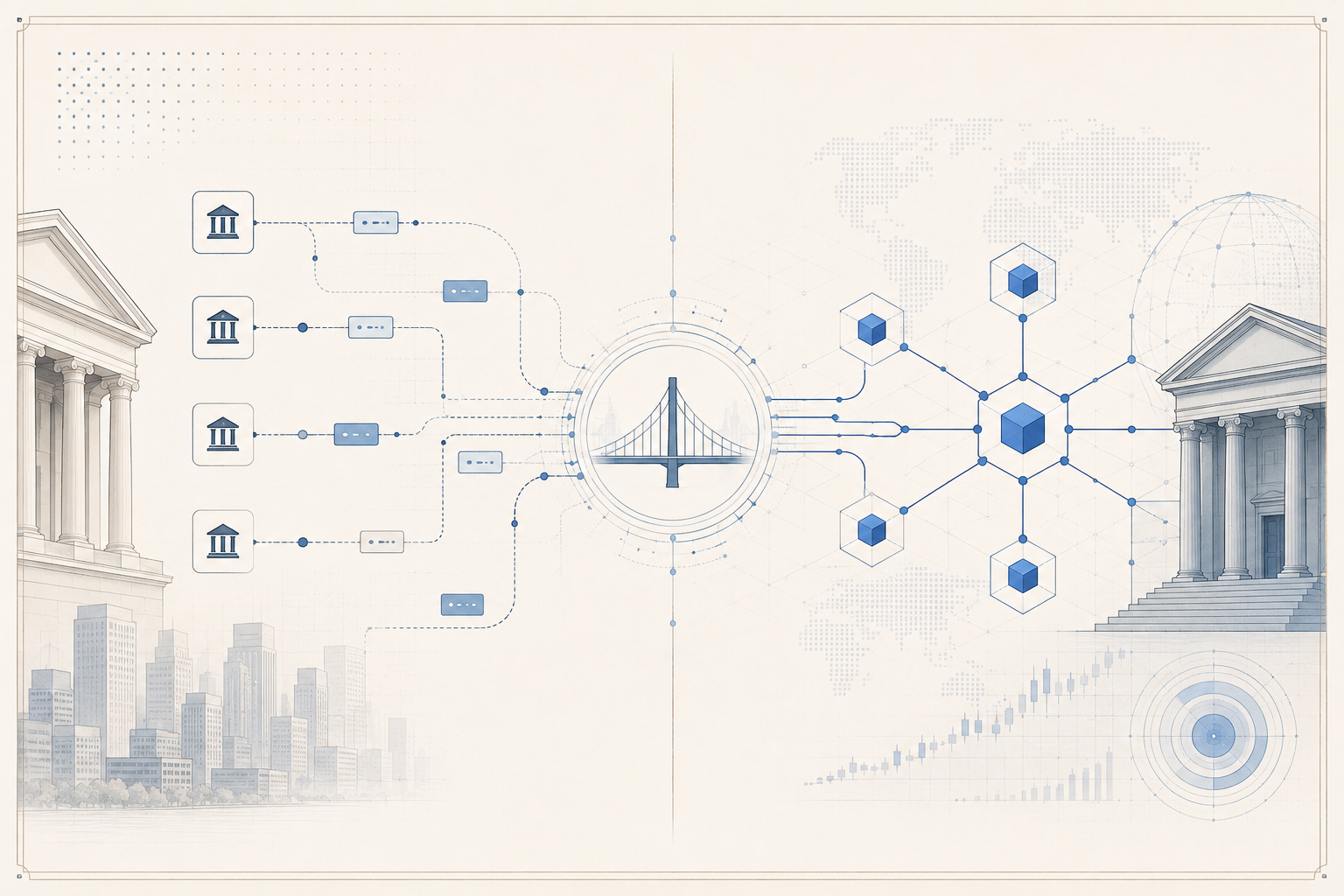
Bottomline’s reported partnership with Chainlink is one of those infrastructure stories that looks small until you place it in the context of how banks actually move money. The headline claim is straightforward: more than 600 Bottomline bank customers could get a path toward blockchain-based cross-border settlement while continuing to use familiar payment-messaging standards. What makes that notable for RWA markets is not simply that another enterprise vendor is talking about blockchain. It is that a long-established bank connectivity layer may be trying to turn tokenized settlement into an operational extension of existing financial messaging, rather than a separate system that treasury and payments teams have to learn from scratch.
Bottomline’s own product materials help explain why that matters. The company markets itself to banks as a provider of financial messaging, commercial banking, payments and fraud infrastructure, and says its connectivity stack supports Swift and other domestic and global networks. On its payments-connectivity pages, Bottomline says it handles 15% of international cross-border Swift traffic, processes roughly 10 million transactions a day through its SaaS services and ranks among the top three Swift service bureaus globally. In other words, this is not a startup trying to win a pilot. It sits in a part of bank operations that already matters for production payment flows.
The reported Chainlink tie-up appears designed to preserve that incumbent workflow. According to the source report, banks would still be able to send payment instructions using ISO 20022-style operational processes, while Chainlink would supply the interoperability and orchestration layer needed to connect those instructions to blockchain settlement. That design choice is crucial. Most banks do not want to replace their messaging, sanctions, approval and reconciliation stack just to experiment with tokenized money or onchain settlement. They want a way to keep the operational shell they trust while swapping in new execution rails where they improve speed, programmability or availability.
Chainlink’s own materials show why it is a plausible partner for that role. Its commercial-banks use case pages pitch privacy-preserving interoperability, policy-controlled workflows and coordination across cross-border settlement, tokenized deposits and tokenized collateral. The company’s CCIP documentation similarly frames the protocol as middleware for moving tokens, messages or both across different blockchain environments without requiring separate point-to-point integrations for every network. That is a useful fit for banks because the problem is rarely just one chain or one asset. The real challenge is synchronizing payment instructions, asset movements, compliance checks and confirmations across multiple systems without forcing operations teams into manual exception handling.
Seen through that lens, the Bottomline story is really about reducing the integration penalty that has slowed institutional tokenization. RWA adoption does not fail because banks cannot imagine tokenized assets. It stalls because a tokenized cash leg, a tokenized security leg and the surrounding bank controls usually live in different operational domains. If a bank can keep its messaging format, approval structure and audit workflow while outsourcing the cross-chain and blockchain-specific logic to a middleware layer, then the path from pilot to production becomes far shorter. That matters for stablecoin settlement, tokenized deposits, delivery-versus-payment flows and eventually for asset servicing around tokenized bonds, funds and other real-world instruments.
There is still a meaningful gap between offering the option to settle onchain and seeing broad bank usage. Bottomline’s installed base will not automatically route real value through blockchain rails just because the interface exists. Risk committees, jurisdictional rules, liquidity preferences, counterparty readiness and custody models still determine adoption. Some institutions will also distinguish sharply between public-chain settlement, permissioned-chain settlement and hybrid models where messaging and controls remain offchain while only final asset movement touches tokenized rails. That means the partnership should be read as an enablement layer, not a guarantee of volume.
Even so, enablement is increasingly the real battleground. As more banks, payment firms and crypto-native infrastructure providers roll out stablecoins, tokenized deposits and tokenized securities platforms, the commercial advantage shifts toward whoever can make those systems work together cleanly. The winning product is not necessarily the one that issues the most tokens. It may be the one that lets a bank continue operating like a bank while selectively introducing 24/7 settlement, programmable transfers and faster reconciliation where the economics justify it. Bottomline’s role in financial messaging gives this experiment a distribution angle that pure blockchain vendors often lack, while Chainlink brings the interoperability narrative institutions want to hear.
For RWA Trails, the practical takeaway is that tokenized finance keeps moving closer to bank middleware instead of remaining a specialist crypto stack. If this integration progresses from reported partnership to real client workflows, it would support the idea that the next phase of tokenization is less about launching isolated digital assets and more about embedding tokenized settlement into the software banks already use for payments and treasury operations. That is exactly the kind of infrastructure shift that can make onchain finance feel less experimental and more like an extension of mainstream market plumbing.