Bank of Korea Extends Won Settlement Toward 24-Hour Market Access
South Korea’s central bank has begun testing a 24-hour offshore won settlement network with four domestic banks. The pilot is not a tokenization launch, but it sits beside Korea’s broader work on tokenized deposits, wholesale CBDC rails and foreign-investor market access.
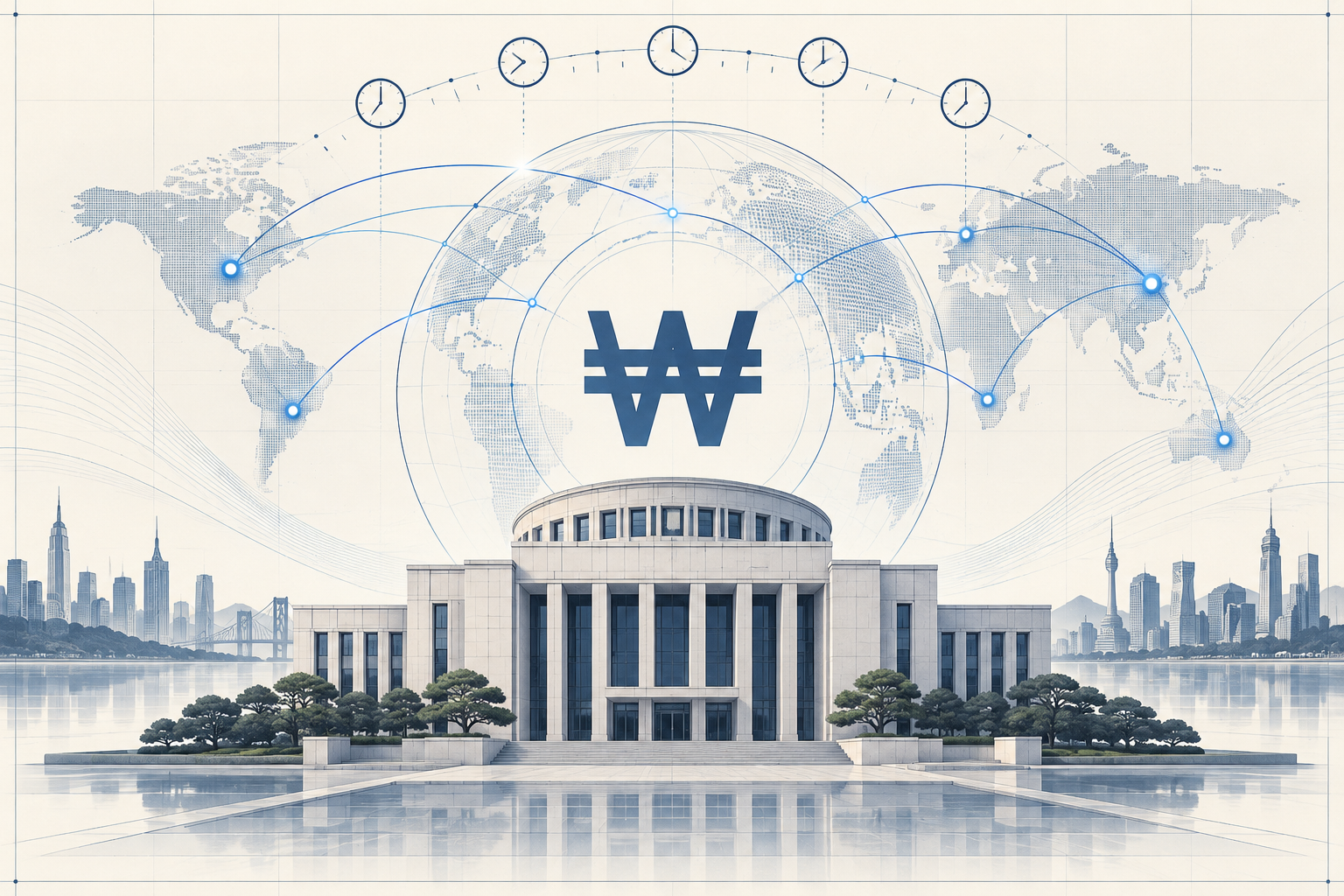
The Bank of Korea has started a pilot for a 24-hour offshore won settlement network, a market-plumbing change that could make Korean currency settlement more usable for overseas investors operating outside Seoul trading hours. The initial trial connects four domestic lenders — KB Kookmin Bank, Woori Bank, Hana Bank and Shinhan Bank — and is scheduled to move into full operation in January 2027, with additional institutions expected to join after launch.
The network is designed to keep won settlement available from 9 a.m. on each Korean business day until 9 a.m. the following day, excluding weekends and public holidays. That matters because currency settlement is often less about headline trading demand than about timing, account access and operational certainty. For foreign investors, a market can be attractive on paper but inefficient in practice if settlement windows force activity into another jurisdiction’s overnight hours.
The central bank’s structure focuses on Registered Foreign Institutions for KRW Business, or RFI-Ks. Instead of requiring offshore investors to open accounts directly with Korean financial institutions, the system allows them to settle won transactions through RFI-K accounts in their home markets. In practical terms, the pilot attempts to make the won easier to use as a settlement currency without fully removing the controls and institutional channels that define Korea’s existing market-access framework.
For RWA markets, the near-term significance is not that the BOK has tokenized the won in this network. It has not. The pilot is better understood as a conventional settlement upgrade that addresses a problem tokenized finance also tries to solve: assets and money increasingly trade across time zones, while the banking systems that settle them still tend to observe local operating hours. Narrowing that mismatch is a prerequisite for deeper onchain securities, tokenized fund and cross-border payment activity.
The timing is important because Korea is also testing more explicitly tokenized forms of settlement infrastructure. The Bank of Korea has participated in Project Agorá, the Bank for International Settlements-led effort exploring cross-border payments using tokenized central-bank reserves and commercial bank deposits. It is also advancing Project Hangang, a domestic wholesale CBDC and tokenized-deposit pilot aimed at testing how bank-issued deposit tokens can settle over central-bank money in controlled market environments.
Those projects occupy a different layer of the stack from the 24-hour offshore won network. Project Agorá and Project Hangang ask whether deposits and central-bank money can be represented and transferred on tokenized ledgers. The new offshore settlement network asks whether foreign investors can access won liquidity more continuously through today’s institutional account model. The overlap is operational: both efforts point toward markets where settlement windows become longer, reconciliation becomes faster and cross-border access depends less on manual cutoffs.
Korea has been moving along several adjacent tracks: expanding foreign-exchange access, developing tokenized securities policy, testing tokenized settlement and supporting bank participation in digital-infrastructure pilots. The 24-hour won network fits that pattern. It is a sober, infrastructure-first move rather than a consumer-facing crypto product, but that is precisely why it deserves attention from RWA operators. Tokenized assets become more useful when the offchain currency and banking rails around them are also upgraded.
The pilot’s main test will be whether it can attract real institutional usage while preserving the controls Korean authorities require around currency access. That balance will determine whether the network becomes a meaningful channel for offshore participants or remains a limited operational convenience for a narrow group of approved institutions.
If it works, Korea will have improved a key piece of foreign-investor plumbing before its larger tokenized-market agenda reaches full production. That would give future tokenized bonds, funds or deposit instruments a more credible settlement environment than a standalone blockchain proof of concept could provide on its own.