BIS sharpens the case for tokenized deposits over stablecoins at Jackson Hole
A Jackson Hole speech from BIS General Manager Pablo Hernández de Cos argued that tokenized deposits fit more cleanly into the existing monetary architecture than stablecoins. The remarks put par settlement, interoperability and compliance back at the center of the digital money debate.
The argument over what form digital money should take moved back into the policy mainstream on Friday, when Bank for International Settlements General Manager Pablo Hernández de Cos used a Jackson Hole speech to make a clear institutional case for tokenized deposits over stablecoins. His core message was not that stablecoins are irrelevant, but that the monetary system already has a trust structure that tokenized bank money can plug into more naturally. In that framework, innovation matters, but the design of the liability matters more.
De Cos framed the issue around a concept central bankers care about more than crypto markets usually do: the singleness of money. In plain terms, that means users should be able to treat monetary claims denominated in the same currency as interchangeable at par, with final settlement into central bank money in the background. He argued that stablecoins do not automatically preserve that property, especially when liquidity fragments across issuers, venues and chains. If one token has to be sold in the secondary market to obtain another, or if redemption certainty depends on the issuer rather than the architecture of the payment system, then money starts to behave less like a universal settlement asset and more like a collection of branded instruments.
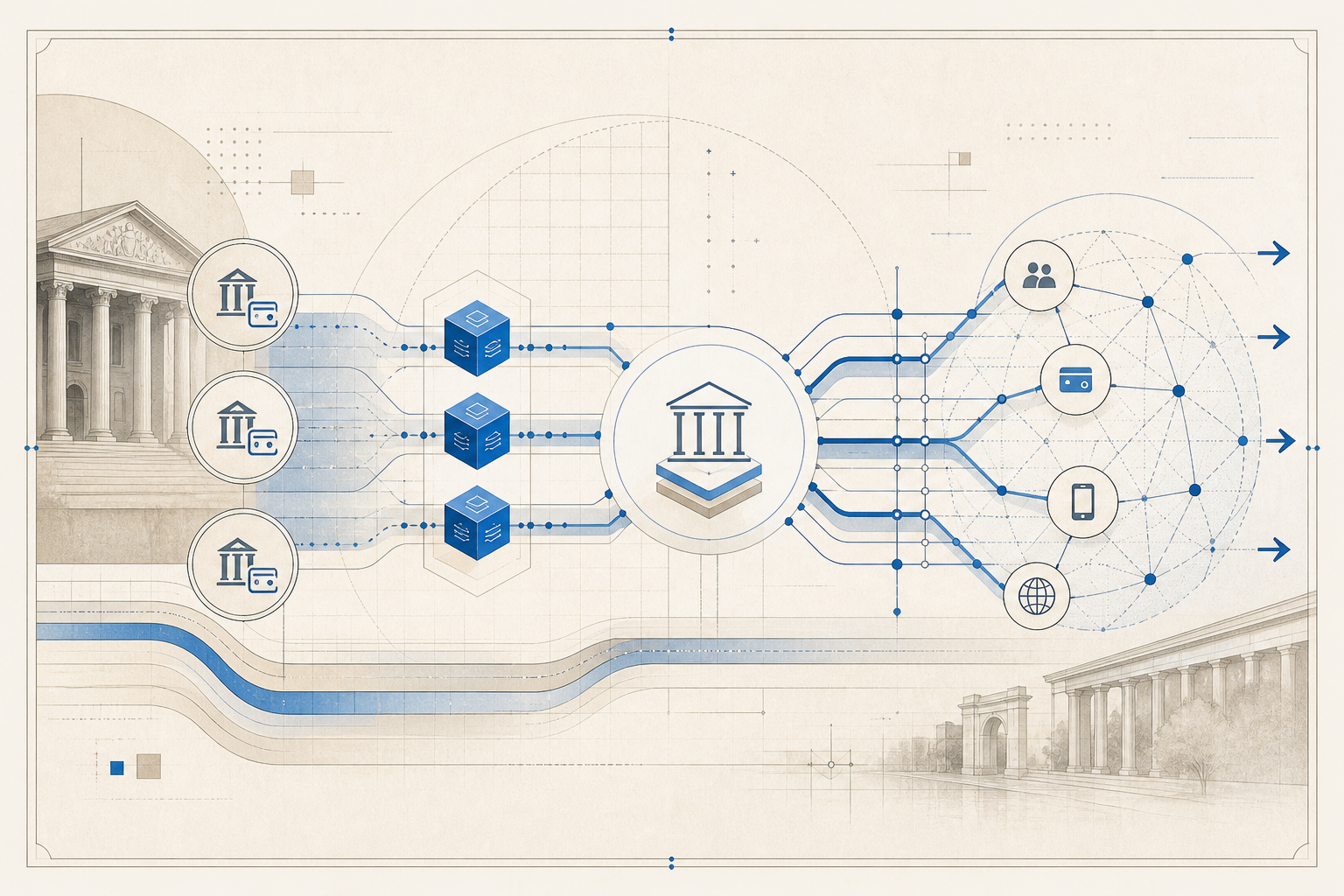
Tokenized deposits, by contrast, sit inside the existing two-tier banking system. They remain bank liabilities, are issued by supervised institutions and can settle across the interbank framework that already links commercial banks to central bank reserves. That does not eliminate friction on its own, and de Cos acknowledged that permissioned platforms can also be siloed. But his argument was that tokenized deposits have a cleaner path to interoperability if they are paired with tokenized central bank reserves or another trusted settlement asset. That point lines up with the BIS's broader work on wholesale tokenization rather than representing a one-off speech-line aimed at stablecoin headlines.
That broader work matters for RWA markets because tokenized securities, funds and cash-equivalent instruments all depend on the quality of settlement money around them. The BIS's Project Agorá prototype, published separately as a public-private collaboration with seven central banks and more than 40 regulated financial institutions, showed a model in which tokenized commercial bank deposits and tokenized central bank reserves can support atomic, multi-currency settlement on a shared programmable platform. For tokenized treasuries, money market funds and other onchain financial products, that is the more consequential signal: policymakers are still trying to reduce cross-border and capital-markets friction, but they want to do it without weakening par convertibility, compliance controls or finality.
The speech also sharpened the line between retail-style crypto distribution and institution-grade payments infrastructure. De Cos warned that public-blockchain stablecoin usage, especially in self-custodied wallets, creates harder anti-money-laundering and financial-integrity questions than systems operated inside supervised banking rails. That does not mean stablecoins cannot keep expanding. It does mean official-sector support may continue to concentrate around models that preserve identity, settlement discipline and direct links to central bank money. For builders in RWA, that distinction matters because the most valuable tokenization businesses are increasingly being designed for regulated fund flows, collateral movement and cross-border treasury operations, not just open-ended token circulation.
The market implication is that stablecoins and tokenized deposits are likely heading toward coexistence rather than a winner-take-all outcome. Stablecoins still have distribution advantages on open networks, faster product iteration and a growing role in merchant settlement and global dollar access. But the BIS is making it clear that when the conversation shifts from access to system design, tokenized deposits look more compatible with the architecture supervisors already trust. That could influence how banks, payment firms and infrastructure providers prioritize product roadmaps over the next cycle, especially in wholesale finance where integration with reserves, custody and compliance workflows is non-negotiable.
For RWA Trails readers, the practical takeaway is that the settlement layer is becoming just as important as the asset layer. Tokenized funds and treasury products may capture headlines because their balances are easy to measure onchain, but the next leg of institutional adoption will depend on whether digital cash instruments can move with the same certainty as the securities they settle. Friday's BIS intervention qualified as a strong signal because it connected policy theory to live infrastructure work. The message was simple: programmable money is welcome, but only if it keeps the monetary system coherent while more real-world assets move onchain.