Banks’ tokenization race is shifting from pilots to money movement
Large banks are no longer treating blockchain only as a lab exercise. The competitive line is moving toward production-grade tokenized deposits, stablecoin settlement and always-on institutional payment rails.
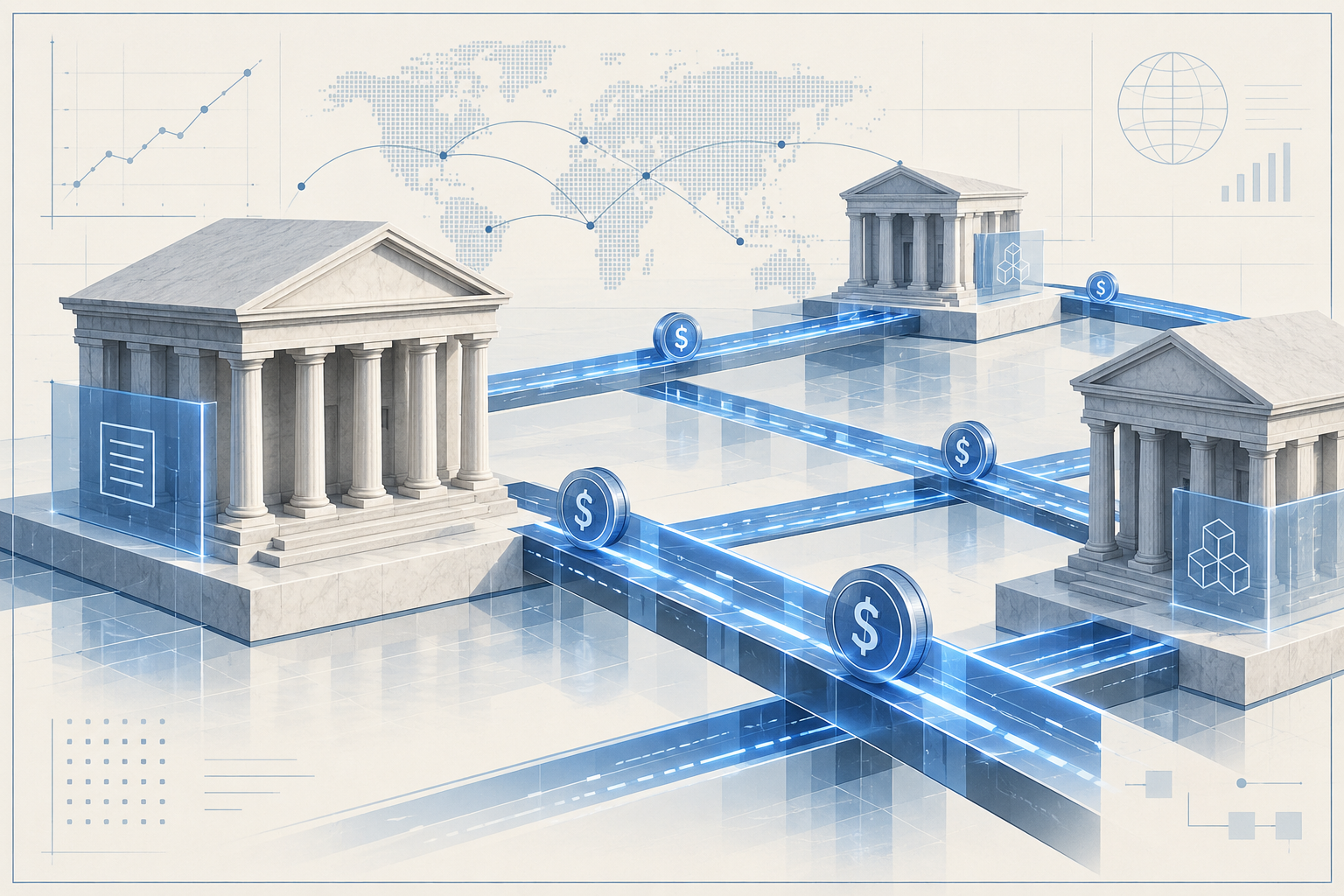
The institutional blockchain story is becoming less about whether banks are experimenting and more about whether they can move regulated money in production. A fresh wave of bank activity shows tokenization splitting into distinct lanes: tokenized securities, tokenized commercial-bank deposits, stablecoin settlement and collateral mobility. For RWA markets, that distinction matters because the cash leg is often the harder piece of the transaction to modernize safely at scale.
J.P. Morgan’s Kinexys platform is the clearest example of bank-led infrastructure moving beyond proof-of-concept status. Its public product materials describe 24/7/365 programmable money movement, a blockchain deposit account, JPM Coin, on-chain foreign exchange and tokenized collateral services. The bank also states that Kinexys has processed more than $3 trillion in transaction volume since inception and more than $7 billion in average daily transaction volume, positioning the platform as operating infrastructure rather than a technology showcase.
That production threshold is where the market is starting to separate. A tokenized security digitizes ownership or economic exposure to an asset. A tokenized deposit is commercial-bank money represented on programmable rails and remains a liability of the issuing bank. A stablecoin is typically issued outside the conventional deposit stack and is designed to circulate more broadly across blockchain networks. All three may touch the same wallets or settlement workflows, but they carry different legal, balance-sheet and operational assumptions.
Visa’s stablecoin work illustrates the other side of the same trend. The payments network says stablecoins can help institutions move value faster across borders, reduce friction and support around-the-clock settlement. Its earlier settlement pilots used USDC over Ethereum and Solana to move funds between Visa and partners, and its current stablecoin materials emphasize cross-border movement, settlement and developer tooling. That makes stablecoins less a crypto-native payment novelty and more a treasury and network-settlement option for regulated firms.
Circle’s USDC materials reinforce why banks and payment networks keep testing the model. Circle presents USDC as a regulated digital dollar redeemable one-for-one for U.S. dollars, built for rapid global payments and 24/7 financial markets. The relevance for banks is not only speed. It is the possibility of reducing prefunding, automating payment logic and making settlement available outside the operating windows of legacy correspondent banking.
The strategic question is interoperability. If tokenized deposits remain trapped inside individual bank networks, they may improve intrabank or closed-loop workflows without becoming broad market infrastructure. If stablecoins move across public chains but sit outside bank balance sheets, they may scale faster while facing a different regulatory and counterparty profile. The highest-value RWA workflows likely require both: regulated bank money for certain institutional contexts and liquid stablecoins for open-network settlement.
That is why the next phase of bank tokenization should be judged by live flows, counterparties and settlement reach rather than announcement volume. The market has enough pilots. What matters now is whether tokenized deposits, stablecoins and tokenized assets can meet in the same transaction path without forcing institutions back into manual reconciliation, delayed cash movement or off-chain settlement breaks.
For RWA adoption, this is a practical infrastructure story. Tokenized funds, collateral and securities become more useful when the payment rail is also programmable and available around the clock. Banks that can provide compliant money movement on shared ledgers will not just participate in tokenization; they will shape which asset markets can actually settle onchain at institutional scale.