Bank of Korea pushes its CBDC pilot toward commercialization with a nine-bank expansion
South Korea’s next CBDC pilot phase is set to widen from seven to nine banks and move beyond infrastructure testing into more practical payment flows. The design matters for RWA markets because it centers tokenized bank deposits, not just a retail wallet experiment, as the bridge between central bank settlement and everyday finance.
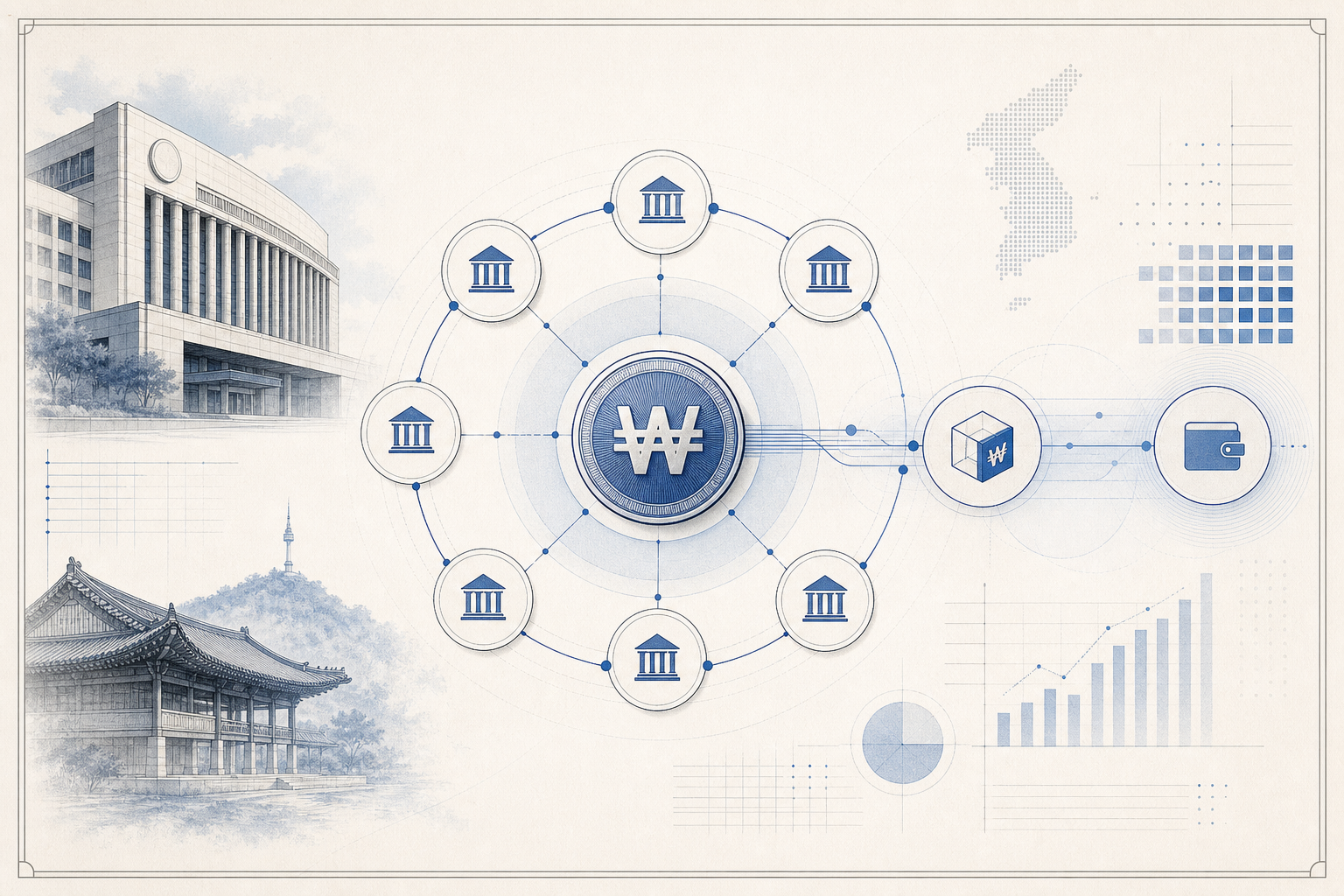
South Korea is preparing a more consequential test of digital sovereign money. In the next phase of the Bank of Korea’s central bank digital currency program, the pilot is expected to resume in September with nine participating banks and a broader focus on real payment activity. That shift takes the project beyond a contained technical exercise and closer to a live market structure question: how should central bank money, bank-issued tokenized deposits and consumer-facing payment flows fit together if digital won infrastructure is ever commercialized at scale?
The most important feature of the Korean design is that it does not treat the central bank as the direct retail service provider. Instead, the Bank of Korea supplies the core institutional settlement layer while commercial banks issue and manage deposit tokens that consumers can actually use. That architecture was already visible in the first phase of the pilot, which attracted roughly 81,000 participants and processed 114,880 transactions, according to reporting on the trial. In other words, the experiment has already moved beyond a white-paper stage and into observable user behavior.
The second phase appears aimed at turning that early testbed into something more commercially instructive. Two regional lenders, Gyeongnam Bank and iM Bank, are expected to join the existing group, taking the total to nine. Reporting on the upcoming phase also points to additional functionality, including peer-to-peer transfers, biometric authentication and tests tied to government subsidy disbursements through tokenized bank deposits. Those additions matter because they expand the pilot from merchant-style payments into a wider set of public and household use cases, where programmability and settlement finality start to matter more directly.
The Bank of Korea’s own CBDC materials help explain why the program is being structured this way. On its public English-language CBDC page, the central bank says it has not yet decided whether to issue a CBDC and stresses that any launch would require years of planning and coordination across government agencies, financial institutions and technology providers. The same page also highlights work undertaken with the Financial Services Commission, the Financial Supervisory Service and the BIS to explore a future monetary system for Korea. That framing suggests the pilot is not just about a new payment app. It is about designing institutional rails that could support broader financial-market modernization.
For RWA observers, the deposit-token angle is the real signal. A wholesale CBDC combined with commercial-bank tokenized deposits creates a hybrid model that preserves the banking system’s customer relationship while still introducing a digitally native settlement asset underneath. That is materially different from a pure retail CBDC model, and it sits closer to how many tokenized-asset markets are likely to evolve in practice. If the central bank provides trusted final settlement while banks distribute programmable claims to users, the result could look less like a direct state wallet system and more like an upgrade to the monetary plumbing around deposits, securities cash legs and regulated onchain payments.
That interpretation also fits Korea’s broader policy direction. The Bank of Korea recently surfaced research on asset tokenization in Korea and global markets as part of its wider publication agenda, underscoring that digital money and tokenized financial assets are increasingly being evaluated together rather than as separate policy silos. A successful deposit-token model would not automatically create an onchain capital market, but it would answer one of the hardest infrastructure questions in tokenization: what form of money settles transactions safely, legally and with enough programmability to support modern market workflows?
None of this means South Korea is on the verge of a retail CBDC launch, or that the September phase guarantees a commercial rollout. The central bank has been careful to keep the question open. But the pilot’s new shape does show the debate becoming more concrete. Instead of asking whether digital sovereign money is conceptually possible, Korea is now testing how a central-bank core and bank-issued token layer might operate in real financial life. For the RWA market, that is exactly the level where digital-cash infrastructure starts to become strategically relevant.