World Liberty Pushes USD1 Into Mainstream Sports Payouts at White House UFC Event
World Liberty Financial used its dollar stablecoin USD1 as part of fighter performance payouts at UFC Freedom 250, turning a high-visibility sports event into a live distribution moment for the token. The move paired consumer-facing promotion with issuer claims around reserves, redemptions and 24/7 onchain settlement.
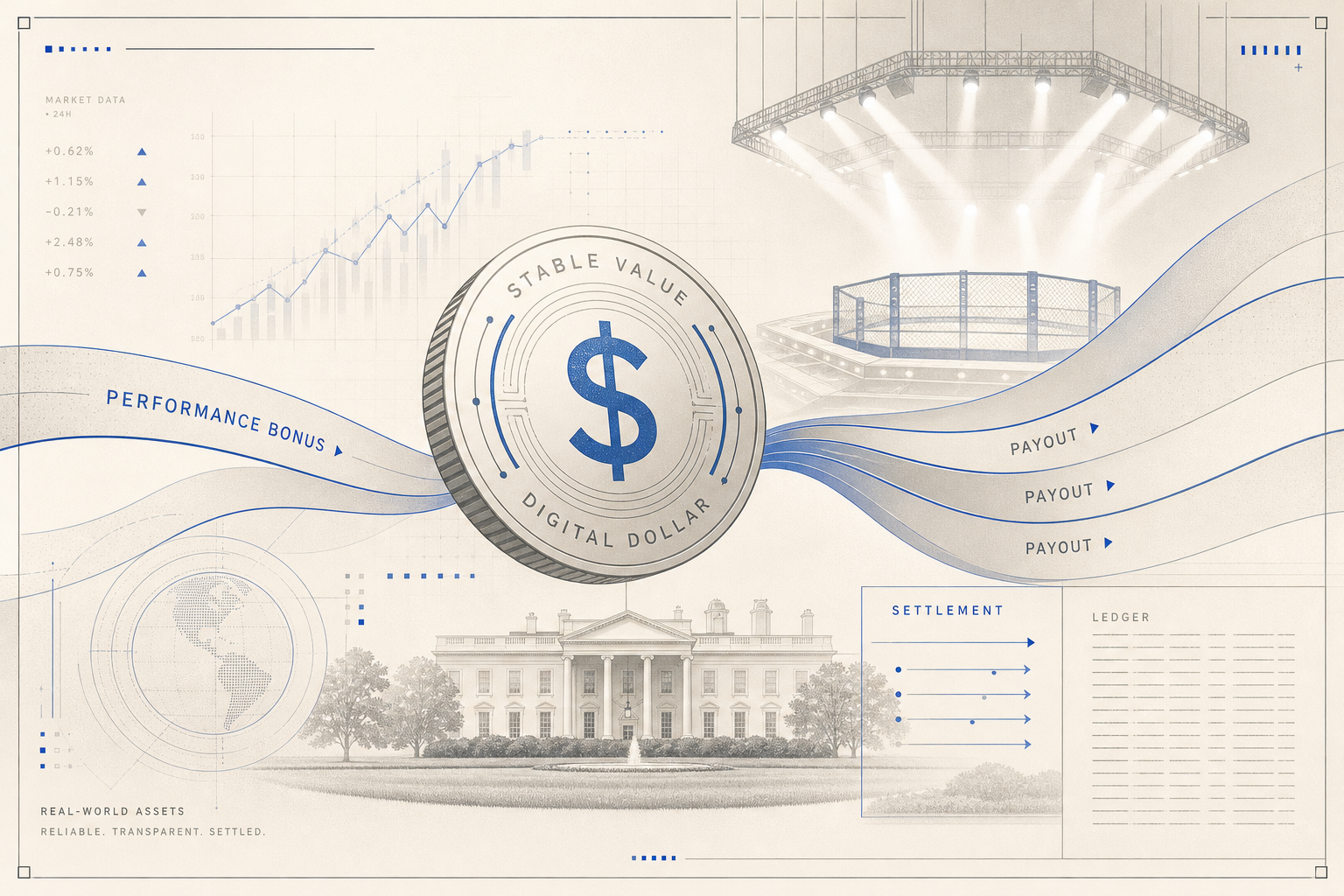
World Liberty Financial used UFC Freedom 250 to give its USD1 stablecoin one of its highest-profile distribution moments yet, tying a branded dollar token to fighter bonuses at a nationally staged sports event on the White House lawn. Official UFC bonus coverage shows that two performance winners each received a package worth $425,000, including $125,000 in USD1, $200,000 in CRO from Crypto.com and the standard $100,000 UFC performance award. That structure matters because it moved the stablecoin out of the usual exchange-and-wallet context and into a public consumer event built around sponsorship, prize money and instant recognition.
The direct exposure is notable even though the dollar amounts are small relative to institutional stablecoin flows. In stablecoins, distribution often matters as much as supply because the hardest part is not minting a token but creating repeat reasons for users, platforms and merchants to hold it. By placing USD1 inside a headline sporting event rather than a purely crypto-native venue, World Liberty tested whether a token can function as both settlement rail and marketing surface. It also showed how stablecoin issuers increasingly want real-world events to serve as acquisition channels, especially when they can pair media attention with simple payout mechanics.
On its official USD1 product page, World Liberty describes the token as redeemable one-to-one for U.S. dollars and backed by dollars and U.S. government money market funds. The issuer also says the token is designed for broad institutional, retail and DeFi use, with multichain support, 24/7 settlement, monthly attestation reports and a live proof-of-reserves dashboard. Those details are central to the product pitch. If an issuer wants a branded token to move beyond crypto trading desks, it needs to convince users that redemptions are straightforward, reserve assets are legible and the token can travel across more than one chain without excessive friction.
The White House event therefore did more than create a publicity splash. It connected stablecoin distribution to an operating model many issuers are now pursuing: pair reserve-backed dollars with embedded payments, incentive programs and partnerships that create captive demand. In that sense, USD1 is following the same broad playbook seen across the sector, where issuers compete not only on backing and compliance language but also on where the token shows up first. Sports sponsorships, exchange integrations, payment tools and onchain finance venues all become pieces of distribution infrastructure rather than separate marketing exercises.
UFC's own event materials underscore that point. The promotion announced Crypto.com as a co-presenting partner for Freedom 250 months before the card and framed the show as a major crypto-backed sports event. After the fights, the official bonus recap documented exactly how the awards were split, confirming that USD1 was not a theoretical sponsor mention but part of the compensation package received by athletes. For stablecoin watchers, that is the more important signal: a token only starts to matter commercially when it is used in concrete flows, even if the first flows are promotional rather than transactional at scale.
Still, high-visibility usage does not remove the normal questions around stablecoin durability. Promotional payouts can generate attention and short-term trading volume, but they do not by themselves prove sticky circulation, merchant acceptance or durable treasury demand. The issuer's transparency stack will matter more over time than a single event: reserve composition, attestation cadence, redemption reliability, supported networks and the breadth of venues where the token can actually be used. World Liberty has put those trust signals at the center of its USD1 presentation, which is exactly where the market will keep looking as the token tries to build relevance beyond political branding and event sponsorships.
There is also a market-structure angle here. Stablecoins are increasingly competing across consumer payments, capital markets collateral, exchange balances and treasury operations all at once. That compresses the distance between brand marketing and financial plumbing. A token that begins life as an event-linked payout instrument can later seek a role in trading, remittances, lending or cross-border settlement, provided the issuer can line up the right partners and keep reserve confidence intact. The practical question for USD1 is whether headline moments like Freedom 250 can be converted into recurring utility across those more demanding use cases.
For RWA markets, the episode is a reminder that distribution is becoming a first-class asset. A reserve-backed digital dollar is not judged only by what sits behind it, but also by the channels through which it reaches users and the credibility of the institutions presenting it. Freedom 250 gave USD1 a rare live showcase in front of a mass audience. The next test is less theatrical: whether the token can turn sponsored visibility into sustained onchain balances, repeat payment activity and the kind of trust signals that matter when stablecoins move from promotion into real financial infrastructure.