Wise Reopens U.S. Trust-Bank Bid as GENIUS Act Shapes the Stablecoin Charter Path
Wise is preparing a new U.S. national trust bank application after the OCC rejected its first filing, putting the GENIUS Act at the center of how payment and stablecoin infrastructure may reach federally supervised bank rails. The move matters beyond one company because trust-bank charters are becoming a serious operating lane for dollar-token and settlement businesses.
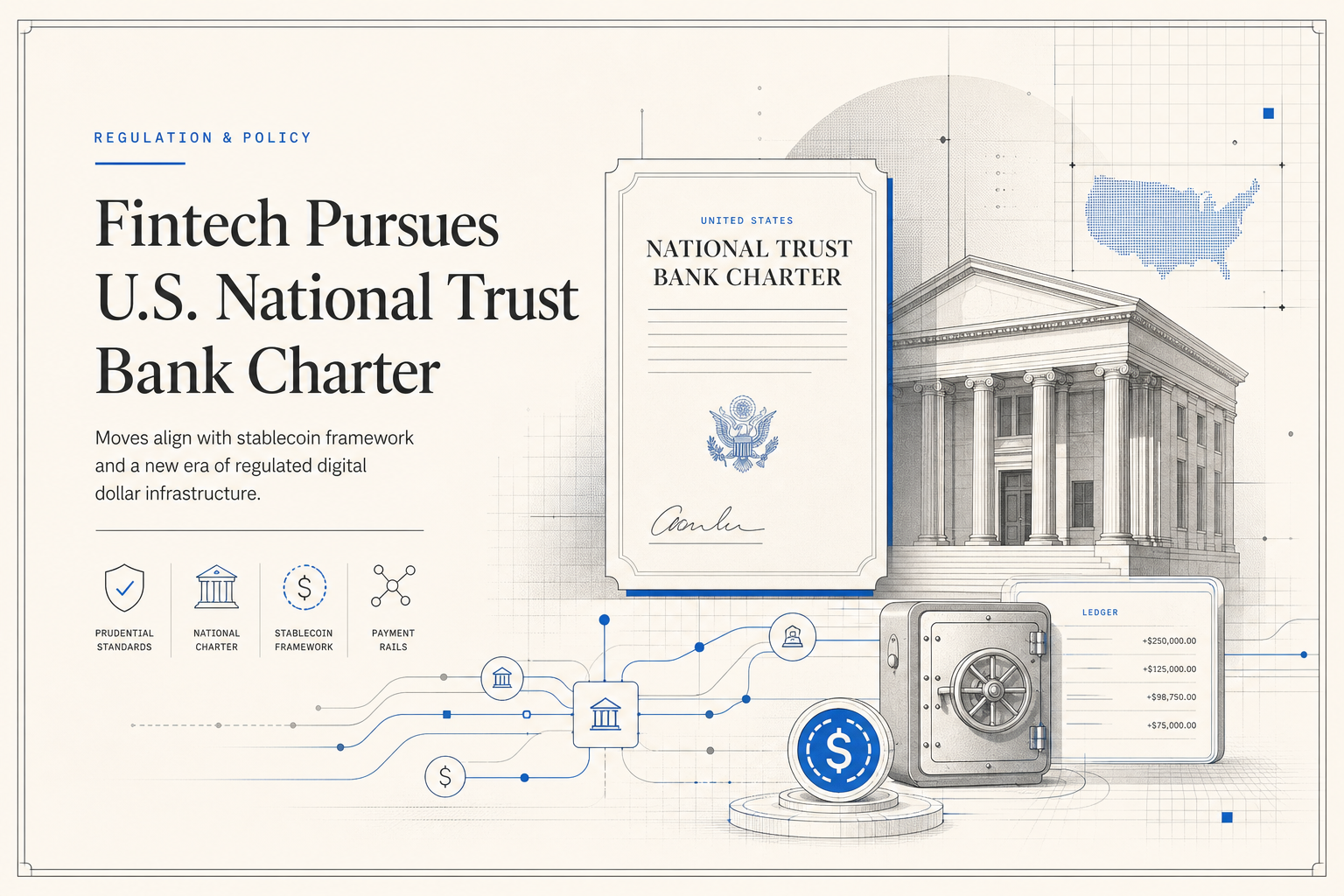
Wise is preparing to take another run at a U.S. national trust bank charter, a move that looks less like a narrow licensing retry and more like a signal about where stablecoin-adjacent payments infrastructure is heading. After the Office of the Comptroller of the Currency rejected Wise’s first application this week, the company is now expected to resubmit under the GENIUS Act framework that has become the main federal rulebook for payment stablecoins and related operating models. For RWA and digital-dollar markets, that makes this more than a company-specific compliance update: it is another marker that federally supervised trust-bank structures are becoming a serious part of the onchain money stack.
The OCC’s July 21 decision denied Wise’s application to charter Wise National Trust in Austin, Texas. In the agency’s letter, the proposed bank was described as a vehicle for three core lines of business: multi-currency stored-value accounts with debit cards for U.S. customers, payments processing for direct customers and affiliates, and fiduciary services tied to those accounts. The filing also carried a strategic infrastructure objective. Wise’s U.S. payments business currently relies on a network of correspondent banking relationships, and the application described a chartered trust bank with potential Federal Reserve master-account access as a way to scale domestic operations more efficiently.
The rejection did not close the door permanently, but it was explicit about the obstacles. The OCC said any subsequent application would need to address the reasons for the denial and fit the statutory and regulatory standards for approval. The letter also pointed back to Wise US becoming subject in July 2025 to a multistate consent order over anti-money-laundering and sanctions-control weaknesses, including suspicious-activity reporting and transaction-monitoring issues. That history matters because national trust bank approvals are not being treated as narrow charter mechanics; they are being evaluated as full governance, controls and supervisory credibility questions.
That is where the GENIUS Act changes the context. Even if Wise itself remains rail-agnostic and does not position stablecoins as its central product, the new framework has made payment-stablecoin infrastructure easier for regulators, banks and fintech operators to map into familiar categories. Reserve-backed digital dollars, custody standards, settlement obligations and prudential expectations now sit inside a clearer federal conversation than they did a year ago. For firms trying to bridge fiat payments, tokenized cash and programmable settlement, resubmitting a charter application under that framework is a rational response to a market in which regulatory architecture is finally catching up to product design.
Wise is also not moving in a vacuum. The charter lane has been getting more crowded as digital-asset and payments firms look for federal footing. BitGo said this year that it had secured full, unconditional OCC approval to operate as a federally chartered national trust bank, framing that status as a way to bring custody and digital-asset services under a more unified supervisory perimeter. Circle has also advanced through the OCC process, and a wider set of firms across crypto and traditional finance have spent the past year exploring national trust bank structures as a route into compliant digital-dollar services. In practice, that means the market is converging on trust charters not as symbolic badges, but as operating infrastructure.
For stablecoin markets, the point is not that every charter applicant will issue a token. It is that a national trust bank can become the compliance and balance-sheet anchor around activities that increasingly touch tokenized dollars, reserve management, custody, payments processing and client asset segregation. That has direct relevance for public stablecoins such as USDC and PYUSD, and for newer yield-aware dollar products such as USDM, because the competitive edge in this segment is shifting from pure issuance toward distribution, supervision and settlement quality. The institutions that can connect regulated cash management to programmable transfer rails are likely to shape the next phase of adoption.
There is still an unresolved policy question underneath all of this: a federal charter does not automatically solve the access problem to core central-bank payment infrastructure. Wise’s first application was judged against a shifting Federal Reserve backdrop around payment-system access, which means the boundary between charter approval and direct rail connectivity remains one of the most important friction points in the stack. That distinction matters for RWA builders because tokenized cash products only become truly scalable when redemption, reserve movement and fiat settlement can happen with fewer intermediaries and less timing friction.
The next version of Wise’s filing will therefore be worth watching for more than its approval odds. If the company narrows the application, strengthens its control narrative and aligns the proposal cleanly with the GENIUS Act’s stablecoin-era framework, it could offer a blueprint for how mainstream fintechs approach federally supervised digital-money infrastructure without having to become crypto-native issuers. For the broader RWA market, that would reinforce a simple takeaway: the race is no longer just to tokenize dollars, but to own the chartered operating rails that make those dollars credible, portable and usable at scale.