USDC’s widening lead in adjusted stablecoin flows is turning into a market-structure story
USDC’s first-half lead over USDT in Visa-tracked adjusted transaction volume suggests institutional stablecoin activity is consolidating around regulated rails with stronger payments and settlement positioning. That matters because the shift is starting to look less like a trading-cycle anomaly and more like an infrastructure preference.
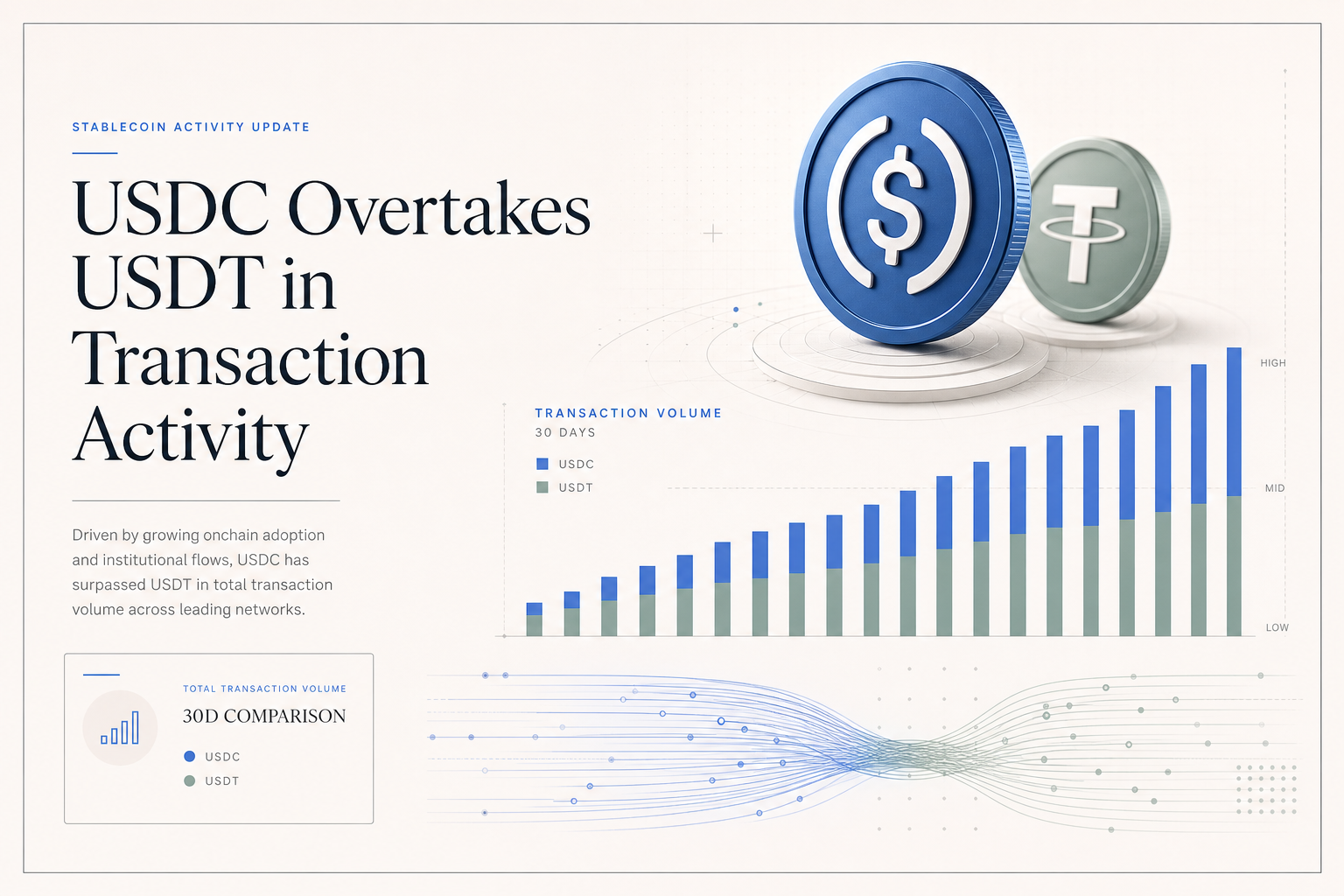
The latest stablecoin transaction data points to a more consequential shift than a monthly leaderboard change. Adjusted onchain volume tracked by Visa’s public analytics dashboard shows USDC widening its lead over USDT during the first half of 2026, a period in which stablecoin usage accelerated sharply across public blockchains. For RWA markets, the significance is not simply that one dollar token moved ahead of another. It is that the stablecoin most closely associated with regulated financial-market integrations is capturing a larger share of the activity that appears to reflect actual economic use rather than exchange reshuffling or bot-driven traffic.
The headline numbers are strong. Adjusted stablecoin transaction volume reached a record $1.79 trillion in June, up from roughly $1.1 trillion in May and about $795 billion in June last year. Across the first six months of 2026, adjusted volume totaled $8.82 trillion. That already exceeds the roughly $5.8 trillion recorded in all of 2024 and leaves the market within striking distance of 2025’s full-year high-water mark. The first-half mix is what stands out most: USDC accounted for about 70% of adjusted stablecoin volume, while USDT represented roughly 25%, a very different balance from the one the market carried earlier in the decade.
That reversal matters because it changes how observers should interpret stablecoin adoption. Earlier cycles were often dominated by exchange liquidity, offshore trading activity and crypto-native settlement loops. In that environment, scale alone was the key signal. The current pattern suggests a different center of gravity. Visa describes its dashboard as a public view into how fiat-backed stablecoins move across blockchains globally, and it presents separate views for supply, transaction activity and addresses. Reporting tied to the latest release says the adjusted figures strip out bot activity, exchange transfers and other transfers that do not look like real economic payments, which makes the directional move more meaningful for institutional observers.
USDC’s own positioning helps explain why that matters to the RWA stack. Circle presents USDC as a regulated digital dollar used for payments, liquidity access and financial-market activity, and its public materials emphasize near-instant global payments, trading services and interoperability across blockchain networks. Circle also states that USDC is redeemable 1:1 for U.S. dollars. Those product choices do not guarantee dominance, but they do make USDC easier to underwrite as treasury and settlement infrastructure for institutions that care about redemption, compliance posture and operational predictability more than purely crypto-native liquidity depth.
The result is a useful signal for tokenized finance. RWA issuance, tokenized funds and onchain collateral arrangements all need a cash leg that institutions can use without treating every transfer as a bespoke risk decision. A stablecoin that is broadly accepted, clearly redeemable and integrated into enterprise payment workflows is more valuable to that market than a token that merely posts large gross transfer numbers. If the share gains seen in the first half persist, USDC’s growing lead would imply that the cash rail for tokenized assets is increasingly being selected on operational quality and regulatory fit, not just historical incumbency.
This does not mean the stablecoin market is settled. USDT remains enormous, globally distributed and deeply embedded in trading venues, cross-border crypto liquidity and non-U.S. user demand. The more important takeaway is that the market now appears segmented. One part is still optimized for broad crypto distribution and exchange liquidity. Another is increasingly optimized for regulated settlement, institutional treasury movement and financial applications that need cleaner reporting and more defensible controls. For RWA builders, that second segment is the one that matters most.
The speed of growth also reinforces a larger point about tokenized finance in 2026. Stablecoins are no longer just a convenient bridge between bank accounts and crypto markets. They are becoming the working cash layer for a broader set of financial operations, including payment orchestration, collateral movement and onchain settlement around tokenized instruments. When adjusted activity rises this quickly, it suggests the sector is moving beyond speculative churn and into higher-frequency operational use cases that can support real asset tokenization at scale.
The near-term question is whether this first-half pattern holds as more banks, asset managers and fintech platforms deepen their stablecoin integrations. If it does, the competitive debate around stablecoins will shift further away from simple circulating-supply rankings and toward which issuer is best positioned to serve as the default money rail for institutional onchain finance. For now, the clearest implication is that USDC’s lead is becoming a structural RWA story: the market is beginning to reveal which digital dollars are being trusted to do actual financial work.