U.S. Stablecoin Policy Is Splitting Digital Dollars From Digital Yield
Washington’s latest market-structure push would make it harder for platforms to pay users simply for parking payment stablecoins in an account. If that approach survives, stablecoins look set to remain transaction rails while yield shifts into explicitly risk-bearing onchain cash and fund products.
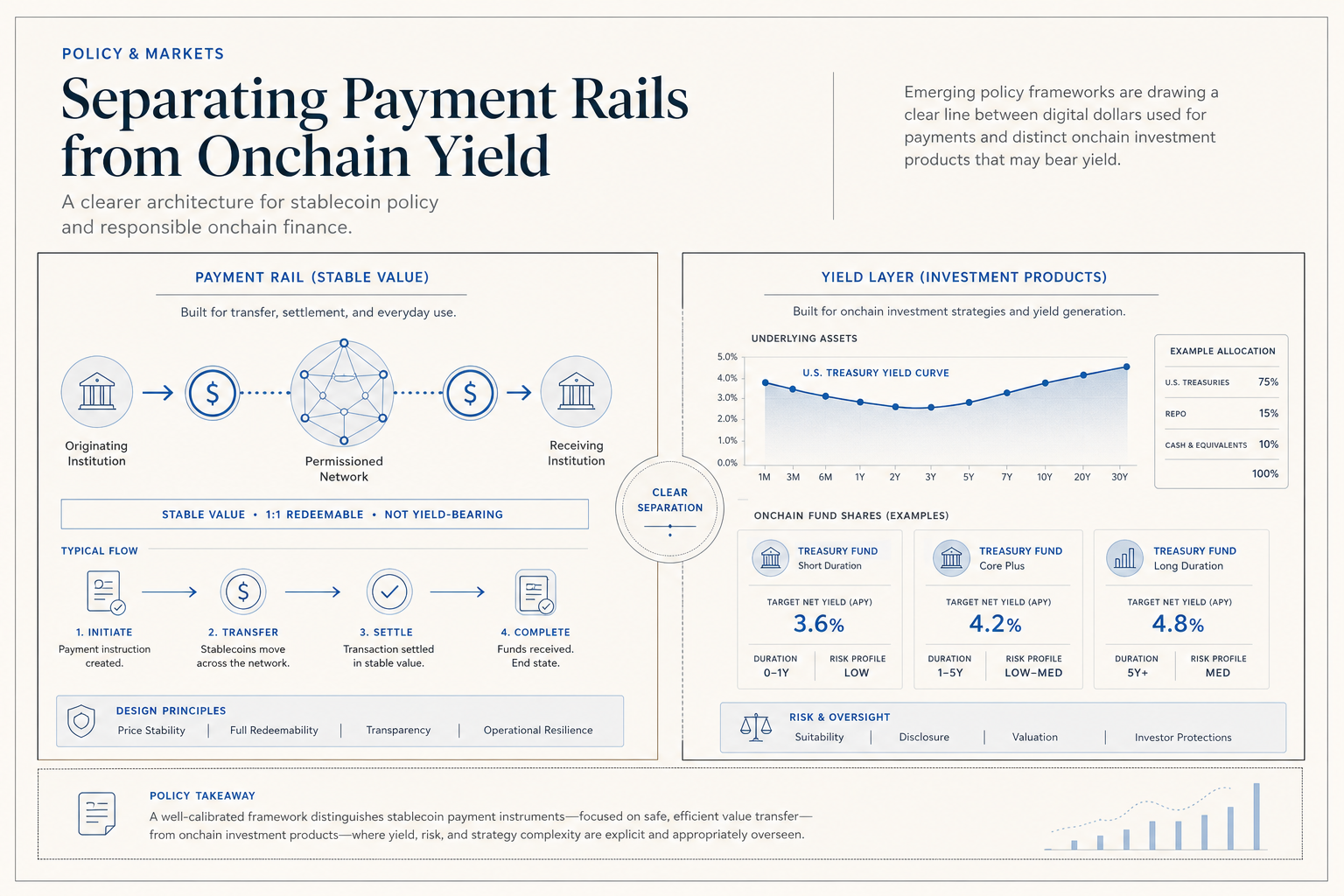
Washington’s latest digital-asset policy push is drawing a sharper line around what a payment stablecoin is supposed to be. The key issue is not whether dollar-backed tokens can keep expanding across payments, remittances and treasury operations; it is whether crypto platforms can market those tokens as the functional equivalent of an interest-bearing cash account. Reporting this week highlighted draft U.S. legislation that would generally prevent covered crypto intermediaries from paying customers yield solely for holding payment stablecoins. That would leave the token itself in a payments role while pushing return-seeking activity into more clearly defined investment products.
The policy distinction matters because it goes to the core of how stablecoin businesses are being framed in Washington. The legislative approach described in current coverage would treat passive yield very differently from compensation tied to actual economic activity. In practical terms, a platform could face pressure if it simply advertises a balance-based return for idle stablecoin holdings that looks and feels like bank-deposit interest. By contrast, rewards connected to payments activity, remittances, liquidity provision, collateral usage, staking or other risk-bearing services would have a stronger case for surviving. That is less a blanket attack on stablecoins than an attempt to separate digital cash from digital investment products.
If that framework holds, product design across the market will have to become more explicit. Wallets, exchanges and fintech apps would no longer be able to rely as easily on a simple “hold dollars here and earn” message if the economics resemble an uninsured savings product. Instead, firms would need to show what activity generates compensation, what risk the user is taking and which entity is actually providing the return. That shifts yield from a marketing line item into an architecture question: one balance for payments, another for collateralized or investment activity, and separate disclosures for each. In effect, crypto account design starts to look more like a brokerage and cash-management stack than a single wallet balance with blended economics.
The current product landscape already hints at that split. Circle’s USDC materials emphasize liquidity access, settlement and full-stack stablecoin payments infrastructure rather than a native savings product. PayPal’s PYUSD page similarly leans on redemption at par, global transfers, merchant use and cross-border movement, even as it currently promotes a rewards program for holders inside the PayPal app. Those two examples show why Washington is focusing on the wrapper around the token rather than only the reserve asset behind it. Regulators are increasingly concerned with whether a platform is offering programmable money for transactions or recreating deposit-like yield without the banking perimeter that normally governs that promise.
That distinction also creates a clearer lane for yield-bearing onchain instruments that are presented as investments instead of cash substitutes. Circle’s product lineup itself points to that direction by separating USDC from USYC, which it describes as a tokenized money market fund. In other words, the market already has a template for splitting stable settlement assets from return-generating instruments backed by short-duration government securities and similar cash-equivalent portfolios. If policymakers keep moving in that direction, yield does not disappear from crypto-dollar markets; it migrates into products where the source of return, the legal wrapper and the associated risk disclosures are more visible.
For RWA markets, that could be one of the more important second-order effects of the current U.S. debate. Tokenized Treasury funds, onchain cash-management products and other regulated yield vehicles stand to benefit if payment stablecoins are boxed more tightly into money-movement and settlement roles. Institutions may prefer that outcome because it creates a cleaner operational division: stablecoins for transfer and settlement, tokenized funds for reserve management and yield. That framework is easier to explain to compliance teams, easier to map onto disclosures and easier to integrate into treasury workflows that already separate operating cash from invested cash. It also fits the way many traditional finance firms want tokenized products to evolve—by mirroring familiar distinctions rather than collapsing everything into a single digital-dollar bucket.
The harder part will be drawing boundaries around incentives that are not obviously passive but still feel economically similar to interest. A loyalty program based on stablecoin balances, a payment incentive with minimal activity requirements or a wallet reward that scales mainly with account size could all sit in a gray zone. Current policy reporting suggests U.S. agencies would be expected to clarify those boundaries after enactment, with the SEC, CFTC and Treasury all playing a role in defining permissible programs and anti-circumvention standards. That means the next phase of the debate will likely move from statutory headlines to line-by-line product analysis: what counts as payment usage, what counts as investment risk and what kinds of rewards are really just deposit interest in different packaging.
The broad direction is still becoming clearer. Washington does not appear to be trying to remove dollar tokens from the financial system; it is trying to decide which parts of the crypto-dollar stack belong in payments and which belong in investment regulation. For stablecoin issuers and distribution platforms, that is a meaningful design constraint. For RWA markets, it is also an opening. The more firmly payment stablecoins are treated as settlement instruments, the more room there may be for tokenized money funds and similar onchain assets to become the transparent yield layer that sits beside them rather than inside them.