US banks line up a Clearing House-led path from internal deposit tokens to a shared settlement rail
Large U.S. banks are reportedly moving toward a shared tokenized-deposit network under The Clearing House, extending an institutional push to keep 24/7 programmable cash inside the regulated deposit system. The plan matters because it would connect blockchain-style settlement to infrastructure banks already use at scale instead of forcing treasury flows onto external stablecoin rails.
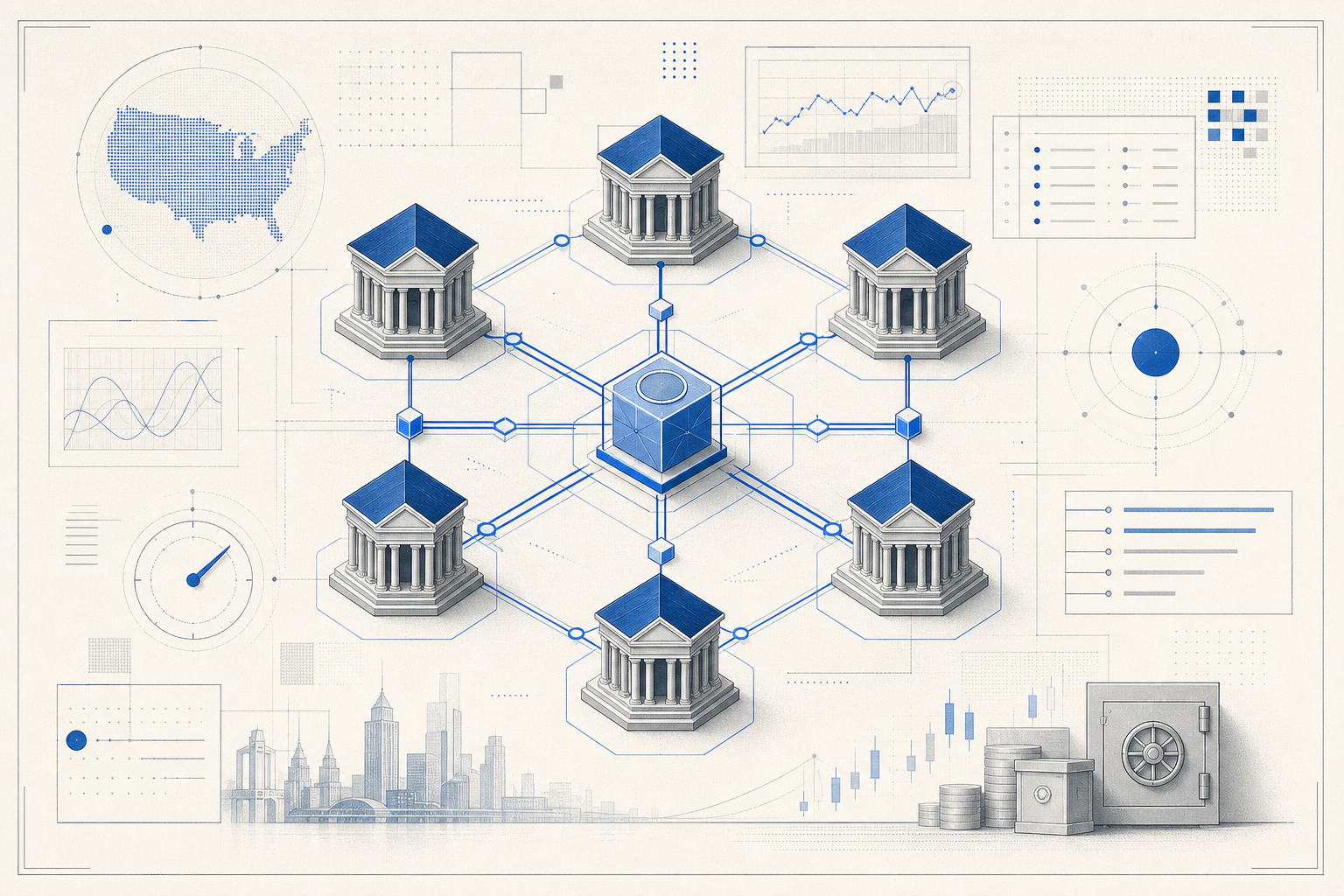
Plans outlined this week by people familiar with a major U.S. banking initiative point to a new phase in tokenized money: not just single-bank pilots, but a shared deposit rail that could connect some of the country’s largest institutions through infrastructure they already trust. The reported design centers on tokenized deposits rather than public stablecoins, which means the core proposition is not creating a new synthetic dollar outside the banking perimeter. It is about turning existing bank money into programmable, transferable tokens that can move with the speed and flexibility blockchain users now expect while remaining tied to regulated deposit accounts.
The operational anchor is significant. The network is expected to run through The Clearing House, the bank-owned operator behind some of the most important payment plumbing in the United States. The Clearing House says its CHIPS system clears and settles roughly $2.2 trillion in domestic and international payments each business day, while its RTP network has processed more than $1.4 trillion instantly since launch and now reaches more than 1,260 participants. If tokenized deposits are attached to that kind of incumbent settlement footprint, the story is no longer just about experimentation in innovation labs. It becomes a question of how quickly traditional bank infrastructure can absorb blockchain-style messaging, atomicity and around-the-clock movement.
That shift would build on groundwork the large banks have already laid inside their own walls. J.P. Morgan’s Kinexys unit says the platform has exceeded $1.5 trillion in notional value since inception, with average daily transaction volume above $2 billion and payments activity growing tenfold year over year. Kinexys also markets 24/7/365 transfers on its blockchain deposit accounts, which shows that the technical case for always-on institutional money movement has already been established at the single-bank level. What has been missing is broader interoperability across institutions, counterparties and treasury systems.
That interoperability challenge is becoming the real battleground. In late 2025, DBS and Kinexys disclosed work on a framework for interbank tokenized-deposit transfers across multiple blockchains, including the ability to exchange value across both public and permissioned environments. The stated goal was to preserve the “singleness of money” even in a world with multiple issuers and multiple chains. A shared U.S. bank network would push the same idea into the domestic wholesale payments stack: deposits should remain deposits, but they should also be able to settle continuously, carry richer business logic and move across bank boundaries without waiting for legacy cut-off times.
Why this is accelerating now is not hard to read. Stablecoins have made it clear that users value instant settlement, portability and programmability, and policymakers have spent the last year building a more formal framework for regulated payment tokens. For banks, that raises a strategic risk. If commercial clients can access faster digital dollars outside the deposit system, a piece of payments activity, operating cash and eventually balance-sheet funding could migrate toward nonbank rails. Tokenized deposits are the banking industry’s answer to that pressure: deliver similar utility, but keep money inside supervised institutions that already intermediate credit, liquidity and compliance.
The model also fits the clients most likely to adopt first. Multinationals, large treasury teams, broker-dealers and infrastructure-heavy financial institutions care less about the retail narrative around crypto wallets and more about intraday liquidity, collateral mobility, cross-border timing and automation. A shared tokenized-deposit network could let those firms move cash late in the day, coordinate settlement with securities or FX workflows, and reduce prefunding friction across affiliates or counterparties. Those are not cosmetic improvements. They change working-capital management and the economics of global treasury operations.
That said, the jump from bilateral or internal tokenized-deposit systems to a broadly usable interbank rail is still a meaningful execution challenge. Governance, access standards, legal finality, privacy architecture, reconciliation rules and cross-bank redemption mechanics all matter as much as the blockchain layer itself. The technology provider for the reported network has not been finalized, and the eventual participation model will determine whether this becomes a genuinely systemwide utility or a higher-end network for a narrower club of institutions. The market should also watch how any launch path handles interoperability with existing real-time payment rails, custodial setups and tokenized-asset settlement venues.
Even with those open questions, the direction is becoming clearer. The tokenized-money race is no longer just banks reacting to crypto; it is banks deciding that if digital dollars are going to become programmable and continuous, deposit money needs to evolve on equal terms. A Clearing House-led network would not end the stablecoin debate, but it would materially strengthen the case that regulated bank deposits can compete in the same 24/7 settlement environment. For the RWA market, that matters because the more institutional cash can move onchain with familiar banking safeguards, the easier it becomes to scale tokenized bonds, funds and other real-world assets without forcing every workflow onto external cash proxies.