UNDP turns blockchain payments from pilot work into operating infrastructure
UNDP and the Stellar Development Foundation have moved their blockchain-payments work from isolated pilots toward a standing delivery capability for country offices. The shift matters because it ties onchain settlement to governance, safeguards and last-mile operating requirements instead of treating blockchain payments as a one-off innovation exercise.
The United Nations Development Programme is moving one of the more substantive public-sector blockchain payment efforts out of the pilot stage and into institutional build-out. On July 6, UNDP and the Stellar Development Foundation said they had signed a new agreement to scale blockchain-based digital payment systems across UNDP programming after more than a year of research and field testing. The change is important not because a development agency ran another technology experiment, but because UNDP is now trying to turn those tests into a reusable operating capability that country offices can call on for real programme delivery. For RWA and onchain-finance watchers, that is the more consequential signal: tokenized payment rails only become durable when an institution is willing to embed them in workflow, controls and distribution.
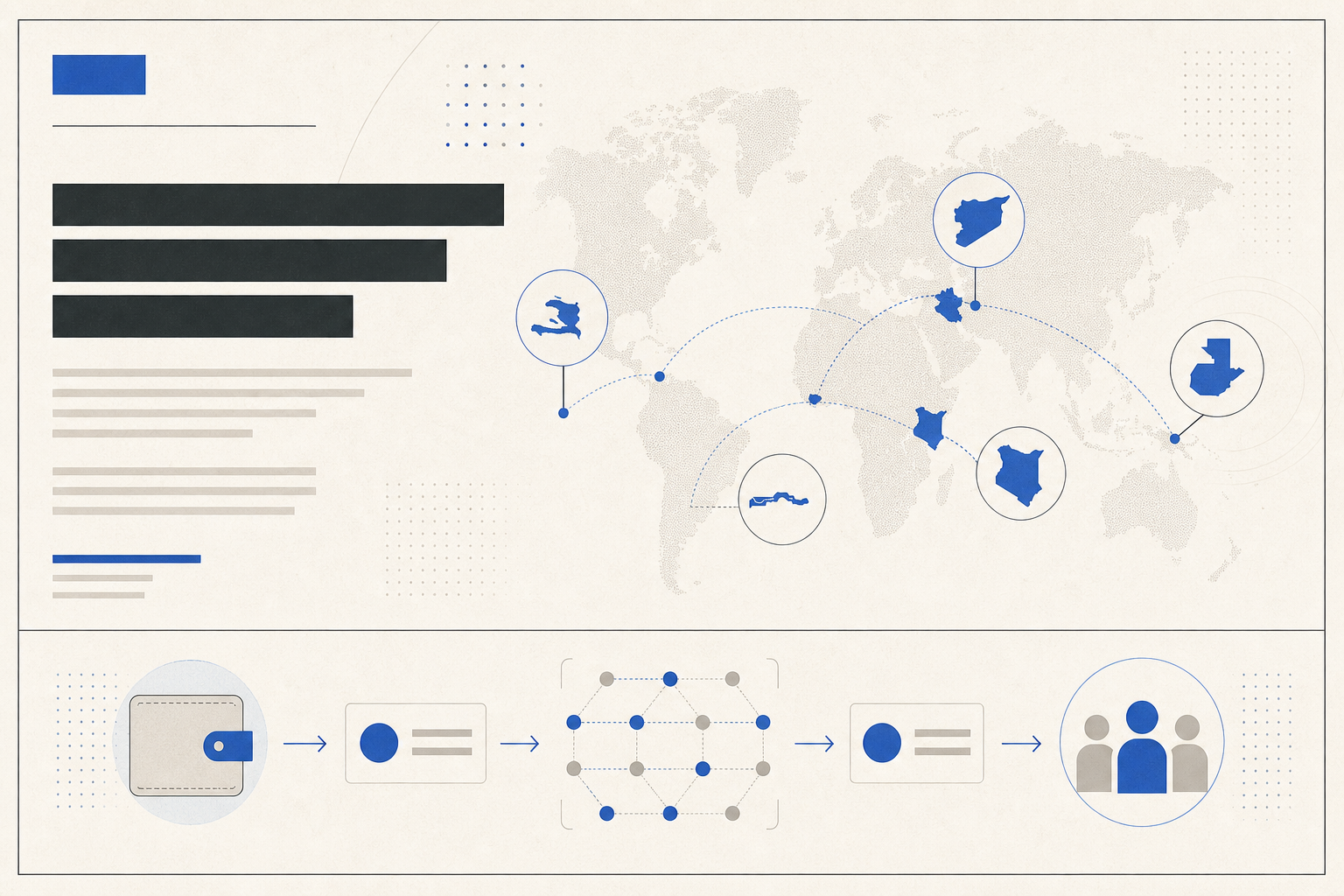
UNDP said the partnership follows 16 months of joint work spanning research across 17 countries, consultations with country offices and stakeholders, and live pilots in Haiti, Syria, Kenya, Guatemala and The Gambia. Two more solutions in Colombia and Papua New Guinea were developed to working-prototype stage. The new phase is meant to establish governance, onboarding processes and safeguards so that blockchain-based payments can be used across a wider set of programmes rather than remaining tied to bespoke pilot budgets. UNDP framed the effort as part of a broader push to make development finance faster, more transparent and more inclusive, while the Stellar Development Foundation is set to provide technical advisory support and coordination across the ecosystem as the operating model is put in place.
The most useful evidence sits in the implementation details that UNDP disclosed. In Aleppo, a Cash for Work programme recorded transactions onchain and cut estimated distribution costs from roughly 10% under conventional methods to about 2%, while still getting every participant paid and cashed out. In Haiti, UNDP said a payment pilot designed for low-connectivity conditions maintained a 100% success rate during testing even when the cellular network failed. Those are not abstract claims about efficiency. They speak directly to the operational questions that determine whether digital payment systems are credible in fragile environments: can money keep moving when connectivity is weak, can recipients actually receive and use funds, and can programme administrators show where the money went.
That operational framing is what makes the announcement more meaningful than a generic blockchain-for-good headline. UNDP said the next phase will focus on validated solutions already in its pipeline, while extending the same infrastructure across humanitarian response, social protection and financial-inclusion programmes. The agreement runs through 2027 and is intended to end with a scaling playbook, a consolidated evidence base and a formal handover so the capability can outlast the partnership that created it. In other words, UNDP is not treating blockchain payments as an isolated vendor deployment. It is trying to standardize the policy, implementation and oversight layers that would let country teams use the model repeatedly without redesigning it from scratch each time.
That fits with the direction of UNDP's wider blockchain portfolio. In late June, the agency's Alternative Finance Lab described how its internal Virtual Development Assignment Programme has been pulling colleagues from across the organization into live workstreams around digital payments, compliance, reporting and user trust. Earlier this year, UNDP also said its SDG Blockchain Accelerator had produced 46 pilot- and implementation-ready solutions, with 70% embedded in active national or regional programmes and digital payments representing the largest solution cluster. The takeaway is that the Stellar-linked work is not standing alone. It is part of a deliberate effort to build internal capacity, implementation pathways and a repeatable pipeline for blockchain systems that have to function inside real public and quasi-public operating environments.
UNDP's own recent work on stablecoins helps explain why that matters. In a May session of its UN Blockchain Talks series focused on stablecoins and last-mile financial inclusion, participants emphasized that faster digital rails do not solve much unless liquidity, merchant acceptance, agent networks, cash-out options and user support are present around the transaction. That is a useful lens for this week's announcement. UNDP did not announce a specific stablecoin rollout, but it is clearly working in the same design space now shaping institutional blockchain payments more broadly: dollar-linked digital settlement, auditable transfers and infrastructure that has to perform under local constraints rather than in ideal lab conditions. For that reason, the development is relevant to the same market architecture being built around assets such as USDC and USDT in cross-border and treasury workflows.
The broader implication for RWA markets is that tokenized finance keeps running into the same truth: issuance is only one layer of the stack. Whether the asset is a tokenized fund share, a digital cash instrument or a programme disbursement, the system still needs onboarding, controls, reconciliation, legal ownership of workflows and resilience when real-world conditions degrade. UNDP's move suggests that institutions with demanding audit and beneficiary obligations are starting to distinguish between blockchain demos and blockchain operating infrastructure. That is a constructive sign for the sector, even if the harder work still lies ahead.
What qualifies this development for close attention is not the rhetoric around innovation, but the fact pattern behind it. A large multilateral organization is pointing to measured cost improvements, outage resilience, traceability and a multi-country implementation record, then using that evidence to justify a formal scaling phase with governance and safeguards attached. For anyone tracking how onchain finance moves from proof of concept into production, that is the kind of transition that matters.