UK payments blueprint pulls tokenized money and programmable rails into the retail infrastructure agenda
The UK’s latest payments-vision update does not treat tokenized money as a side experiment anymore. By placing interoperability between new and existing forms of digital money inside the future retail-payments architecture, policymakers are moving stablecoins, tokenized deposits and programmable payments closer to mainstream infrastructure planning.
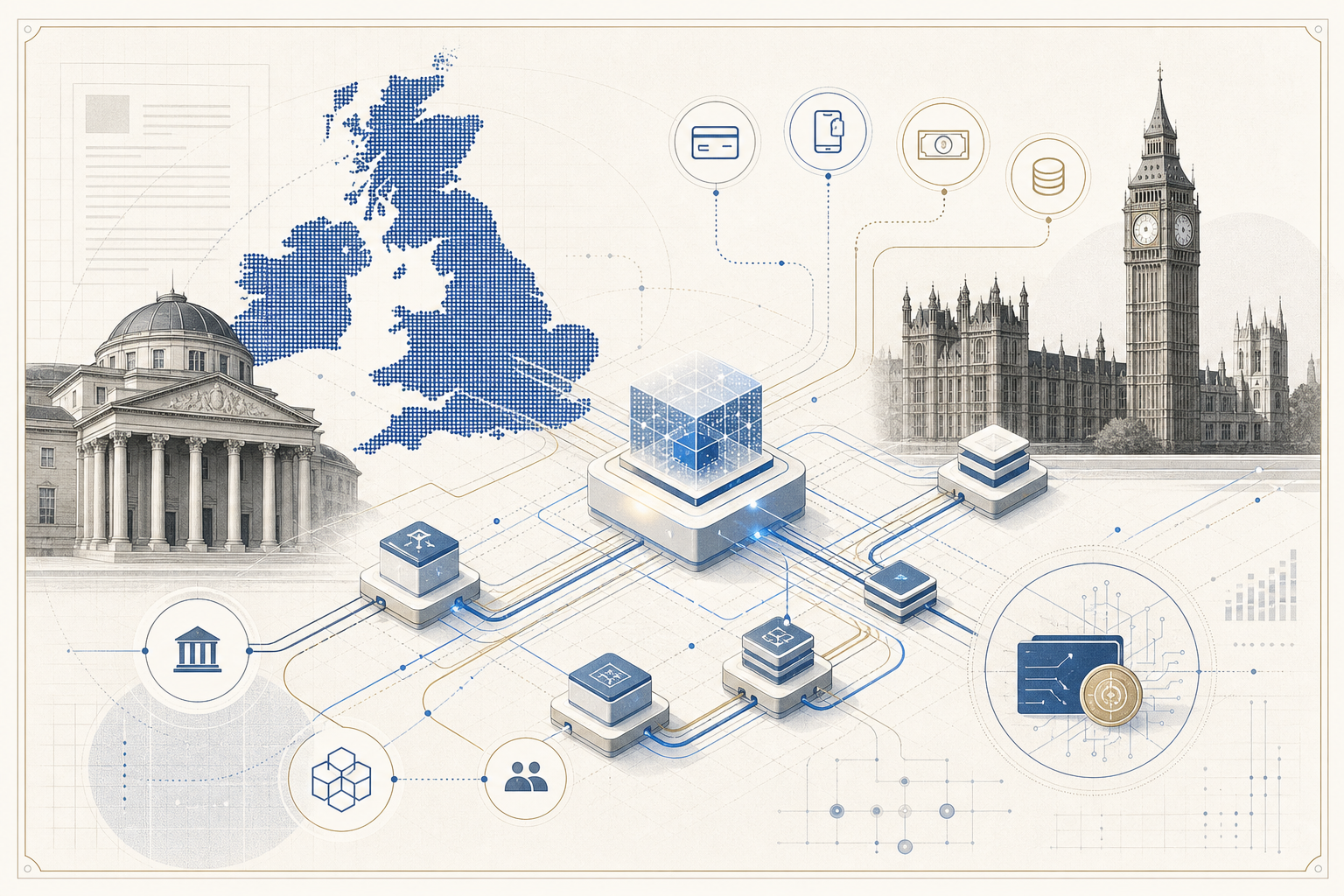
The UK’s latest payments blueprint is notable not because it launches a new digital-asset regime overnight, but because it moves tokenized money into the center of infrastructure design. In its latest update to the National Payments Vision, the Payments Vision Delivery Committee set out a future retail-payments framework that explicitly contemplates a multi-money ecosystem in which new forms of digital money can interoperate with existing payment systems. That language matters. It signals that tokenized payment instruments are no longer being treated simply as a niche fintech overlay, but as something the next generation of UK payments architecture may need to support in a durable, standards-based way.
The official update frames interoperability as one of the core outcomes for future infrastructure. It says payments should operate seamlessly across new and existing forms of digital money, supported by common technical standards, scheme rules and settlement arrangements. It also highlights programmable payments, including arrangements that rely on tokenization, as one of the possible payment-layer functions the future ecosystem may need to enable. In plain terms, the UK is beginning to think about payment modernization not only as faster bank transfers or cleaner front-end user experiences, but as a design problem involving how traditional account-based money, tokenized money and new digital payment workflows coexist.
That position builds on the government’s broader April package on payments and fintech policy. In that earlier announcement, HM Treasury said it would pursue a more coherent framework for both traditional and tokenized payments, explicitly naming stablecoins and tokenized deposits as part of the regulatory modernization effort. It also pointed to future legislation aimed at reducing administrative friction for firms that want to provide stablecoin payments while keeping safeguards in place. Taken together with the new July update, the trajectory is becoming clearer: the UK is not limiting its digital-money strategy to a narrow stablecoin rulebook, but is trying to map how multiple forms of money might interact across a common payments environment.
For RWA markets, that distinction is important. Stablecoins often get discussed as standalone crypto instruments, while tokenized deposits are usually framed as bank-led balance-sheet tools. The UK documents point toward a more functional view in which different money forms may need shared standards, common rails or interoperable settlement logic if they are going to be useful at scale. That is relevant well beyond payments. A credible multi-money framework could shape how tokenized securities settle, how treasury products move across wallets and bank accounts, and how programmable transaction logic connects capital-markets activity with day-to-day commerce.
The practical challenge, of course, is that interoperability is much harder to build than to describe. Once policymakers say multiple forms of money should work together, they inherit questions about legal finality, liability transfer, consumer protection, fraud controls, access rules, scheme governance and cross-platform messaging standards. The committee’s update does not pretend those questions are settled. Instead, it positions them as part of a longer infrastructure-design process, alongside consultation on the future retail-payments core. That cautious posture is appropriate. The real value of the document is not that it resolves market structure, but that it identifies tokenized and programmable payment capabilities as design requirements rather than edge cases.
This matters for competitive positioning too. Jurisdictions that want to lead in tokenized finance increasingly need more than permissive digital-asset policy; they need payment and settlement infrastructure that can support mixed forms of money without creating fragmentation. If the UK can align retail payments modernization with a workable framework for stablecoins, tokenized deposits and programmable settlement, it could create an environment where tokenized financial products plug into the broader economy more naturally. If it cannot, then tokenized money risks remaining siloed in specialist platforms, useful in demos but less compelling in everyday financial workflows.
The key takeaway is that the UK has started to define payment modernization in terms that are highly relevant to RWA adoption. By putting interoperability, programmable payments and digital-money coexistence into the formal infrastructure conversation, policymakers are laying conceptual groundwork for a market where tokenized cash instruments can support tokenized assets rather than develop on separate tracks. The blueprint is still a planning document, not a production system. But in policy terms, it marks a meaningful shift: tokenized money is being treated less as an exception to the payments system and more as one of the categories the future system must be built to handle.