UK Digital Gilt Pilot Moves Toward Launch, but the Cash Leg Is Still Unsettled
Britain now has a clearer path to a live digital gilt issuance, with HM Treasury targeting a first-quarter 2027 pilot on HSBC Orion and linking in LSEG infrastructure. The harder question is whether the UK can pair tokenized sovereign debt with a credible onchain sterling settlement asset.
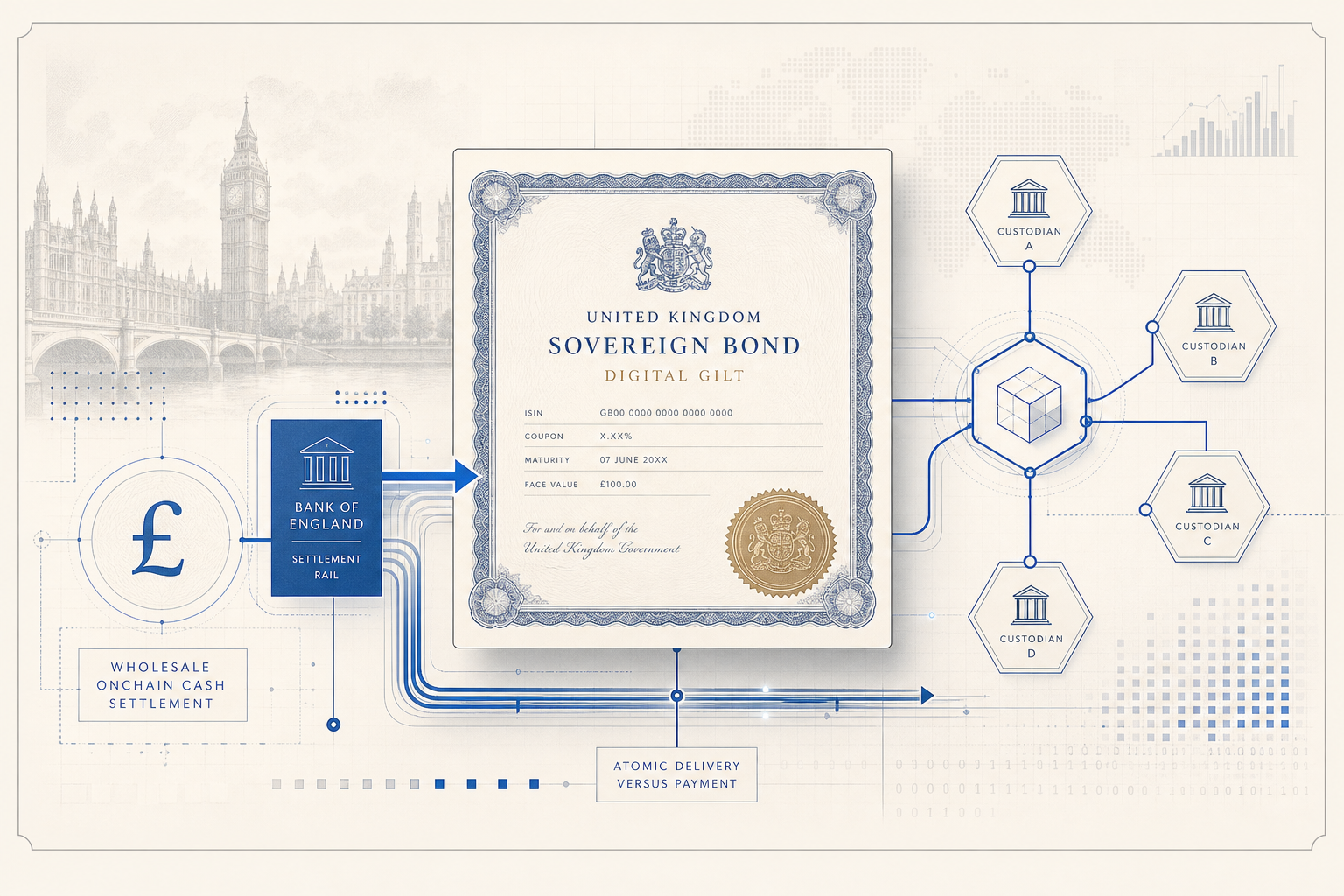
Britain’s push to bring sovereign debt issuance onto distributed ledger infrastructure is moving from concept work toward execution, but the market is already coalescing around a harder question than issuance alone: what cash instrument will actually settle the trade onchain. HM Treasury said this month that the first Digital Gilt Instrument, or DIGIT, transaction is expected by the first quarter of 2027 on HSBC Orion, with a bilateral link to London Stock Exchange Group infrastructure intended to widen investor access. That timetable gives the UK one of the clearest public sovereign bond pilot tracks in Europe, but it also sharpens the debate over whether a digitally native gilt can deliver meaningful market efficiency without a robust onchain settlement asset.
The latest Treasury update makes clear that the government wants more than a symbolic blockchain issuance. DIGIT is being designed as a digitally native, short-dated sovereign instrument inside the Digital Securities Sandbox, and the state has now tied together several pieces of infrastructure that matter for a real market test. HSBC was selected earlier this year as platform provider, then received Gate 2 approval in the sandbox to provide live digital securities depository services. Treasury also said HSBC and LSEG have signed a memorandum of understanding for a bilateral depository link, with Orion acting as issuer-side infrastructure and LSEG positioned to support investor-side settlement and servicing. In practical terms, that is an attempt to avoid creating a closed pilot that works technically but remains disconnected from the institutions likely to buy, hold and finance the paper.
That architecture addresses one major barrier to tokenized bond markets: fragmentation between new ledger-based systems and existing market plumbing. It does not fully answer the payment question. Treasury’s earlier DIGIT pilot update said the government would prioritize solutions that support onchain settlement across the full lifecycle of the instrument, explicitly including the cash leg of DIGIT transactions. That wording is important. Tokenizing the security is only one half of delivery-versus-payment. If the bond sits on distributed ledger rails while cash settlement still depends on offchain reconciliation or delayed fiat movements, many of the benefits usually promised for tokenization — intraday liquidity mobility, faster collateral turnover, and cleaner operational workflows — become much harder to realize at scale.
That is why comments from market participants are converging on settlement asset design as the real bottleneck. Fireblocks executive Varun Paul said the initiative appears to have enough institutional backing across HM Treasury, the Bank of England and the Financial Conduct Authority to continue despite the UK’s change in political leadership. Markets Evolution founder Jannah Patchay argued that the missing piece remains a counterparty-risk-minimized instrument to settle the bond directly onchain, pointing to compliant sterling stablecoins as one possible route. Those views line up with the government’s own sequencing: build the legal and depository framework first, then confront the question of how cash and securities can move together without reintroducing the frictions the pilot is meant to remove.
The Digital Securities Sandbox is the mechanism the UK is using to test that transition under a modified legal and regulatory perimeter. HM Treasury has described the sandbox as a way for market infrastructure operators to use digital asset technology for digital securities while regulators evaluate policy and legal issues that standard rulebooks do not yet solve neatly. That matters because tokenized bond markets are not just a software problem. Settlement finality, insolvency treatment, depository responsibilities, investor access rules and exchange listing mechanics all have to work together if the product is to support repo, collateral management and secondary trading rather than a one-off issuance. Treasury has already said it expects DIGIT to be listed on the London Stock Exchange’s main market as part of the pilot, another sign that the project is being framed as capital-markets infrastructure rather than a standalone innovation exercise.
The commercial case for solving the cash leg is straightforward. Government bonds are foundational collateral instruments. If a digitally native gilt can be issued, transferred, financed and settled with a regulated onchain cash instrument, the result is not merely a faster primary issuance process. It opens the door to intraday collateral mobility, more automated repo workflows and potentially broader interoperability across tokenized money-market and fixed-income products. If that cash leg remains unresolved, however, DIGIT risks demonstrating that securities can be represented onchain without proving that market participants can actually capture the balance-sheet and liquidity benefits that justify operational change.
For RWA markets, that makes the UK pilot worth watching even before the first transaction is priced. The country now has a published issuance target, a named infrastructure operator, an interoperability link with LSEG, and a sandbox framework meant to absorb the legal adjustments still required for digital securities. What it does not yet have is a clearly established answer to onchain sterling settlement. Until that piece is in place, the UK can advance the mechanics of tokenized sovereign issuance, but the broader promise of a digitally native gilt market will remain tied to whether cash can move on the same rails as the bond itself.