Taiwan’s new virtual asset law puts stablecoin issuers inside a full licensing regime
Taiwan has moved beyond AML-only registration by passing a new virtual asset law that brings exchanges, custodians and stablecoin issuers under formal supervision. The stablecoin section is the real signal for RWA markets: reserve segregation, trust structures, audits and licensing are being written directly into the operating model.
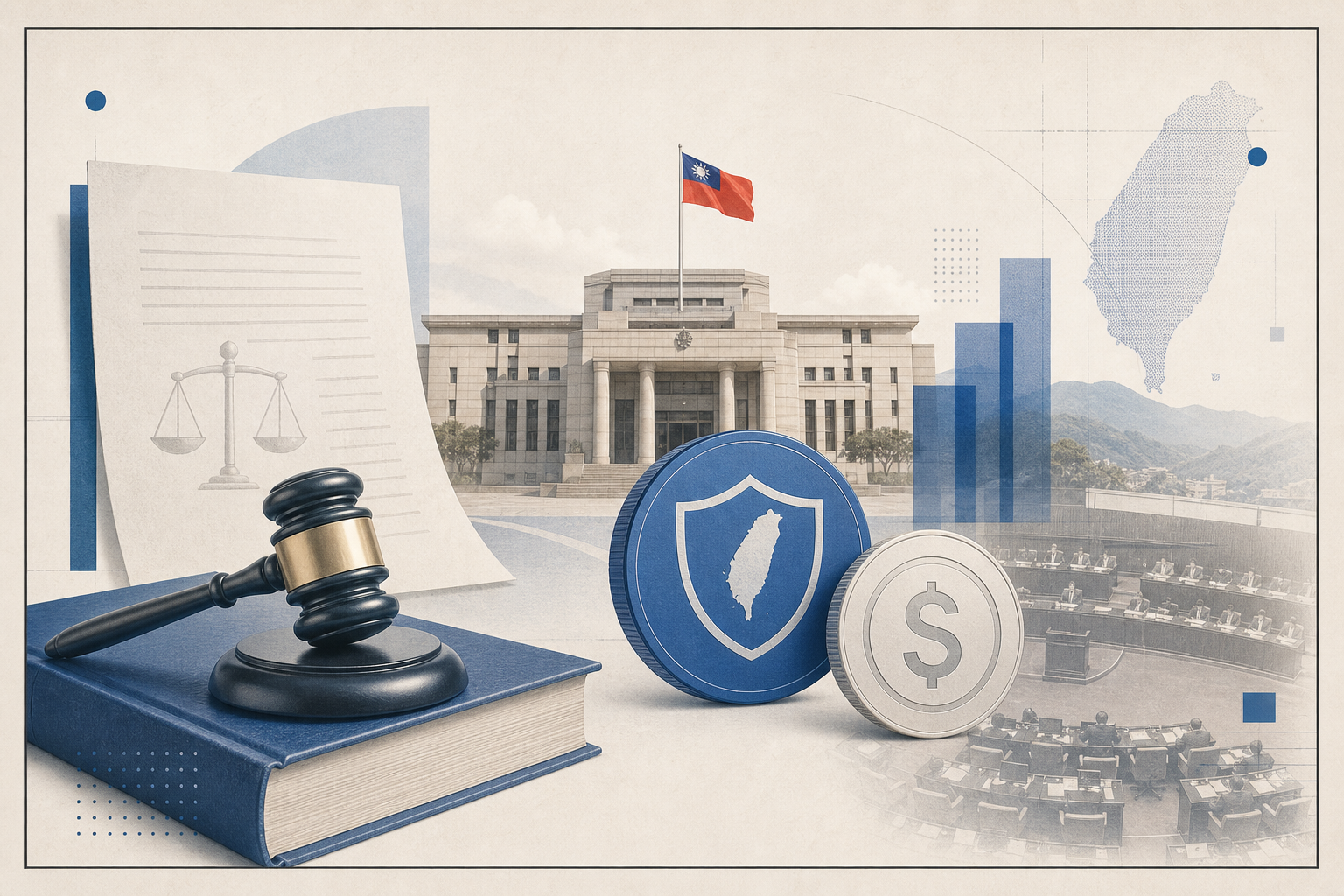
Taiwan has taken a meaningful step toward bringing stablecoins into the perimeter of licensed finance. On June 30, the Legislative Yuan passed the Virtual Asset Service Act, creating a formal supervisory framework for virtual asset service providers and giving the island its first dedicated legal regime for stablecoin issuance. The practical shift is significant: Taiwan is moving from a model centered mainly on anti-money-laundering registration toward one in which operating standards, reserve management, disclosures and market conduct sit under a fuller regulatory rulebook. For RWA and payments infrastructure, that is the part worth watching.
The law gives the Financial Supervisory Commission a much broader role over the sector. According to reporting on the final text and the FSC-backed draft that preceded it, firms will need approval before operating as virtual asset service providers and will have to comply with requirements around internal controls, audit, cybersecurity, business continuity and customer-asset segregation. Coverage extends beyond exchange venues alone. The regime defines multiple categories of service provider, including trading platforms, transfer services, custody, underwriting and lending. Existing firms are not being forced out immediately, but they are being put on a clock: businesses that previously completed AML registration will have 12 months after the law takes effect to apply for licenses and 21 months to secure approval, with only limited room for extension.
Stablecoin issuers face an even tighter standard, and that is where the law intersects most directly with institutional tokenized-finance design. The new framework requires full reserve backing for stablecoins, with reserve assets held separately in trust by domestic financial institutions. Those assets are meant to stay ring-fenced from other creditor claims if an issuer fails, and issuers are expected to undergo regular audits and provide ongoing disclosures. Reporting on the law also indicates that domestic issuance requires approval from the FSC alongside central-bank consent. In other words, Taiwan is not treating stablecoins as lightly regulated software products; it is treating them as liabilities that need bank-grade reserve governance and a clearly supervised issuance pathway.
The penalties reinforce that posture. Running an unlicensed virtual asset business or issuing stablecoins without authorization can trigger prison terms of up to seven years and fines of up to NT$100 million. Fraud and market manipulation carry a still harsher range of three to 10 years in prison, plus fines that can rise to NT$200 million. Those sanctions matter because they show the law is not only about licensing new entrants. It is also about defining a credible enforcement perimeter around custody, issuance and market conduct. That is especially relevant in stablecoins, where trust depends not just on code or branding, but on reserve integrity, legal segregation and the regulator’s ability to shut down noncompliant operators.
The direction of travel did not emerge overnight. When the Executive Yuan approved the draft bill on April 2, it said the goal was to support the development of virtual asset businesses while strengthening financial soundness, segregated custody, anti-fraud controls and investor protection. The final law keeps that balance. It does not amount to a blank check for crypto expansion, and it does not frame stablecoins primarily as a speculative growth category. Instead, it puts the sector on a path where firms that want to participate have to look more like supervised financial operators and less like lightly monitored technology intermediaries.
That design choice places Taiwan closer to the jurisdictions trying to normalize digital-asset activity through licensing rather than informal toleration. Japan, Singapore, Hong Kong and the European Union have all moved in that direction with different emphases, but Taiwan’s contribution is notable because the stablecoin provisions lean so heavily on reserve protection, domestic trusteeship and formal approval channels. Lawmakers also adopted a nonbinding resolution asking the FSC to produce a plan within a year for allowing virtual asset firms to offer crypto derivatives, which suggests the government is thinking not just about containment, but about how the market structure could broaden once the base rules are in place.
For RWA markets, the lesson is straightforward. Stablecoins become more useful to regulated finance when regulators force the issuance model to answer basic balance-sheet questions: who holds the reserves, where are they kept, how often are they tested, and what happens if the issuer breaks. Taiwan’s new law does not instantly create a large institutional stablecoin market, but it does establish the legal scaffolding required for one. Over time, that could make the island more relevant to tokenized payments, treasury workflows and cross-border settlement. In the near term, the more immediate takeaway is that another Asian market has decided stablecoins belong inside an explicit prudential and supervisory framework rather than at the edge of it.