Stellar sees the DTCC link as proof that public blockchains can support institutional tokenization at scale
Stellar Development Foundation CEO Denelle Dixon says DTCC’s decision to connect a tokenized securities platform to Stellar validates years of work on compliance, reliability and institutional tooling. Her argument is that regulation can accelerate tokenization, but large financial firms are already moving because the operating case is becoming clearer.
Original source
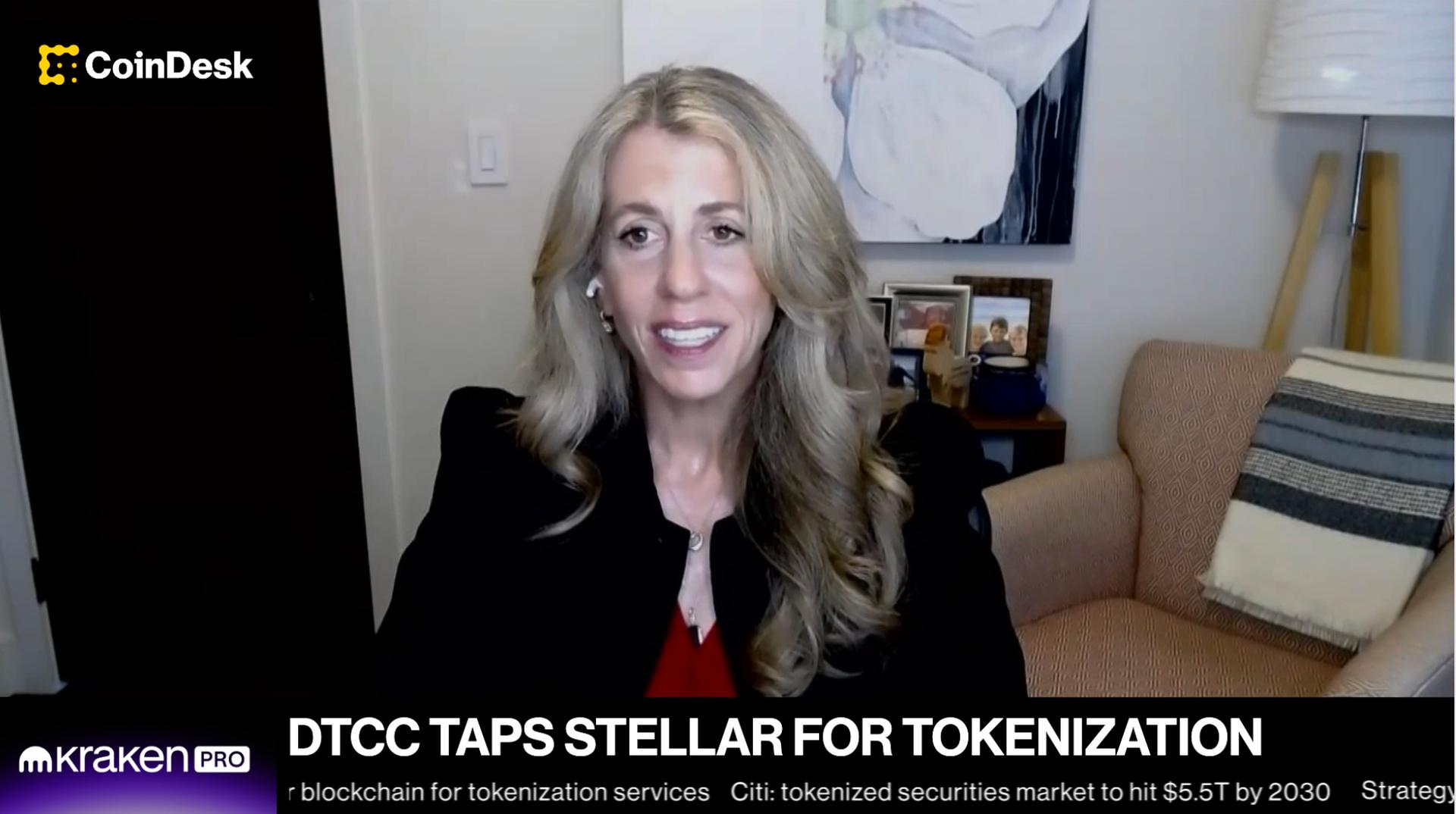
Stellar is using its latest institutional win to make a broader point about the direction of tokenized capital markets. In comments reported by CoinDesk, Stellar Development Foundation CEO Denelle Dixon said DTCC’s decision to connect its upcoming tokenized securities settlement platform to Stellar marks a new phase for public-blockchain adoption in mainstream finance. Dixon described the selection as the kind of moment the network was built for after years spent focusing on compliance, reliability and infrastructure that larger financial institutions would actually require. The announcement matters because DTCC sits close to the center of traditional securities plumbing, and its choice to connect with a public blockchain sends a stronger signal than a small pilot or sandbox exercise.
Dixon’s comments also framed tokenization as a market that now has enough momentum to continue even if U.S. legislation remains unfinished. She told CoinDesk that the GENIUS Act has helped financial institutions gain confidence that Washington intends to support the industry with clearer rules. At the same time, she argued that the market is not waiting for every bill to become law before launching products. As evidence, Dixon pointed to firms such as Franklin Templeton, which already brought a tokenized money market fund to Stellar before the latest regulatory progress. In that view, the Clarity Act would be helpful, but it is not the single switch that determines whether tokenization moves forward. Institutions are increasingly responding to product economics, distribution efficiency and settlement design as much as to statutory milestones.
The network’s recent growth gives Stellar more credibility when making that case. According to Dixon, tokenized real-world assets on Stellar passed $1 billion in December and climbed to roughly $3 billion over the following five months. She said the network has maintained 99.99.99% uptime and processes billions of transactions each quarter, metrics meant to show that public-chain infrastructure can meet operational standards that institutional users expect. Dixon also emphasized that compliance features were designed into Stellar’s architecture rather than added later through custom smart-contract workarounds. That matters for regulated issuers because it can reduce implementation complexity and make it easier to tailor controls to specific product structures.
Privacy and control remain part of that institutional pitch as well. CoinDesk reported that Stellar is developing composable privacy capabilities so firms can adapt disclosure and permissions to different assets and use cases. That approach reflects a wider shift in tokenization strategy. Early experiments often treated blockchains mainly as alternative issuance rails, but institutions now want configurable operating environments that can support issuance, transfer restrictions, reporting and settlement without rebuilding the stack for each product. Dixon’s message was that public networks do not have to be crude or compliance-light to stay open. Instead, she argued that carefully designed public infrastructure can give institutions the flexibility they need while preserving the innovation speed that comes from open developer ecosystems.
Even so, the scale challenge is real. CoinDesk noted that DTCC processed $4.7 quadrillion in securities transactions last year, a reminder that tokenized settlement systems are still operating far below the throughput of incumbent market infrastructure. Dixon acknowledged that volumes will ramp gradually and that no serious institution expects full-scale migration overnight. Reliability during that transition is likely to matter more than headline announcements. If tokenized settlement introduces outages, operational ambiguity or fragmented liquidity, large firms will slow down quickly. That is why Dixon repeatedly tied adoption not just to innovation but to continuity, uptime and the ability to handle institutional standards under production conditions.
Her broader conclusion was that tokenized finance is unlikely to consolidate onto a single chain. Instead, Dixon told CoinDesk that a small group of public blockchains will probably capture most issuance based on their technical strengths and institutional fit. She rejected the idea that one network will own the entire market and argued that open chains should ultimately outperform closed alternatives because they evolve faster through global developer participation. For RWA builders and allocators, that is a useful signal: the competition is moving beyond whether tokenization will happen and toward which networks can turn compliance, settlement and resilience into repeatable operating advantages.