Stablecoin rulemaking is shifting toward the harder question: who polices activity after issuance?
The next U.S. stablecoin policy fight is no longer just about reserve quality or issuer licensing. Banks and crypto market groups are now pressing regulators to decide where compliance responsibility should sit once dollar tokens move into exchanges, wallets and DeFi venues.
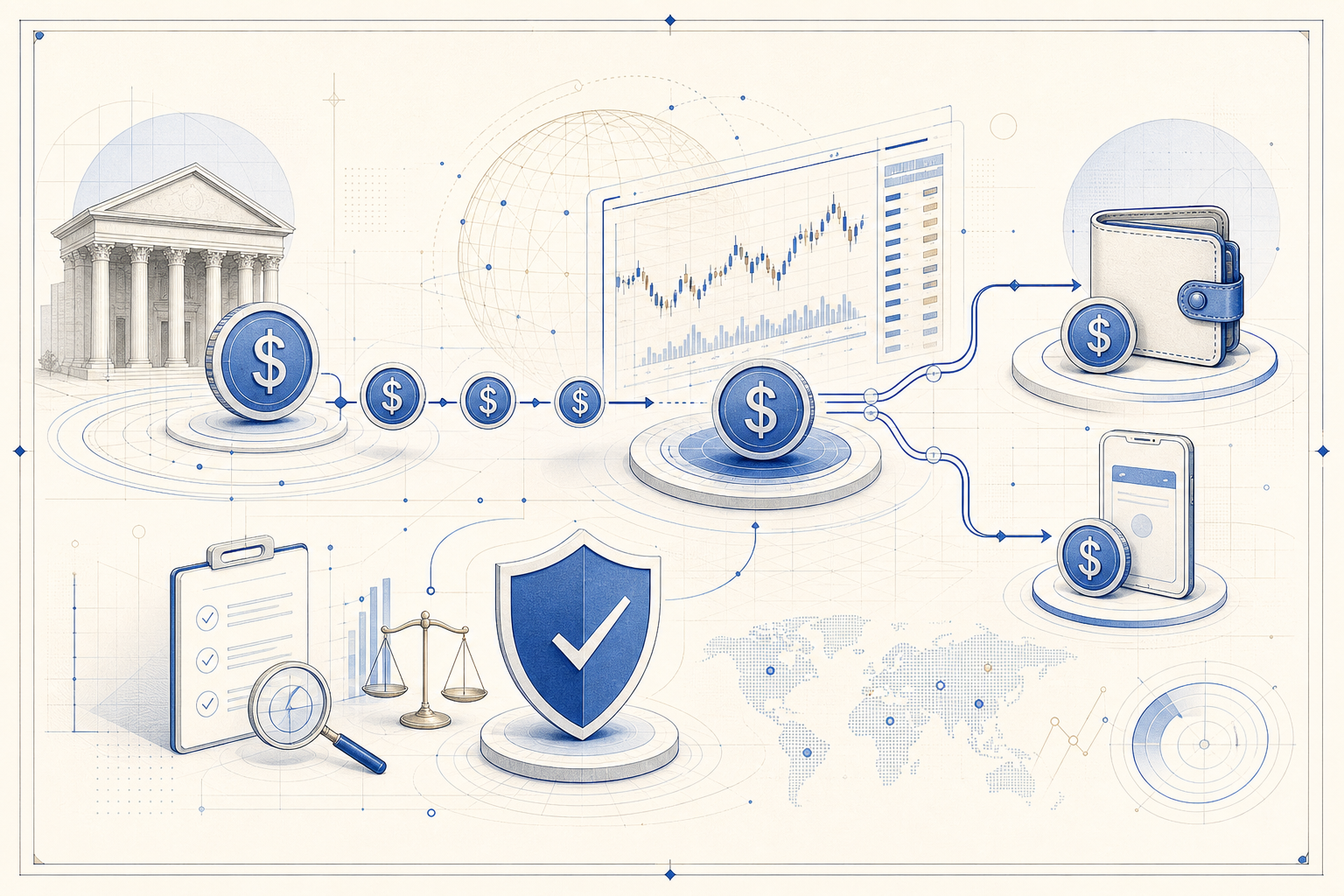
The U.S. stablecoin debate is moving into a more difficult phase. After months of focus on issuer licensing, reserve backing and redemption rules, the live policy question is now what happens after a token leaves the issuer’s hands. That issue moved to the forefront this week as banking trade groups argued that anti-money-laundering and sanctions controls need to address secondary-market stablecoin activity more directly, while crypto-native groups warned that going too far would push regulated dollar tokens away from open blockchain markets. For RWA infrastructure, this is not a side argument. It goes to the heart of whether compliant stablecoins can remain usable as settlement assets across onchain trading, treasury and tokenized-asset workflows.
The bank side of the case is laid out in a June 9 comment letter from the Bank Policy Institute and The Clearing House to FinCEN and OFAC on the proposed U.S. rule for permitted payment stablecoin issuers. The letter says regulators are right to distinguish between primary-market and secondary-market activity, but it also argues that the broader digital-asset ecosystem still does not impose enough comparable obligations on custodians, exchanges, digital-asset service providers and decentralized market participants once tokens circulate beyond the issuer. In plain terms, the banks are saying the riskiest flows often happen after issuance, so any serious compliance framework has to reach beyond the mint-and-redeem perimeter.
Crypto market participants are pushing back from the opposite direction. In their own June 9 submission, Paradigm and the Hyperliquid Policy Center said the final rule should make a sharper distinction between issuer responsibilities and secondary-market activity that issuers do not directly control. Their argument is that stablecoin issuers can reasonably identify and monitor customers at issuance and redemption, but they should not be treated as if they have a direct relationship with every wallet, validator, application developer or protocol user once tokens move through permissionless networks. The concern is operational as much as ideological: if compliance duties become too broad or too ambiguous, U.S.-regulated stablecoins could become less attractive to deploy in open onchain venues.
That tension matters because stablecoins increasingly function as the cash layer for tokenized finance. They are used for spot settlement, collateral posting, treasury transfers, onchain lending, market making and payment flows around tokenized funds and securities. If the rule lands too narrowly, regulators will worry that illicit activity can migrate into secondary-market venues with weaker controls. If it lands too broadly, issuers may respond by limiting chain support, restricting integrations or favoring closed environments where counterparties are easier to identify. Either outcome would shape the practical utility of stablecoins as infrastructure for a broader RWA stack.
The tradeoff is not purely theoretical. The BPI and Clearing House letter explicitly notes that regulators themselves have recognized that much illicit stablecoin activity occurs on the secondary market. Paradigm and the Hyperliquid Policy Center, meanwhile, argue that applying issuer-style obligations across secondary-market activity could create large volumes of low-value reporting while muddying who is actually in a position to monitor or block problematic transactions. Both camps are effectively contesting the same design problem: how to place compliance obligations on the actors that have real operational control without making every layer of blockchain infrastructure behave like a depository institution.
For tokenized-asset markets, the implications are immediate. Stablecoins only work as credible settlement tools if institutions believe they will remain legally durable, operationally available and broadly interoperable across the venues where tokenized assets trade. Treasurers, issuers and market operators do not want to build around a cash instrument that could be functionally fenced off from major DeFi pools, offshore exchanges or self-custodied workflows with each regulatory revision. At the same time, banks and policymakers are unlikely to support large-scale stablecoin settlement if obvious secondary-market blind spots remain unaddressed.
That is why this policy fight deserves more attention than the headline politics usually get. The next generation of stablecoin rules is not just deciding who can issue a dollar token. It is deciding whether regulated stablecoins can serve as open yet supervised market infrastructure after issuance. The answer will influence how comfortably tokenized funds, private-credit products, securities platforms and cross-border payment systems can rely on public-chain cash legs. In other words, the secondary-market debate is quickly becoming a market-structure debate for the entire RWA ecosystem.