Stablecoin FX is getting cheaper, but Borderless says provider routing now matters more than headline spreads
A new Borderless benchmark argues that stablecoin-to-fiat delivery costs have compressed to the point where price leadership is now won less by raw spread and more by routing discipline across providers and corridors. For RWA and payments operators, the report shifts attention from stablecoin adoption headlines to the market structure behind cross-border execution.
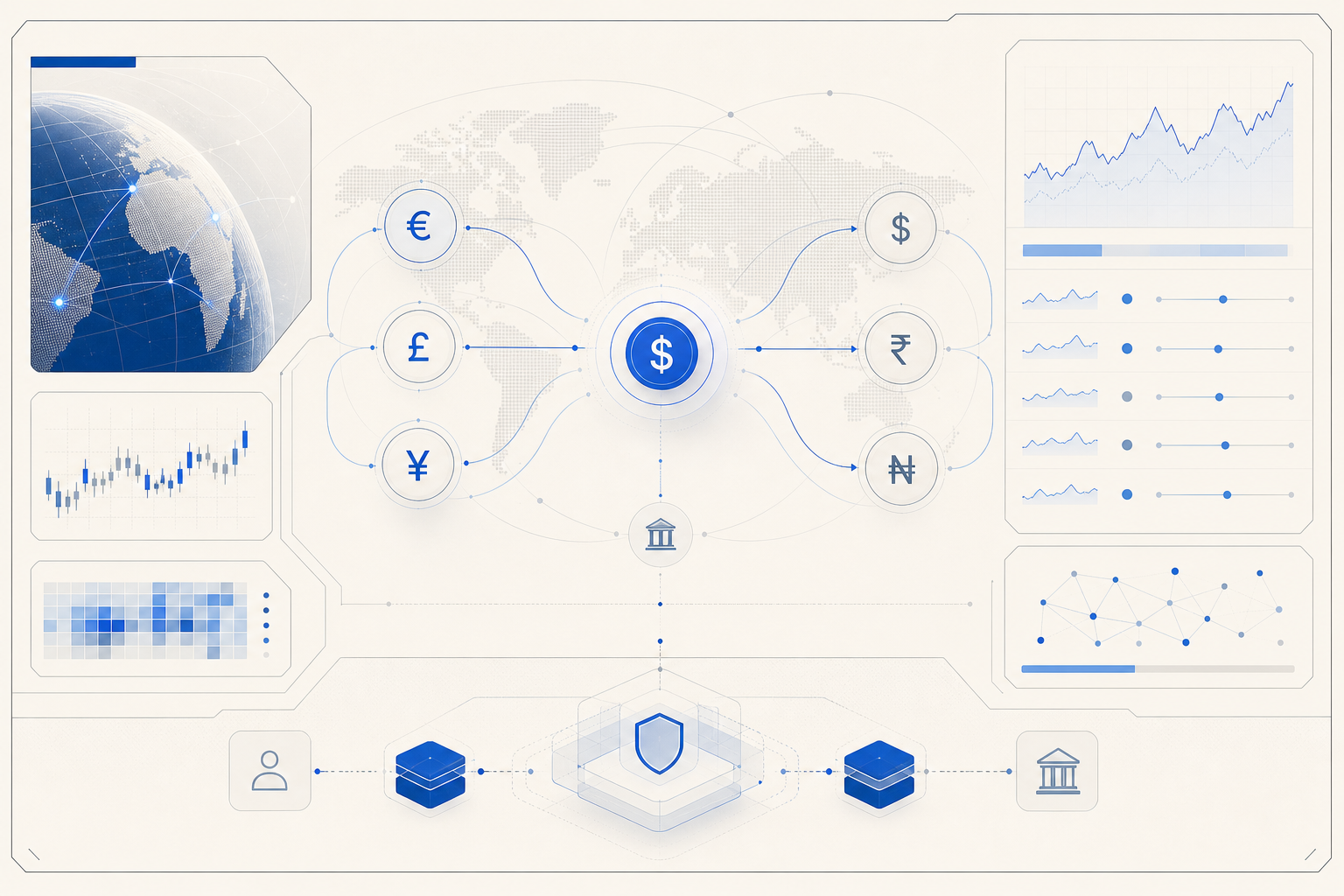
Cross-border stablecoin payments are starting to look less like a novelty pricing edge and more like a market-structure problem. In Borderless’s Q2 2026 benchmark report, published on July 13, the company argues that the cheapest path in stablecoin FX is no longer determined mainly by whether a business uses blockchain rails at all. Instead, the decisive variable is how intelligently that business routes across providers, currencies and corridors. That is an important shift for the broader RWA stack, because once pricing compresses, the advantage moves away from simple stablecoin access and toward the infrastructure layer that decides where a transaction is executed, how many fallback routes exist, and whether treasury teams can move between providers without operational friction.
The headline numbers in the report point to a market that is maturing quickly. Borderless says the median cost of delivering a $10,000 payment across its typical corridor set was 27.2 basis points, or about $27.20, and that this figure has barely moved for five consecutive months. The report also says its so-called parity gap, which compares stablecoin delivery pricing against interbank reference pricing, averaged negative 3.2 basis points in Q2. Read conservatively, that does not mean stablecoin settlement has replaced bank FX in every institutional workflow. It does mean that, on the quoted execution layer Borderless tracks, the historical premium for using stablecoin rails appears to have compressed materially in active corridors.
Where the report gets more interesting is in what it says about the remaining cost. Borderless argues that the larger source of inefficiency now comes from single-provider dependence rather than from the baseline price of stablecoin conversion itself. Its benchmark labels that gap the routing tax and estimates it at 23.3 basis points, or roughly $2,330 per $1 million routed without access to the best available quote over time. In practical terms, the claim is straightforward: if pricing leadership rotates often and a treasury team is connected to only one off-ramp or one preferred execution partner, the business may systematically overpay even after stablecoin spreads narrow. For operators building payment products, that makes orchestration, failover and quote comparison look less like nice-to-have tooling and more like core economic infrastructure.
Borderless’s own methodology helps explain why it frames the market this way. The company describes the benchmark as an open reference built from buy and sell quotes supplied by regulated partner financial institutions across supported stablecoin-fiat pairs, with continuous rate collection through the day and aggregation across multiple providers where they exist. On the benchmark page, Borderless presents the product as a neutral reference for stablecoin FX rather than a trading venue itself, and the Q2 report says the dataset covered more than 260 corridors and 2.96 million rate observations. That does not remove the need for caution: the benchmark reflects the network Borderless has assembled, not the entire global stablecoin market. But it does make the findings useful as a read on how institutional-style payment routing is evolving where regulated on- and off-ramp competition is already reasonably deep.
The operational lesson in the report is that redundancy is becoming a pricing product in its own right. Borderless says major repricings in the quarter were concentrated in corridors where only one provider was available, while corridors with backup providers retained cheaper paths during volatility. That point matters beyond payments specialists. Tokenized treasuries, onchain cash management, merchant settlement and cross-border issuer operations all rely on reliable fiat conversion at the edge of the system. If the cost of getting in and out of stablecoins depends heavily on corridor depth and provider optionality, then the scalability of RWA-linked payment flows will be constrained as much by local distribution and compliance coverage as by the token itself.
For market participants, the report lands at a time when stablecoins are increasingly being judged against traditional treasury workflows rather than against crypto-native benchmarks. Once a product manager or CFO accepts that dollar stablecoins can be a normal settlement tool, the next question becomes whether execution can be audited, benchmarked and optimized like any other financial rail. Borderless is effectively arguing that the sector has entered that phase. The strongest evidence is not simply lower headline cost, but the emergence of measurable concepts such as lead-provider churn, corridor grades and provider-day pricing comparisons. Those are the kinds of signals that suggest a market is becoming operationally legible to institutions.
There is still an important qualifier. The report is not a universal statement that every business should route every cross-border flow over stablecoins today. Corridor coverage remains uneven, the benchmark itself shows quality differences across markets, and compliance, accounting and treasury controls still determine whether cheaper quoted execution translates into production savings. Even so, the direction is clear. In a market where baseline delivery pricing is stabilizing, the competitive edge is migrating toward the software and partnerships that choose the route, preserve optionality and keep backup liquidity live when conditions move.
That is why the Borderless data matters for RWA Trails readers beyond payments alone. Real-world-asset products increasingly depend on programmable cash movement, whether for subscriptions into tokenized funds, collateral transfers, distribution payouts or treasury operations spanning several jurisdictions. If stablecoin FX is now close enough to commodity pricing in the best corridors, then the next build cycle is not about proving that blockchain settlement can be cheaper in principle. It is about building the orchestration layer that makes that cheaper path dependable at scale.