Stablecoins start competing on collateral quality, not just yield
Headline APYs are grabbing attention, but reserve design is becoming the harder competitive edge in onchain dollars. Official materials from Circle, Falcon and Ondo show the stablecoin market converging on a more institutional question: which tokens are backed by assets and structures that venues will actually accept as collateral?
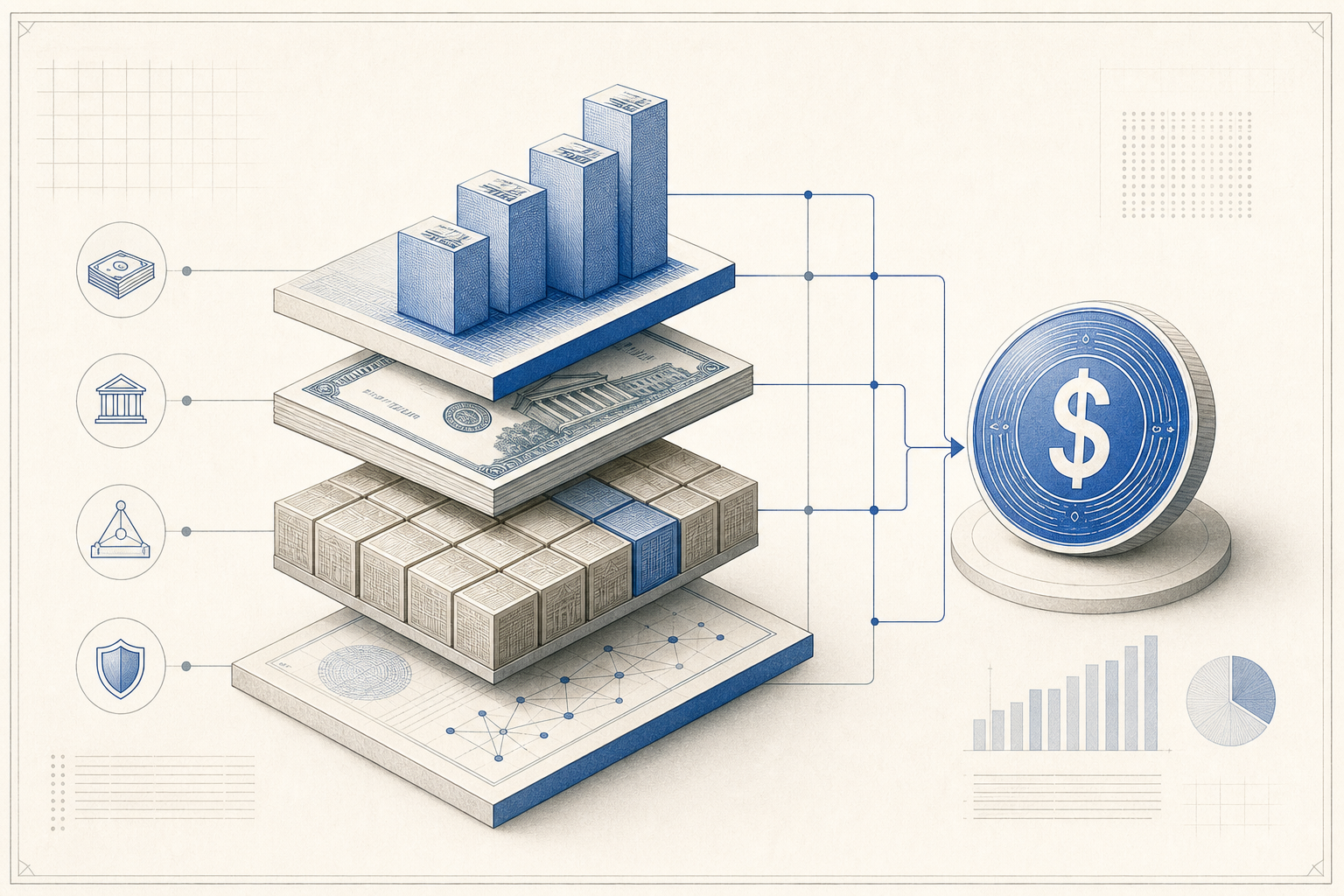
The next battleground in stablecoins is shifting away from headline yield and toward collateral quality. Early growth in dollar tokens was mostly about distribution, redemption and peg confidence. More recently, issuers have tried to stand out by offering users a return on idle balances. That tactic still attracts attention, but it does not answer the question that matters most for exchanges, lenders and treasury desks: what sits underneath the token, how quickly can it be redeemed, and will the market actually treat it as dependable collateral? As onchain dollars move deeper into leveraged trading, settlement and working-capital flows, those infrastructure questions are becoming harder to avoid.
Newer issuers are openly leaning into more complex reserve architectures. Falcon Finance describes itself as a universal collateralization infrastructure that lets users post liquid assets to issue onchain liquidity, while its own site presents USDf as an overcollateralized synthetic dollar and sUSDf as the yield-bearing version. Ethena uses similar language for USDe, describing a synthetic dollar protocol built on crypto rails rather than a classic bank-deposit model. Those products are designed to make dormant collateral productive, but they also push the market beyond a simple one-token-equals-one-dollar framing. The competitive issue becomes the quality, liquidity and risk management of the assets and hedges supporting that dollar claim.
The contrast with the most established reserve-backed model is sharp. Circle’s transparency materials say USDC is redeemable 1:1 for U.S. dollars and that the majority of the reserve sits in the Circle Reserve Fund, an SEC-registered government money market fund managed by BlackRock. Circle also says that fund can hold cash, short-dated U.S. Treasuries and overnight Treasury repurchase agreements, with the remainder of reserves held in cash at major banks. For market makers and venue risk teams, that kind of reserve disclosure is not just comfort language. It is what allows a token to be placed into haircut frameworks, liquidity assumptions and redemption playbooks with fewer unknowns.
Tokenized Treasury products are also moving from end-user investments into the plumbing underneath onchain dollar systems. Ondo describes OUSG as a short-term U.S. Treasuries fund, and its current product materials list BlackRock’s BUIDL and Franklin Templeton’s BENJI among portfolio holdings. That is a meaningful signal for the broader RWA market. Instruments often discussed as standalone tokenized funds are increasingly serving as reserve-style building blocks for treasury management, cash-equivalent allocation and collateral transformation. In practical terms, the stablecoin stack is starting to overlap much more directly with tokenized money-market infrastructure.
Once that overlap deepens, yield becomes a less complete measure of competitive strength. A token can advertise an attractive annualized return and still be operationally weak if lenders apply steep haircuts, if spreads widen under stress, or if chain mobility and redemption windows remain uncertain. By contrast, a token with modest or even no embedded yield can become strategically sticky if it is easy to move across venues, broadly accepted as margin and backed by reserve assets that outside risk committees already understand. The stablecoins that matter most in institutional workflows are likely to be the ones that function as working capital, not merely as parked balances with a coupon attached.
That is why reserve composition is becoming a distribution issue as much as a balance-sheet issue. A venue deciding whether to accept a token as collateral is effectively underwriting its redemption path, legal structure, settlement reliability and price stability. Treasury teams make a similar judgment when choosing where to keep excess onchain dollars. As banks, brokers and exchanges continue wiring stablecoin rails into mainstream products, those internal risk reviews are likely to become more formal and more demanding. The result should be a market in which collateral eligibility, not promotional APY, becomes the harder moat to win.
For RWA builders, the implication is straightforward. The next phase of stablecoin competition will not be decided only by who can advertise the best yield, but by who can combine transparent reserve assets, clear redemption mechanics and broad venue acceptance into a dollar instrument that actually circulates. That is good news for first-party tokenized Treasury products such as BUIDL and BENJI, because their role may increasingly extend beyond being investable wrappers. They are becoming part of the trust layer that determines which onchain dollars are usable across the financial system.