Spiko Opens Its UCITS Treasury Funds to Stablecoin Funding on Base
Spiko has added USDC and EURC subscription and redemption rails to its euro and dollar Treasury-bill funds, bringing stablecoin settlement into a regulated UCITS wrapper without changing the funds’ dealing cycle. The move is an important test of whether tokenized cash management products can meet institutional treasury workflows more natively than bank wires.
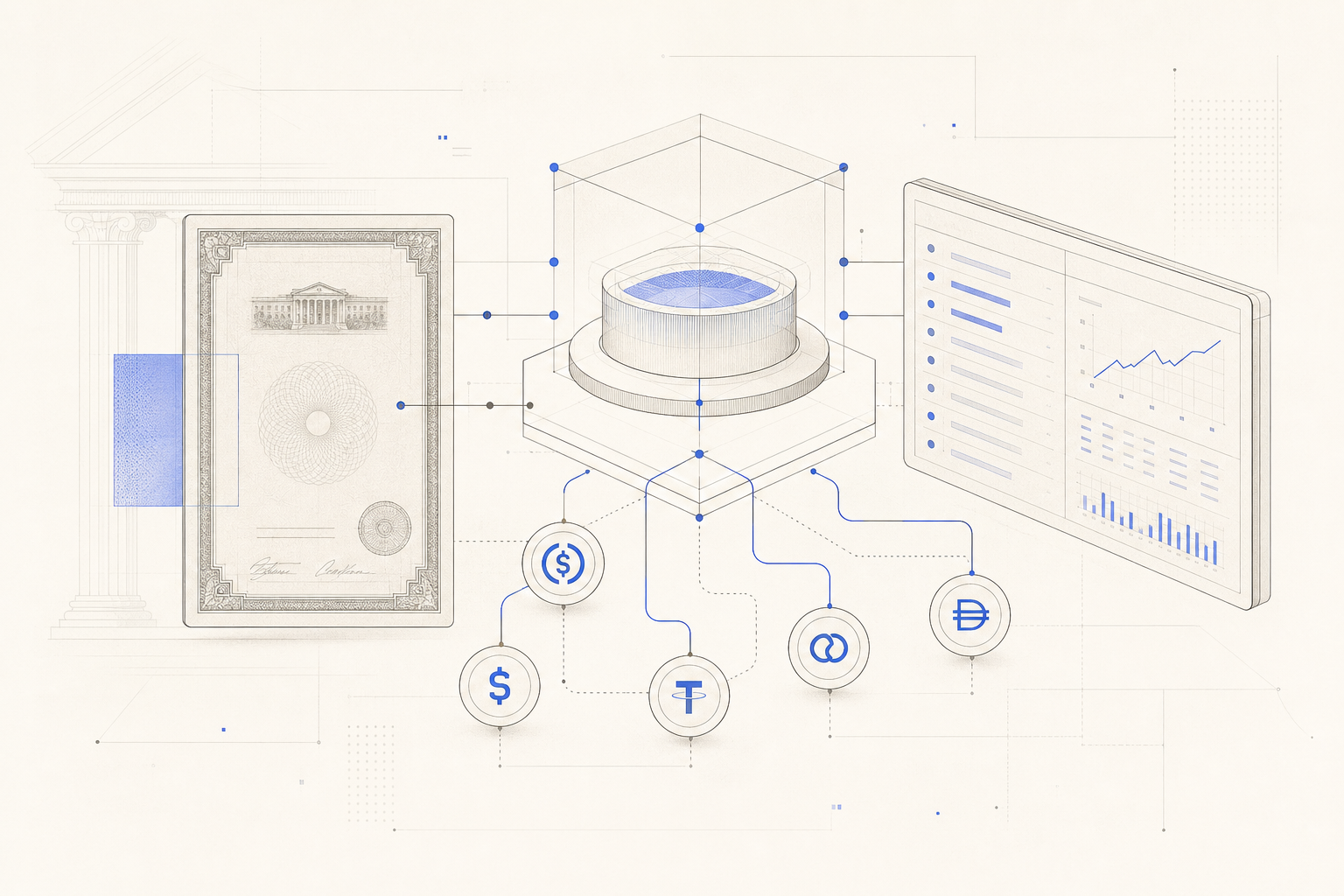
Spiko has added stablecoin payment rails to two of its regulated Treasury-bill money market funds, giving eligible investors a way to subscribe and redeem with USDC and EURC instead of relying only on traditional bank transfers. The integration runs through Coinbase Payments and settles on Base, extending onchain access to Spiko’s euro and dollar UCITS vehicles while leaving the underlying funds inside a conventional regulated structure. For the tokenized fund market, the significance is not simply that another manager supports stablecoins. It is that a regulated fund wrapper is beginning to treat blockchain-based dollars and euros as an operational funding rail rather than as a separate crypto product.
According to Spiko’s published product update, the change applies to the firm’s EU T-Bills Money Market Fund and US T-Bills Money Market Fund. The company says those vehicles are UCITS funds, approved by the French AMF and overseen with CACEIS as depositary, and that admitting Coinbase as a payment provider at the fund level required nearly two years of work. Spiko describes the rollout as the first time UCITS funds have accepted native stablecoin payments directly for subscriptions and redemptions. That claim matters because UCITS is one of Europe’s most established fund frameworks for investor protection, distribution and operational discipline, so changes to cash movement standards inside that wrapper carry broader signal than a standalone crypto-native launch would.
The operating detail is also important. Coinbase said the integration provides the payment, wallet and API layer for the flows, and that transfers settle over Base. But the faster transfer leg does not turn the funds themselves into 24/7 dealing products. Spiko makes clear that the stablecoin option changes the funding method, not the legal or portfolio mechanics of the funds. Investors can send money at any time, including outside banking hours, yet subscriptions and redemptions still remain subject to the funds’ own processing and liquidity timetable. In practice, that means the innovation is best understood as compression of operational friction at the edges of the fund rather than a wholesale rewrite of regulated money market fund operations.
That distinction is precisely why the launch is relevant for the RWA stack. A large part of the tokenized asset thesis depends on improving the path between idle cash, collateral and regulated investment products. Stablecoin rails can remove delays tied to cross-border wires, cutoff windows and banking holidays, but most institutional products still settle through traditional transfer processes. By inserting stablecoins into the subscription and redemption workflow without changing the regulated fund core, Spiko is testing a more incremental model: keep the fund wrapper familiar, but modernize how capital enters and exits it. If that pattern holds, other asset managers may not need to redesign products from scratch to capture some of the efficiency gains associated with tokenization.
The broader market backdrop is supportive. EFAMA said UCITS net sales rebounded to 104 billion euros in April 2026 after net outflows in March, with money market funds contributing 34 billion euros of inflows. Earlier EFAMA data for full-year 2025 showed UCITS net sales reached a record 828 billion euros, with bond funds and money market funds among the main beneficiaries. Those numbers do not prove demand for onchain settlement by themselves, but they do show that Europe’s regulated fund ecosystem remains deep and highly active. For tokenized distribution models, that matters more than headline crypto volumes, because the opportunity is not just to issue digital wrappers around assets. It is to plug new rails into fund categories that already move meaningful institutional cash.
The competitive implication is that tokenized treasury products are starting to differentiate on workflow, not only yield or legal structure. Over the last year, much of the market conversation has focused on assets under management in tokenized Treasury funds and money market strategies. Spiko’s rollout points to a different battleground: how quickly users can move between stablecoin balances and regulated low-duration yield products, how much operational handoff is eliminated, and whether treasury teams can treat tokenized funds as part of a programmable cash stack. If onchain treasurers can move from wallet-held dollars to regulated fund exposure with fewer intermediaries, that could expand the practical addressable market for these products beyond crypto-native asset allocators.
For RWA infrastructure builders, the launch is a useful proof point because it joins three layers that are often discussed separately: regulated fund manufacturing, licensed custody and payment oversight, and public-chain settlement rails. It does not eliminate all of the timing, compliance or eligibility constraints that govern institutional funds. But it does show that stablecoins can be integrated into a mainstream fund subscription process without discarding regulatory guardrails. If more European managers follow that path, the next phase of tokenized funds may be defined less by putting assets onchain and more by making the surrounding cash and transfer machinery behave like the internet.