SpaceX’s $135 IPO sets a live benchmark for tokenized equity rails
SpaceX’s official IPO price gave tokenized stock venues a real cash-market reference point on day one. That matters because the next test for onchain equities is no longer whether demand exists, but whether tokenized wrappers can match public-market ownership, redemption and settlement standards.
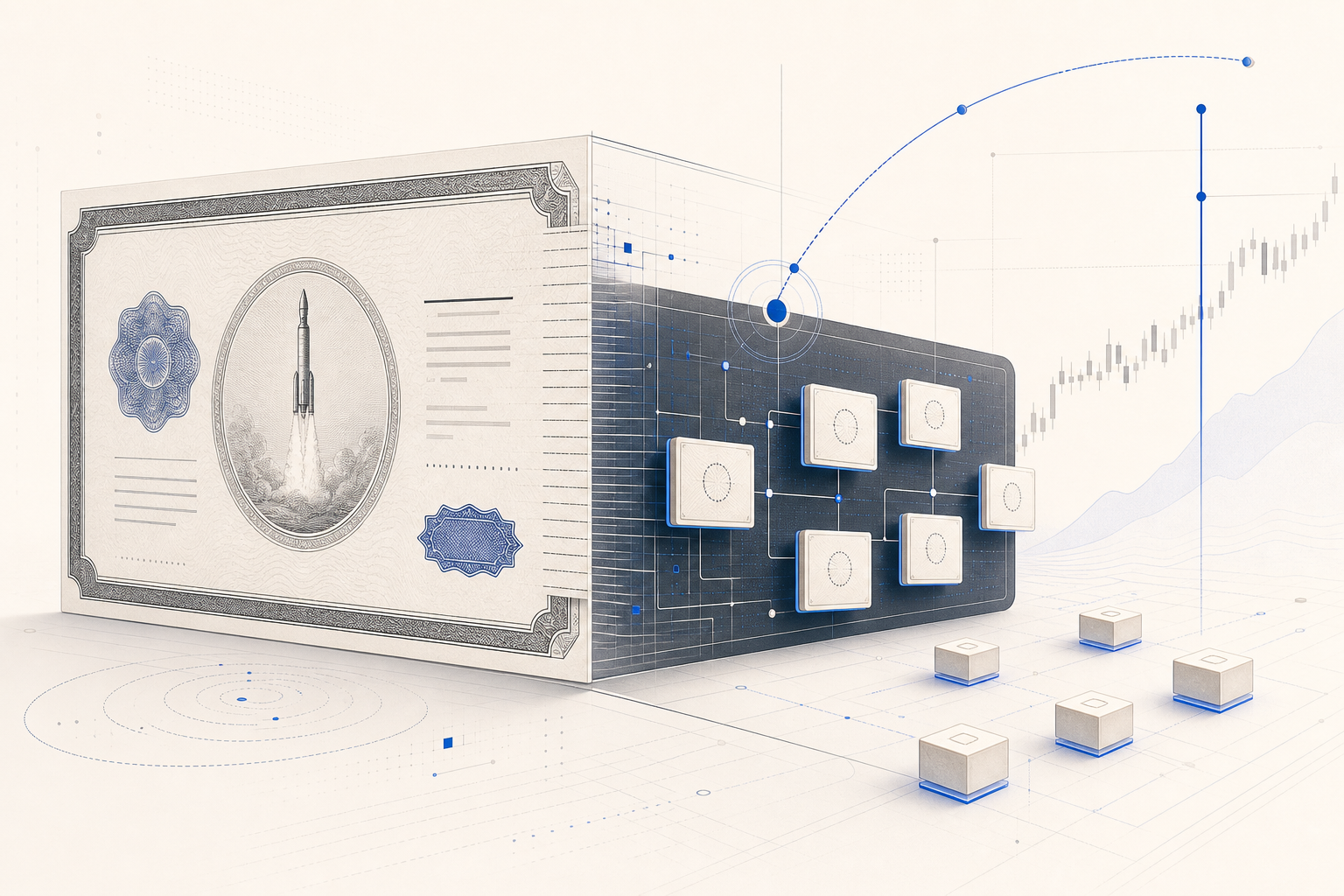
SpaceX’s decision to price its initial public offering at $135 a share did more than set terms for the largest listing in recent memory. It also gave tokenized equity platforms a hard opening benchmark against which their own market structure could be judged in real time. For RWA builders, that is the more important signal. Once a company of this scale enters public trading with a fixed offer price, blockchain-based wrappers are no longer trading around rumor, synthetic sentiment or private-market guesswork alone. They are being measured directly against a live public-market security with a known reference price, known trading venue and known settlement timetable.
According to SpaceX’s pricing announcement, the company offered 555,555,555 Class A shares at $135.00 each, implying roughly $75 billion in gross proceeds. The shares were scheduled to begin trading on Nasdaq and Nasdaq Texas under the ticker SPCX on June 12, with closing expected on June 15, subject to standard conditions. That matters for tokenized markets because it turns a pre-IPO narrative into an execution problem. Once official terms are public, the question stops being whether crypto traders want exposure and becomes whether tokenized infrastructure can carry that exposure in a way that remains legible to investors used to brokerages, transfer controls and predictable redemption mechanics.
Backpack is one of the firms trying to answer that question with a structure that goes beyond simple price tracking. In its product materials, the company says investors can hold SpaceX exposure in two forms: as traditional securities through Backpack Securities, or as tokenized securities on Solana that can be redeemed back into the corresponding security entitlement. Backpack describes those traditional holdings as rights supported by conventional brokerage, custody, clearing and transfer infrastructure, while the tokenized form adds self-custody, wallet transfers, DeFi compatibility and 24/7 trading. That distinction is important because many tokenized stock products in crypto have historically offered only contractual price exposure, often with cash settlement and limited portability.
Backpack’s own description of tokenized SPCX makes the design ambition explicit. The firm says the tokenized security is redeemable for the underlying SpaceX position through its brokerage stack and that dividend and corporate-action handling is supported across both ownership models. In practice, that means the product is trying to preserve a recognizable securities ownership framework while extending distribution onto Solana. If that model holds operationally, it gives tokenized equities a stronger institutional argument than wrappers that only mirror price. A redeemability path, however controlled, is what starts to narrow the gap between an onchain trading instrument and a marketable security that traditional investors can underwrite, account for and reconcile.
The broader significance is that official IPO pricing now exposes where tokenization efforts are genuinely improving access and where they are still mostly improving optics. When the underlying public-market asset has a transparent offer price and regular-way listing, tokenized venues have to prove that their quoted prices, custody claims and redemption promises stay coherent under stress. They also have to prove that users understand what they own. Ondo’s public documentation for its own tokenized stock platform makes a similar point in a different way: tokenized equities need clear disclosures around economic exposure, trading hours, eligibility, dividend treatment and the exact relationship between the token and the underlying instrument. SpaceX’s debut puts those disclosure and infrastructure questions under a much brighter spotlight.
That is why this listing matters beyond one high-profile tech name. Tokenized equities have often been discussed as a future product category waiting for a catalyst. A marquee IPO with immediate onchain distribution turns that thesis into something more concrete. Market operators can now compare price formation between traditional books and blockchain venues, test whether redemptions and conversions are smooth, and watch how investors value portability versus conventional brokerage protections. Regulators and institutions, meanwhile, get a cleaner case study of what tokenized stock products actually promise when they are launched alongside a newly public U.S. equity rather than long after secondary-market trading has settled.
The near-term conclusion is not that tokenized equities have solved distribution, compliance or settlement. It is that they have moved into a phase where those claims can be checked against a real, liquid and widely watched public-market event. SpaceX’s $135 pricing gave the market that benchmark. What follows from here will determine whether tokenized stocks are mainly alternative wrappers around familiar assets, or whether they can become durable financial rails that combine public-market ownership standards with the programmability and global reach that onchain investors expect.