South Korea sets 2027 pilot for tokenized government bonds tied to wholesale CBDC rails
South Korea has set a 2027 pilot for tokenized government bonds linked to the Bank of Korea’s wholesale CBDC infrastructure, bringing sovereign debt tokenization into the country’s formal market-modernization agenda. The move matters because it combines legal reform, central-bank settlement design and blockchain interoperability planning on a single timeline.
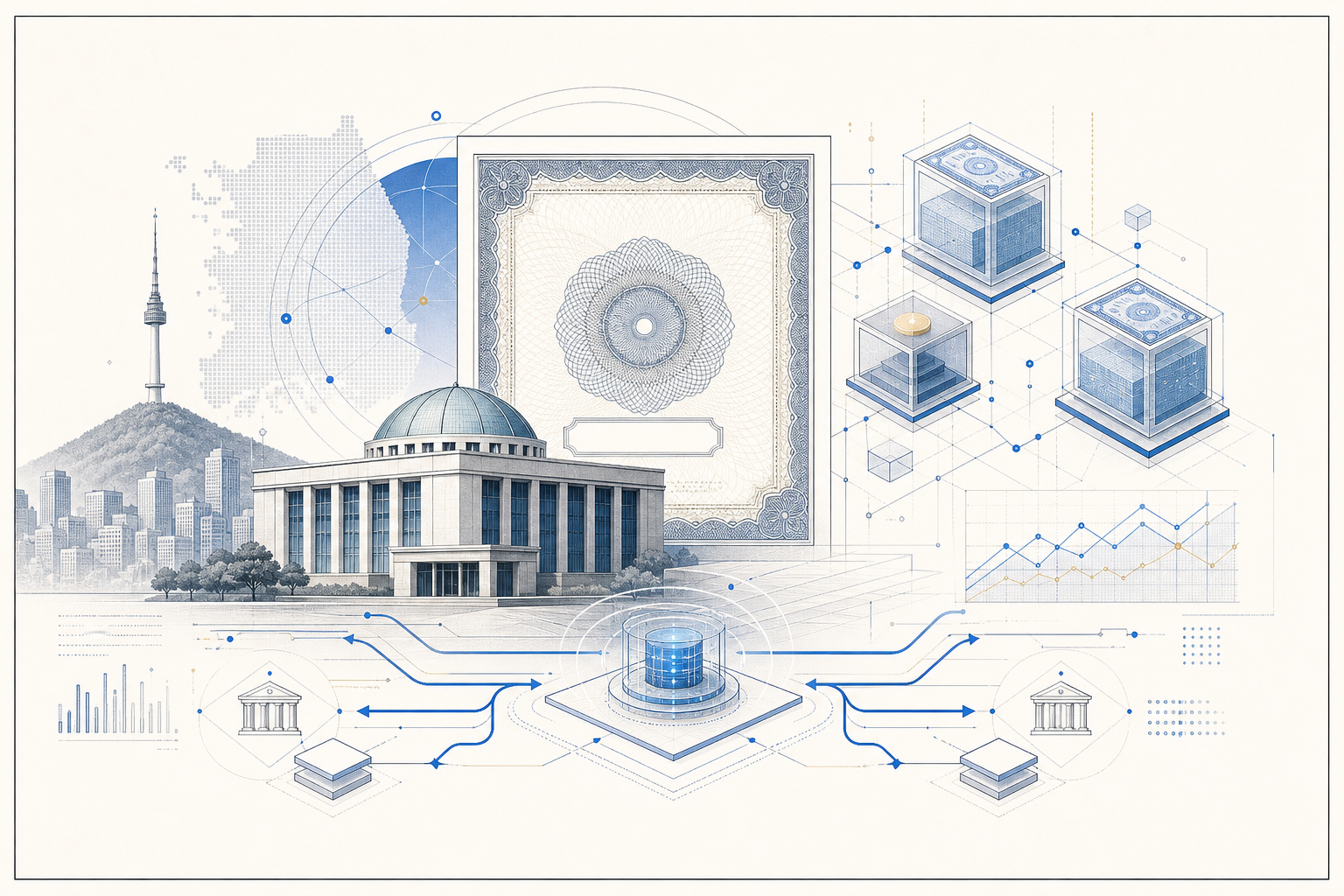
South Korea has put a date on one of the more consequential sovereign tokenization experiments now on the global roadmap. In its second-half 2026 economic growth strategy, the government said it plans to run a 2027 pilot that links tokenized government bonds to the Bank of Korea’s wholesale central bank digital currency infrastructure. That matters because it shifts the discussion from general support for blockchain-based finance to a concrete timetable for testing whether sovereign debt can move through a regulated, programmable settlement stack built around central bank money. In practical terms, the pilot would take tokenized bonds out of the proof-of-concept stage and place them inside the country’s formal market modernization agenda.
The policy signal is larger than the headline date. The strategy also says authorities will study how to make the Bank of Korea’s CBDC infrastructure interoperable with other blockchains, a step that could determine whether the eventual market design stays inside a tightly controlled permissioned environment or can connect with external distributed ledgers under defined rules. The same strategy frames the bond work as part of a broader push to develop a “blockchain economy,” including support for large-scale demonstrations and digital-asset technologies in the second half of 2026. What officials have not yet disclosed is equally important: the government has not identified which bond lines would be tokenized, how large the pilot would be, which institutions would participate or whether the test would cover issuance, secondary trading, post-trade settlement, or some combination of all three.
The institutional logic for the pilot has already been sketched by Bank of Korea Governor Hyun Song Shin. In a paper prepared for the ECB Forum on Central Banking 2026, Shin and his co-authors described Project Hangang as a practical implementation of a unified ledger architecture in which tokenized central bank money, tokenized bank deposits and tokenized assets can coexist on the same programmable platform. The paper says Project Hangang has already conducted live retail transactions involving about 80,000 users using tokenized deposits settled in tokenized central bank money. It also explicitly lists the next agenda as extending the system toward tokenized government bonds and broader capital-markets use cases.
That architecture matters because government securities are not just another asset class. In wholesale finance, sovereign bonds are foundational collateral for repo, liquidity management and central bank operations. The ECB forum paper argues that if wholesale CBDC and government bonds sit on the same ledger, delivery-versus-payment can occur atomically in a single transaction rather than through separate messaging, clearing and settlement steps. It also notes that collateral checks and updates to collateral pools could be automated through smart contracts, potentially improving the timeliness of intraday liquidity provision. For RWA markets, that is the real prize: not only digitizing the bond itself, but making settlement, collateral mobility and post-trade workflows materially more efficient inside a regulated framework.
The legal rails are moving in parallel. South Korea’s financial authorities have already laid out a path for tokenized securities to enter the mainstream capital-markets rulebook. The country’s amended Capital Markets Act and Electronic Securities Act are scheduled to take effect on Feb. 4, 2027, recognizing distributed ledgers as valid securities registries and allowing regulated issuance and circulation of tokenized securities. Officials have also said subordinate rules and guidelines for tokenized securities are due before that date, alongside work on market infrastructure. That sequence is critical: a bond pilot tied to wholesale CBDC only becomes durable if the registry, issuance, custody and transfer rules are settled in advance rather than improvised around a single demonstration.
There are still meaningful design risks. The same Bank of Korea paper warns that faster and more continuous settlement can transmit stress more quickly through the system, and that smart-contract, liquidity and data-oracle risks become more important when assets and money are synchronized on programmable rails. It also notes that Project Hangang’s digital ledger and the central bank’s existing payment system do not yet communicate in real time, highlighting a practical integration challenge that many tokenization initiatives face. Interoperability is therefore not a cosmetic feature. It is the difference between a closed pilot that proves a narrow workflow and a market structure that can eventually support repo, collateral reuse, fund distribution and cross-platform settlement at scale.
For the wider RWA sector, South Korea’s timeline is notable because it joins three pieces that are often discussed separately: sovereign debt tokenization, central-bank settlement infrastructure and securities-law reform. Many markets have advanced one or two of those elements, but fewer have aligned all three on an official schedule. If the 2027 pilot moves ahead on time, it would give investors and infrastructure providers an early look at how tokenized public debt might function when the money leg, the legal registry and the operational workflow are designed together. The most important takeaway is not that the model is finished, because it plainly is not. It is that South Korea is now treating tokenized government bonds as a capital-markets buildout problem with a policy timetable, not simply a technology experiment.