Securitize makes the case for tokenized equities as the RWA market’s next growth leg
Securitize CEO Carlos Domingo says listed equities and ETFs, not just tokenized Treasuries, may be the asset class that carries real-world assets into the trillions. The thesis depends on whether blockchain rails can support actual ownership rights and regulated market infrastructure, not just synthetic exposure.
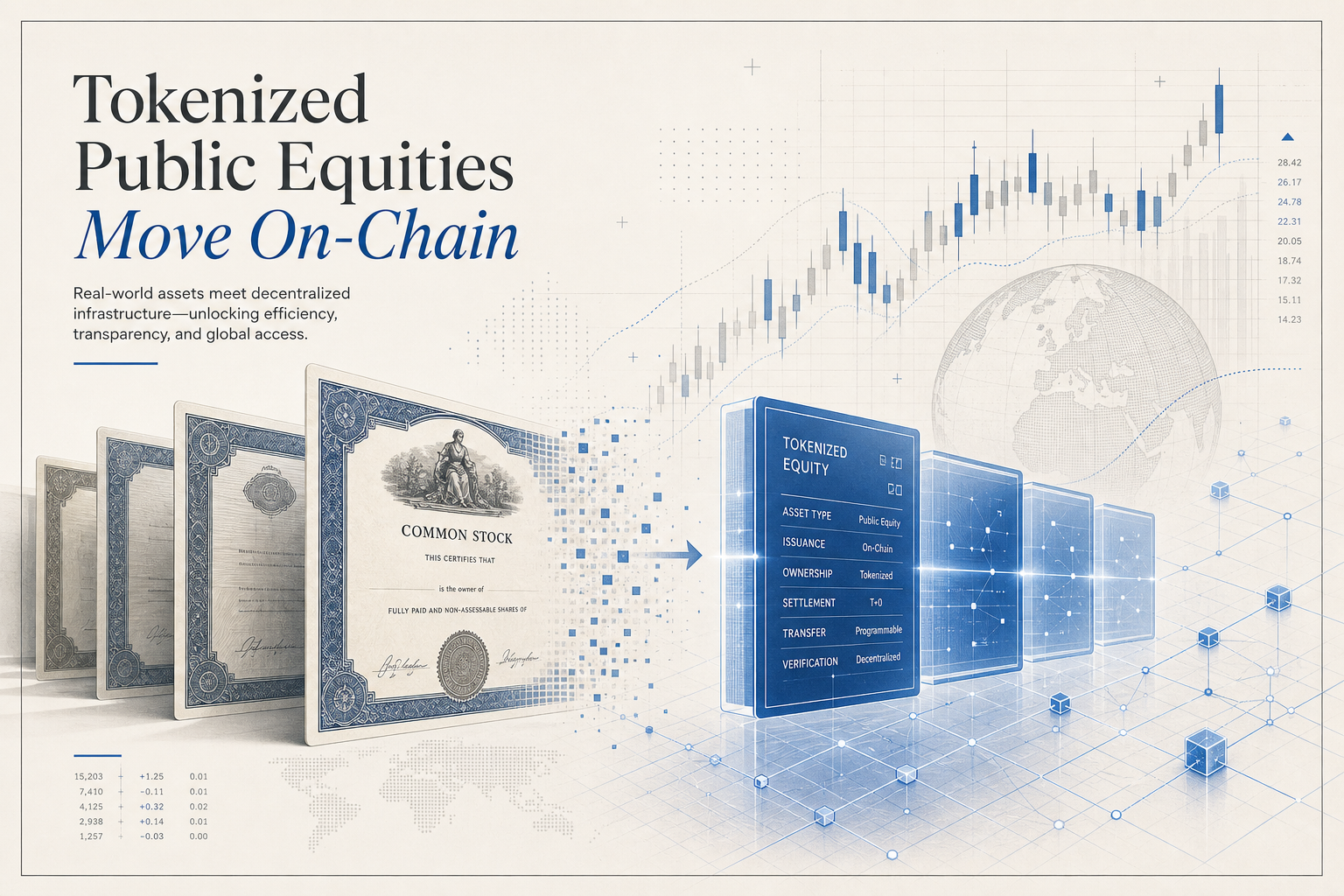
Tokenized Treasuries and private credit have carried most of the real-world asset narrative so far, but a fresh argument is emerging around what could broaden the category far beyond its current base. At an industry panel in New York on Tuesday, Securitize chief executive Carlos Domingo said the bigger long-term opportunity may sit in public equities and exchange-traded funds, not just yield-bearing instruments already familiar to crypto-native investors. His framing matters because it shifts the RWA discussion from niche balance-sheet products toward one of the largest and most operationally demanding pools of traditional financial assets.
The basic math behind the claim is straightforward. Global equity and ETF markets are vastly larger than the tokenized Treasury and private credit segments that dominate today’s onchain asset mix. Domingo’s argument was that only a low-single-digit share of those listed markets would need to migrate onto blockchain rails for tokenized securities to move into multi-trillion-dollar territory. That is still a projection rather than a near-term forecast, but it captures why market structure participants keep returning to tokenized stocks as a potential second wave for the sector after the first wave proved demand for onchain wrappers around cash-equivalent and fixed-income instruments.
What makes the thesis more than conference-stage speculation is that Securitize is positioning around listed securities infrastructure rather than talking about tokenization in the abstract. The company’s public materials now include a tokenized public stocks platform describing blockchain-based trading with faster settlement and always-available transfer rails, while its broader institutional product stack remains centered on regulated issuance, transfer restrictions and lifecycle tooling for real-world assets. That matters because tokenized equities are not simply another wallet-based interface for price exposure. If the category is going to expand inside regulated markets, the operational stack has to handle ownership records, transfer controls, investor eligibility and corporate action workflows with the same rigor expected in conventional securities operations.
That distinction also explains why Domingo drew a line between true tokenized shares and synthetic stock exposure. A large share of the market’s early “tokenized equity” experiments gave users economic exposure through derivatives, contractual claims or offshore structures rather than direct ownership in the underlying security. For institutional allocators and market infrastructure providers, that difference is decisive. The upside case for tokenized stocks depends on whether blockchain settlement can be attached to actual securities rights such as dividends, voting, transfer records and cap table integrity, not just to price tracking products that look equity-like on a trading screen.
There are also signs that Securitize is trying to build from a more permanent market position than a pilot-only RWA vendor. The company recently announced plans to become a public company through a business combination with Cantor Equity Partners II at a stated $1.25 billion valuation, a step that puts added weight behind its claim that public-market tokenization is becoming strategic infrastructure rather than a side experiment. Going public does not guarantee adoption, but it does signal that investors expect tokenization providers to sit closer to the core plumbing of asset issuance, servicing and distribution over time.
Even so, the path from thesis to scale is still constrained by regulation, market structure and investor protections. Tokenized equities touch broker-dealer rules, transfer agent responsibilities, exchange connectivity, settlement finality, disclosure standards and jurisdiction-specific restrictions around who can hold what and where those instruments can trade. Public blockchains may offer the always-on transfer layer and programmability that tokenization advocates want, but the winning model will likely be the one that can preserve compliance and legal certainty without re-creating so much friction that the efficiency case disappears. That is why infrastructure partnerships, custody design and transfer governance may matter more over the next year than headline market-size estimates.
The near-term implication is not that trillions of dollars in listed securities are about to move onchain overnight. It is that the RWA market may be approaching a transition from proving tokenization works for conservative yield products to testing whether it can support mainstream capital-markets instruments at scale. If firms like Securitize can show that onchain equities can carry real ownership rights while improving settlement speed and distribution, tokenized stocks could become the category that pushes RWA from a fast-growing specialty segment into a broader market-structure conversation.