SBI assembles the pieces of an Asia-focused digital asset corridor
SBI’s Coinhako acquisition looks bigger than an exchange deal: it adds a regulated Singapore hub to a broader push spanning tokenized Japanese equities, stablecoin settlement and onchain market infrastructure. Together, the moves show SBI trying to build a compliant digital-asset corridor between Japan and Southeast Asia.
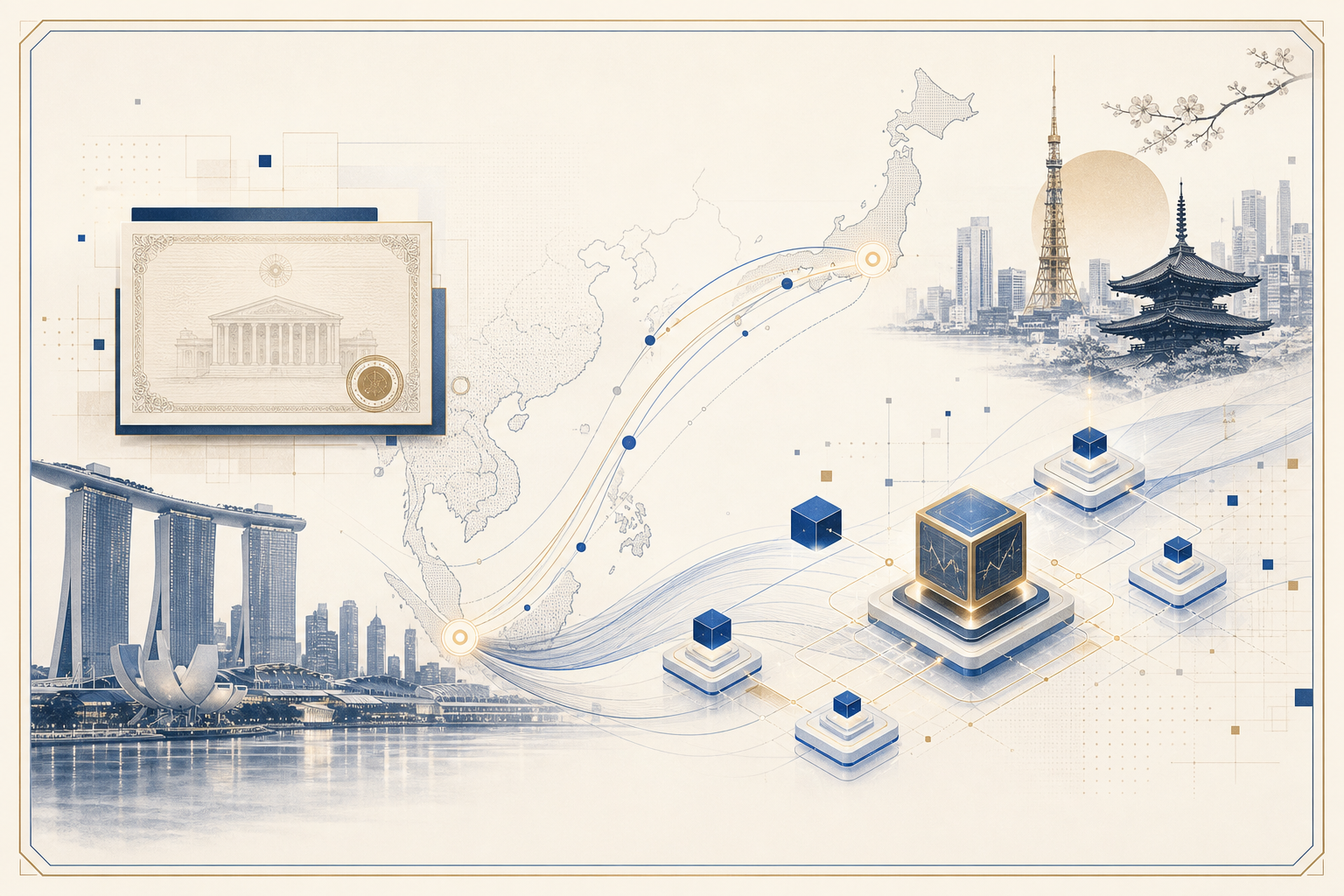
SBI Holdings has turned a week of separate announcements into a clearer strategic signal: the Japanese financial group is trying to assemble a regulated cross-border distribution and settlement corridor for digital assets across Asia. Its newly disclosed majority acquisition of Singapore-based Coinhako, completed after Monetary Authority of Singapore approval on July 16, matters less as a standalone exchange deal than as a piece of market structure. With a licensed Singapore venue, a domestic Japanese financial base and parallel work on tokenized securities and stablecoins, SBI is moving toward an integrated stack for issuing, moving and distributing onchain financial products.
The Coinhako acquisition gives SBI a stronger operating foothold in one of Asia’s most important digital-asset jurisdictions. In its announcement, SBI said Coinhako becomes a consolidated subsidiary through its Singapore unit SBI Ventures Asset after the required MAS approval for the capital injection and share acquisition. SBI described Singapore as a vital hub in its digital-asset strategy and said the combination should help extend a global corridor for digital assets originating from Japan and Southeast Asia. That matters because Singapore offers both regulatory legitimacy and regional reach, two ingredients that institutions will likely require before tokenized products can scale beyond pilot programs.
The more direct RWA angle comes from SBI’s partnership with Ondo Finance, announced this week, to bring Japanese equities onchain and distribute Ondo tokenized products across the SBI ecosystem. The two companies said they plan to work on the tokenization and distribution of Japanese assets, while also using SBI’s JPYSC stablecoin for onchain settlement and collateral. That pairing is notable. It suggests SBI is not only interested in owning access points such as exchanges, but also in linking tokenized issuance to a native settlement rail and then pushing those products through a large domestic and regional customer base. In other words, the strategy is aimed at the plumbing of onchain capital markets, not only the storefront.
A third announcement fills in another layer of that buildout. SBI said its collaboration with the Solana Foundation will expand through SBI R3 Japan, which is planned to be renamed SBI Solana Global, with a mandate that includes supporting stablecoin issuance, structuring and distributing tokenized real-world assets, developing cross-border settlement infrastructure and serving institutional investors. The company explicitly listed corporate bonds, commercial paper, funds and real estate among the asset classes it wants to support. Taken together with the Ondo arrangement and the Coinhako acquisition, the picture is of a group trying to control multiple stages of the value chain: product creation, blockchain distribution, trading access and payment or collateral rails.
There are still meaningful constraints. SBI’s own statement on Coinhako said JPYSC is being advanced with Startale as Japan’s first trust-type yen stablecoin, but current functionality remains narrower than the long-term ambition. The company has said JPYSC is not yet available for withdrawal to external wallets and does not yet operate as an open public-blockchain settlement asset. That limitation means the settlement side of SBI’s thesis is still partially internalized. For now, the market should treat JPYSC as an important directional signal rather than a fully live regional settlement standard. The broader strategy is credible, but some of its most valuable network effects will depend on external interoperability rather than captive usage alone.
Even so, the sequencing looks deliberate. By first securing regulated exchange infrastructure in Singapore, then lining up tokenized asset supply through Ondo, and separately preparing a chain-specific entity to support stablecoins and RWAs, SBI is reducing one of the biggest frictions in Asian tokenization: fragmentation across jurisdictions, products and compliance regimes. Japan has deep pools of financial assets and increasingly clear digital-asset rules, while Singapore remains a key gateway for regional market access. If SBI can connect those two centers with compliant issuance and settlement workflows, it could create one of the more practical routes for tokenized securities and other RWAs to move from domestic financial systems into broader onchain distribution.
The next test is execution. SBI still has to prove that these assets can be distributed at meaningful scale, that settlement tools like JPYSC can become more interoperable, and that institutions will adopt the resulting workflow instead of treating it as another closed ecosystem. But this week’s disclosures show that SBI is making a serious infrastructure bet rather than a cyclical crypto bet. For the RWA market, that distinction matters. The groups most likely to shape the next phase of tokenization are the ones building regulated corridors between issuance, custody, settlement and distribution, and SBI is now positioning itself squarely in that camp.