Samsung Wallet puts stablecoins on the mobile-wallet roadmap
Samsung has signaled that stablecoins are headed for Samsung Wallet, moving tokenized dollars closer to a mainstream handset interface even though launch timing, partners and settlement rails remain undisclosed. The announcement matters because wallet distribution, not just issuance, is becoming a strategic layer in the stablecoin market.
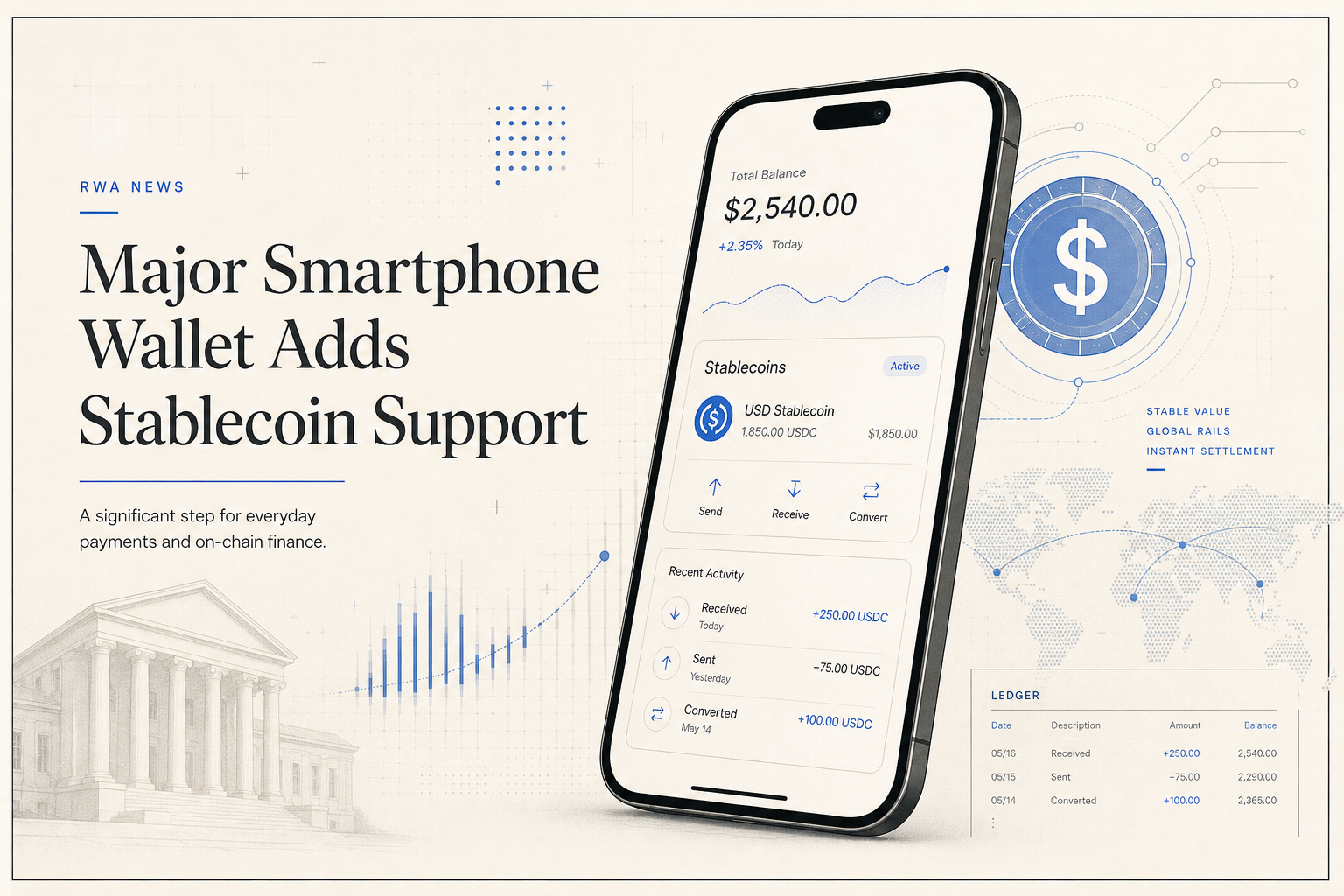
Samsung has signaled that stablecoins are moving from crypto-native apps toward a mass-market handset wallet, and that alone makes the announcement notable for the real-world asset market. At the company’s Galaxy Unpacked event in London, Samsung said Wallet will expand beyond cards and credentials to support new forms of digital value, including stablecoins. Even without a product launch date, that marks a meaningful shift: one of the world’s largest consumer-device ecosystems is now openly treating tokenized dollars as a wallet feature rather than a niche add-on.
That matters because Samsung Wallet already sits in a high-frequency part of the mobile-finance stack. On Samsung’s own product pages, the app is positioned as a home for payment cards, IDs, boarding passes, memberships, passwords and digital keys, with quick access from the phone and watch. In other words, Samsung is not introducing stablecoins into a standalone crypto product. It is inserting them into an existing consumer wallet surface that is designed to sit alongside everyday payments and identity functions. For the stablecoin market, distribution through familiar wallet software can be as important as the token itself.
The disclosure was directionally clear but operationally thin. Samsung indicated that stablecoins are coming, and event imagery reviewed by multiple reports showed a wallet mockup containing USDC. But the company did not publish a launch calendar, specify whether an issuer has been selected, identify which blockchain networks will be supported, or explain whether the eventual model will be custodial, non-custodial or some hybrid arrangement. It also left open basic rollout questions such as which jurisdictions will get the feature first and whether the initial use case is storage, peer-to-peer transfer, merchant payments or some combination of the three.
The appearance of USDC in the mockup is still important, even if it stops short of confirming a formal partnership. Circle describes USDC as redeemable one-for-one for U.S. dollars, backed by reserves held in cash and cash-equivalent assets, and supported by monthly reserve attestations. Circle also says USDC is natively issued across dozens of blockchain networks, giving product teams a broad menu of settlement rails and interoperability options. For a consumer hardware company that wants a dollar token with established liquidity, compliance positioning and cross-chain reach, USDC is an obvious reference asset to show on screen.
The harder part is not the asset icon; it is the wallet architecture around it. A mainstream mobile wallet that handles stablecoins has to answer questions around identity checks, fraud controls, jurisdictional restrictions, sanctions screening, wallet recovery, fees, network selection and the user experience for moving funds between bank deposits and tokenized cash. It also has to decide whether users are meant to hold balances for spending, use stablecoins as a transfer rail behind the scenes, or eventually interact with a wider set of onchain financial products. Those decisions will determine whether Samsung is building a visible consumer stablecoin wallet, a payment utility layer, or a broader entry point into tokenized finance.
That is why Samsung’s move matters beyond handset strategy. Stablecoin competition is no longer just about who issues the token or who holds the reserve assets; it is increasingly about who controls the interface where users discover, receive and move tokenized money. Banks, fintechs, exchanges and payment networks are all trying to secure that distribution layer. If Samsung follows through, stablecoins gain a credible path onto one of the most familiar consumer finance screens in the market, which would lower the behavioral barrier between traditional mobile payments and onchain dollar balances.
For RWA builders, the broader implication is that stablecoins continue to act as the front door for tokenized finance. A consumer wallet that can store and move regulated dollar tokens is a natural staging point for adjacent products such as tokenized deposits, money-market fund exposures, treasury-backed cash alternatives and yield-bearing cash instruments, subject to local rules. Samsung has not announced any of that, and the current disclosure should be treated as a roadmap signal rather than a shipped payments network. But the signal is strong enough to matter: the next phase of stablecoin adoption may be decided less by crypto exchanges and more by who owns the default wallet on the phone.