Robinhood Chain’s Early Activity Puts Its RWA Distribution Thesis to the Test
Robinhood has shown it can push retail attention onto its new chain, but early usage is still dominated by speculative trading rather than tokenized real-world assets. That makes the next phase less about one-off volume spikes and more about whether Robinhood can turn brokerage distribution into durable onchain asset activity.
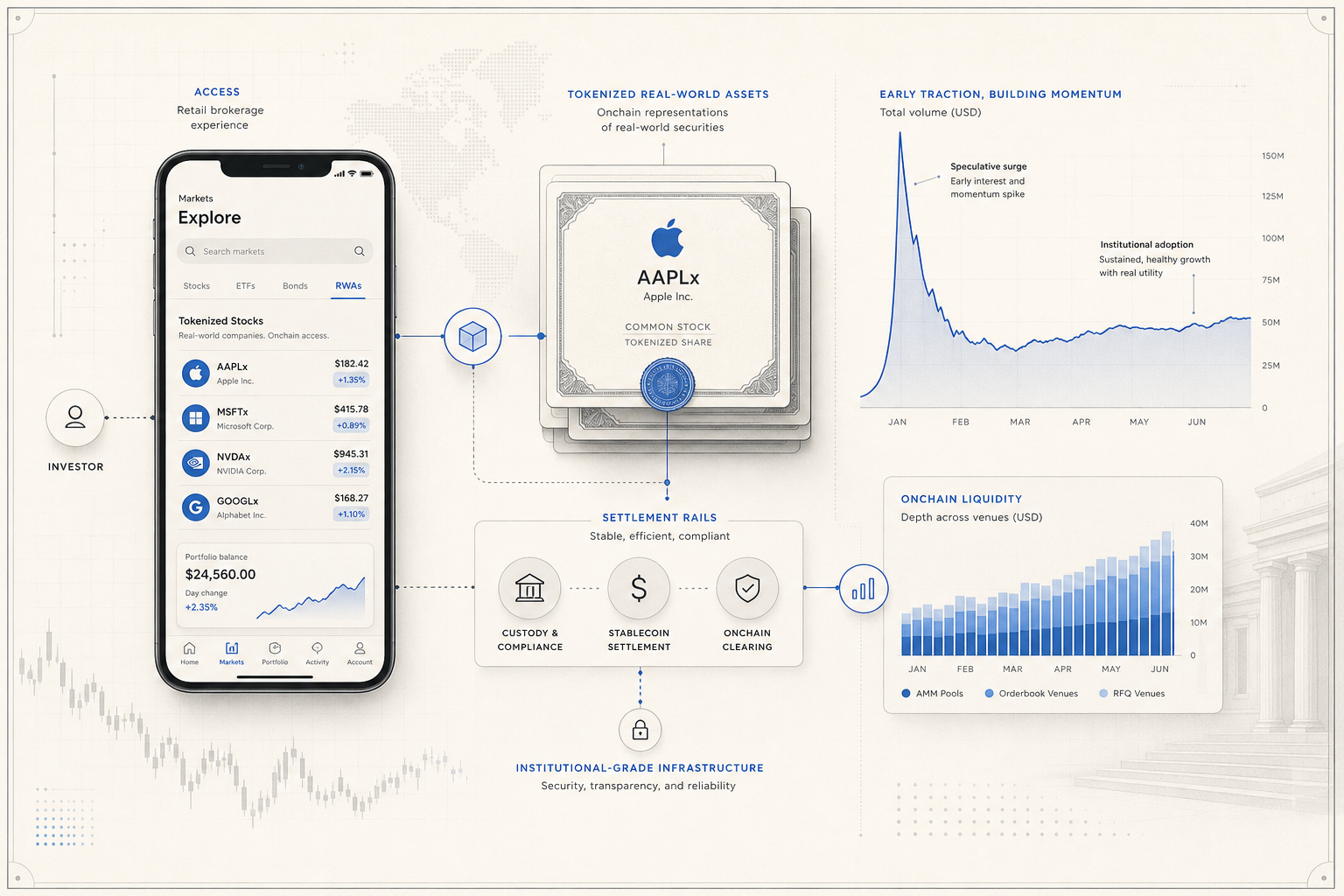
Robinhood Chain has already delivered the kind of launch-week headline most new networks would want: a brief surge into the upper tier of decentralized trading by volume and a wave of attention across crypto markets. But the more important story for RWA watchers is not whether the chain can win a weekend leaderboard battle. It is whether Robinhood can convert its large retail distribution base into sustained activity around tokenized real-world assets, onchain collateral and regulated market access. That is a much harder test, and one that sits closer to the company’s long-term value proposition than the early burst of speculative trading that first pulled the chain into view.
CoinDesk’s reporting captured that split clearly. The network briefly reached roughly $878 million in 24-hour DEX volume on July 12, drawing comparisons with larger crypto venues, yet the same report showed how uneven the activity mix remains. Perpetual futures volume on July 13 was only about $5.9 million, far below the scale of established onchain derivatives venues, while much of the spot activity was driven by trading in CASHCAT, a memecoin linked to Robinhood’s old mascot. CoinDesk also reported that tokenized real-world assets on the chain represented only about $12.66 million in active market capitalization at the time, while the memecoin’s market cap briefly reached roughly $156 million. In other words, the chain succeeded in attracting attention, but not yet in proving that tokenized assets are the main product pulling users onchain.
Robinhood’s own materials make clear that the company is aiming at a much broader outcome than meme-driven trading. On its official Robinhood Chain pages, the company describes the network as a blockchain built for financial services and tokenized real-world assets, with stock tokens tied to names such as Nvidia, Google and Apple. The company also says the chain is developed on Arbitrum’s Layer 2 infrastructure, targeting high throughput with 100 millisecond block times while inheriting Ethereum’s security. That framing matters. Robinhood is not pitching the network as a general-purpose crypto playground first and figuring out finance later. It is explicitly positioning the chain around tokenized market access, programmability and app-level financial services, including trading, lending and borrowing use cases that can matter in a regulated asset environment.
The strategic logic is strong even if the current product mix is still immature. Robinhood already has something most crypto-native networks do not: a very large base of funded customers, a recognizable consumer interface and a brokerage relationship that can lower the friction of moving users from a familiar trading app into onchain products. That distribution advantage is precisely why the chain deserves attention from the RWA market even before its asset mix fully matures. Live DeFiLlama data retrieved during this run showed Robinhood Chain still handling more than $566 million in 24-hour DEX volume and about $5.3 billion over the last seven days, with chain TVL around $249.5 million. Those figures are volatile, but they do suggest that the network is not merely theoretical infrastructure. Users are arriving, capital is being bridged and the market is testing the interface between mainstream brokerage demand and open onchain venues in real time.
What is still missing is the deeper form of engagement that RWA builders actually need. Bridged balances and trading spikes do not automatically create a durable tokenized asset market. For that to happen, Robinhood needs repeat usage in products where regulatory permissions, settlement design, issuer participation and liquidity quality all matter. Tokenized equities, funds and cash-like instruments require more than a viral token launch; they require reliable market making, rights handling, treasury workflows and enough two-sided participation that assets remain useful after the first wave of curiosity passes. Robinhood’s official pages also note that stock tokens are not available in the United States and remain subject to restrictions in other jurisdictions, which underlines how much of the network’s eventual RWA footprint will depend on rollout geography and compliance design, not just raw trading enthusiasm.
That distinction is why Robinhood Chain matters beyond its own metrics. The RWA sector has spent the last two years proving that tokenized treasuries, private credit vehicles and stock-linked instruments can exist onchain. The next bottleneck is distribution: who can actually place those assets in front of users at scale, with a familiar interface and low operational friction. Robinhood may be one of the few firms with a credible answer to that problem. If even a modest share of its user base begins to hold tokenized securities, rotate idle balances into onchain yield products or use chain-based collateral and lending tools, the market structure implications could be significant. In that scenario, the competitive edge would come less from pure protocol design and more from brokerage-led customer acquisition and embedded wallet access.
For now, though, the cleanest read is that Robinhood has validated interest in its distribution funnel before it has validated the full RWA thesis behind the chain. Early trading activity shows that the company can bring attention and capital onto its rails. What remains unproven is whether that traffic can be redirected from speculative bursts into repeat use of tokenized financial products that justify the chain’s institutional ambitions. That is the benchmark worth tracking over the next several quarters. If Robinhood can turn retail flow into steady RWA balances and regulated onchain market activity, it will have built something strategically important. If not, the chain may still be active, but for reasons that sit well outside the product story Robinhood is trying to tell.