Revolut’s reported USDT offboarding shows how MiCA is reshaping stablecoin distribution
Revolut’s reported plan to remove USDT for some customers is an early signal that MiCA-era compliance is starting to reorder which dollar tokens regulated platforms are willing to carry. The immediate issue is one fintech’s product shelf, but the deeper story is the narrowing path for offshore stablecoins inside Europe’s licensed distribution stack.
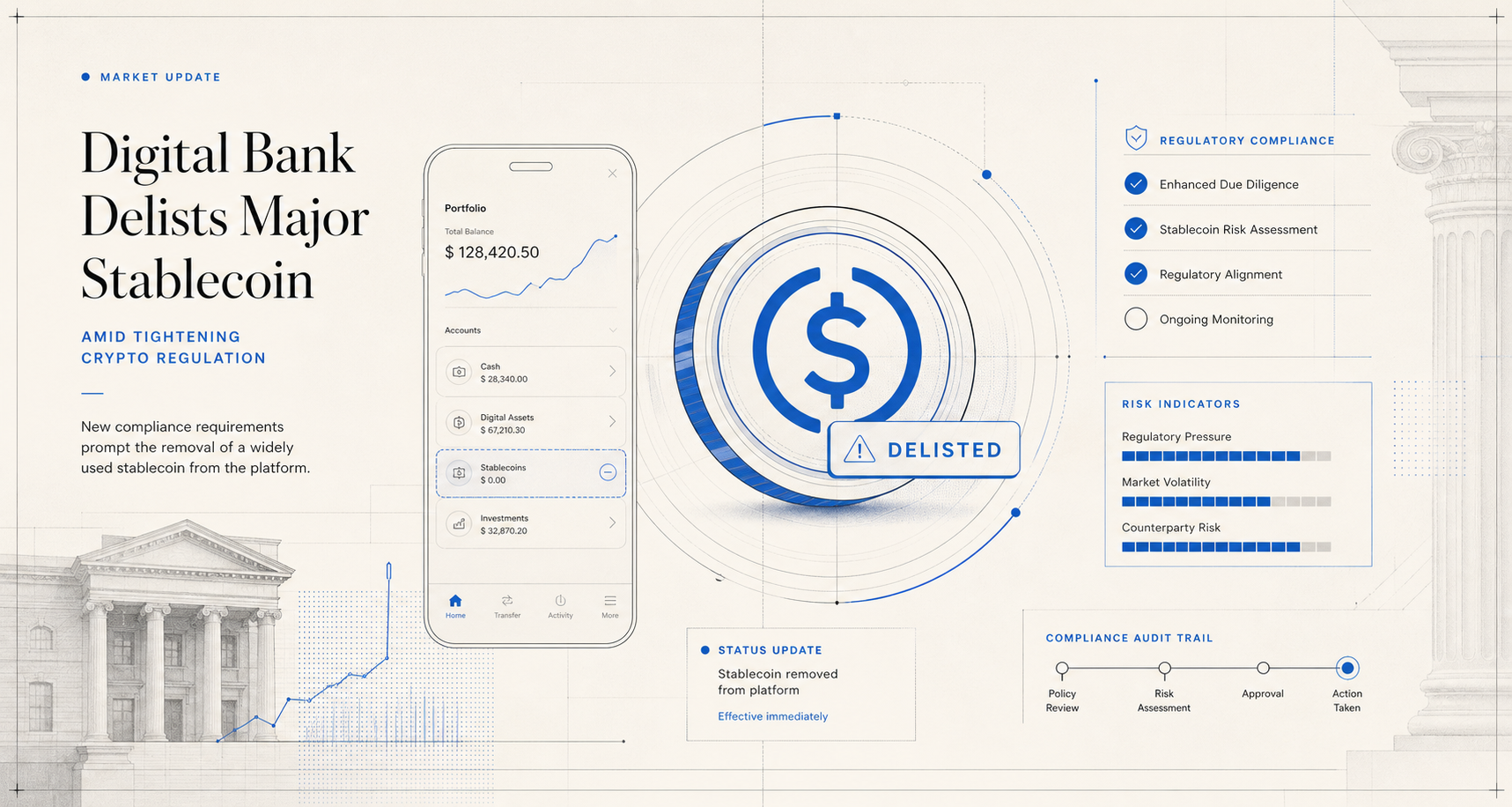
Revolut’s reported decision to phase out Tether’s USDT for at least part of its customer base is less important as a single listing change than as a market-structure signal. According to a customer notice described in market reporting on Friday, the fintech plans to stop USDT purchases on July 6, reject new USDT deposits after July 30 and fully delist the token on Aug. 31, with any remaining balances automatically converted into a user’s base currency. Revolut has not publicly clarified whether the move is global or limited to specific jurisdictions, but even with that caveat, the timetable points to a stricter compliance posture around stablecoin access on regulated retail platforms.
The timing matters because Revolut is no longer operating at the edge of the European crypto market. ESMA’s MiCA framework now gives the region a single supervisory architecture for crypto-assets, and the public ESMA materials make clear that the regime places disclosure, authorization and oversight obligations on issuers and service providers dealing in crypto-assets, including stablecoins categorized as e-money tokens or asset-referenced tokens. In that environment, a licensed distributor has a strong incentive to reduce ambiguity around which tokens it is willing to offer, especially when a stablecoin’s regulatory status is less straightforward than that of products explicitly built for regulated market access.
That is what makes the reported Revolut move significant for RWA and stablecoin watchers. Distribution is increasingly becoming the choke point. Stablecoins can scale technically through wallets, exchanges and blockchains, but mainstream reach still depends on whether banks, fintech apps, brokerages and payment interfaces are willing to carry them inside controlled onboarding, sanctions, AML and consumer-protection workflows. Once those distributors adopt a narrower asset menu, the consequences are larger than a single delisting event: liquidity fragments, user flows migrate toward tokens with cleaner approval paths, and issuers without a clear route into licensed channels are pushed back toward offshore or crypto-native demand.
The story also underlines the difference between market capitalization and distribution quality. USDT remains the largest dollar stablecoin by supply, and its global presence means a single platform’s decision does not materially threaten its overall circulation. But Europe’s regulated shelf space has strategic value that exceeds its immediate volumes. The platforms that secure MiCA-aligned access are effectively deciding which stablecoins can sit closest to payroll accounts, treasury workflows, card rails and mainstream savings behavior. If a major app with millions of retail users is no longer comfortable supporting USDT in that context, the signal to the rest of the market is that scale alone is not enough; regulatory fit increasingly determines where a token can be natively embedded.
Revolut’s own positioning makes that signal stronger. The company has spent the last several years turning crypto from a peripheral feature into a regulated product line inside a broader consumer-finance stack. That means its listing choices are not just speculative-market decisions; they sit inside a framework that has to satisfy licensing expectations, customer disclosures, operational controls and risk committees. A fintech in that position is likely to prefer fewer edge cases, not more. Even without a public statement tying the reported USDT offboarding to one specific article of MiCA, the combination of regulatory licensing, risk language and phased withdrawal dates is consistent with a platform choosing clarity over optionality.
For the wider stablecoin market, the likely near-term effect is not a collapse in demand but a continued sorting of use cases. Crypto-native traders and offshore liquidity venues can still support tokens that remain highly liquid on-chain, while licensed European apps are likely to concentrate around stablecoins and tokenized cash instruments that fit more neatly into supervisory expectations. That matters for the RWA stack because tokenized funds, digital-bond settlement flows and cross-border treasury products all depend on a predictable cash leg. If distributors, custodians and payment providers do not align on which stablecoins are operationally acceptable, the cash side of tokenized finance remains fragmented even as the asset side matures.
The cleanest way to read Revolut’s reported move, then, is not as an isolated strike against Tether but as another marker in the institutionalization of stablecoin distribution. MiCA is pushing the European market away from the era when listing decisions could be treated mainly as product merchandising. They now look more like balance-sheet and conduct-risk decisions made inside licensed financial infrastructure. Whether or not other large platforms follow Revolut on the same timeline, the direction of travel is increasingly clear: in regulated markets, the winners in stablecoins will not be defined only by issuance scale or trading volume, but by who can hold distribution inside the compliance perimeter.