Open USD faces early governance test after several named consortium members distance themselves
Open Standard’s bid to launch Open USD with a blue-chip partner roster has run into an immediate credibility test after several South Korean companies said they had not formally agreed to join the consortium. The dispute matters because Open USD is trying to compete with incumbent stablecoins by turning partner distribution and shared reserve economics into the center of its model.
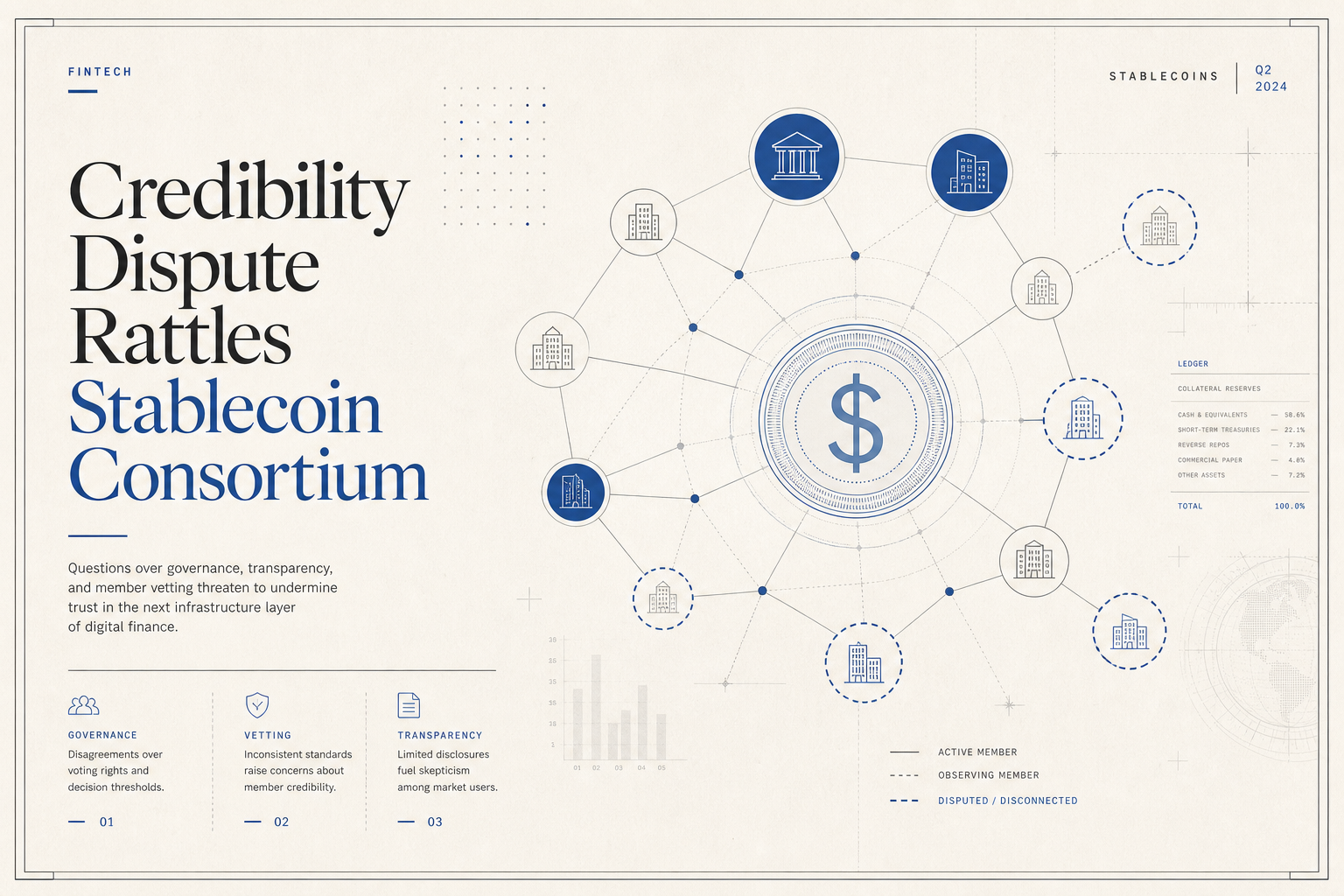
Open Standard’s attempt to launch Open USD as a consortium-backed stablecoin has hit an early governance test after several companies named as members said they had not entered a formal commitment to participate. The dispute cuts deeper than an ordinary launch-day misunderstanding because Open USD is not pitching itself as just another dollar token. Its strategy is to challenge incumbent stablecoin issuers by presenting a broad commercial network of banks, payment companies, technology firms and crypto platforms as the core product. If that membership list is unsettled, one of the project’s main trust signals comes under immediate scrutiny.
Representatives for Samsung Electronics, Dunamu and other South Korean financial groups said in local business reporting that they had either not been formally consulted or had only given noncommittal responses when approached about the initiative. Some said they learned they had been included in the consortium only after media coverage circulated. That matters because Open USD’s launch materials had framed the network as a coalition of roughly 140 participants spanning payments, banking, technology and digital asset infrastructure. When a stablecoin network is marketed as institutionally backed from day one, the difference between exploratory outreach and confirmed participation is not a cosmetic detail; it goes to the credibility of governance, distribution and commercial readiness.
Open Standard’s earlier launch disclosure laid out an ambitious model. The group said businesses would be able to mint and redeem OUSD without fees or hard volume caps, while most reserve income would be distributed back to participating partners after a small management fee. That is a deliberate break from the dominant stablecoin template, where the issuer typically captures most of the economics associated with reserve assets such as short-dated government paper and cash equivalents. Open USD is instead trying to unbundle the stablecoin business by using shared economics to persuade distributors and payment intermediaries to treat the token as a common settlement rail rather than a product owned by a single sponsor.
That structure helps explain why the membership dispute is so consequential. For a conventional fiat-backed stablecoin, early traction can be demonstrated through liquidity, exchange listings and redemption reliability. For Open USD, the go-to-market story also depends on whether major businesses are genuinely willing to embed the token into payments, remittances, treasury operations and onchain settlement flows. A partner list padded with companies still in review would weaken the project’s claim that it already has broad institutional distribution. It would also raise more basic questions about how the network verifies membership, communicates governance rights and distinguishes between interested prospects and committed operators.
The episode lands at a sensitive moment in the stablecoin market. Dollar-linked tokens have grown into core plumbing for crypto trading, cross-border transfers and the cash leg of tokenized asset markets, but the economics remain heavily concentrated in a few issuers. Tether and Circle still set the benchmark for liquidity, scale and redemption credibility, even as new entrants argue that the next wave of competition will be won through better distribution and more attractive revenue sharing. Open USD’s pitch is explicitly aimed at that opening: if reserve yield can be shared with the institutions that bring users and transaction volume, then distribution partners may have a stronger reason to support a new network instead of simply integrating the incumbents.
The challenge is that stablecoin users and institutional counterparties do not only evaluate incentives; they also evaluate operational certainty. A token meant to support payments and real-world settlement flows needs clear responsibility for issuance, reserve management, redemptions, compliance standards and partner onboarding. If member institutions are still deciding whether to participate, the market has less visibility into who will actually provide liquidity, who will distribute the token to end users and which parts of the ecosystem are prepared to stand behind it at launch. In practice, that can slow adoption even if the economic model is attractive on paper.
The underlying idea behind Open USD still addresses a real market tension. As stablecoins become more deeply tied to tokenized securities, fund subscriptions, collateral movements and merchant settlement, distributors increasingly want a larger share of the value created by reserve-backed digital dollars. A network that offers fee-free minting and redemption plus partner revenue sharing is therefore targeting one of the biggest unresolved questions in tokenized finance: whether the future cash layer will be controlled by a handful of issuers or organized as shared infrastructure across many commercial participants. The current dispute does not invalidate that thesis, but it does show how difficult it is to build consortium credibility at institutional scale.
What comes next is straightforward but important. Open Standard needs to clarify which companies are formally committed, what obligations attach to membership and how governance and reserve economics work in operational terms rather than promotional language. Until that happens, the project remains strategically interesting but commercially unproven. For the broader RWA market, the takeaway is that stablecoin competition is no longer just about who can mint the next digital dollar. It is increasingly about who can assemble a trustworthy distribution network around that dollar without blurring the line between interest, endorsement and execution readiness.