Ondo Tests a U.S.-Aligned Path for Tokenized Public Securities With IVV and Micron
Ondo has rolled out tokenized exposures tied to BlackRock's IVV ETF and Micron shares using existing U.S. transfer-agent and custody infrastructure, offering one of the clearest live tests yet of how public securities could move onchain without stepping outside traditional market plumbing.
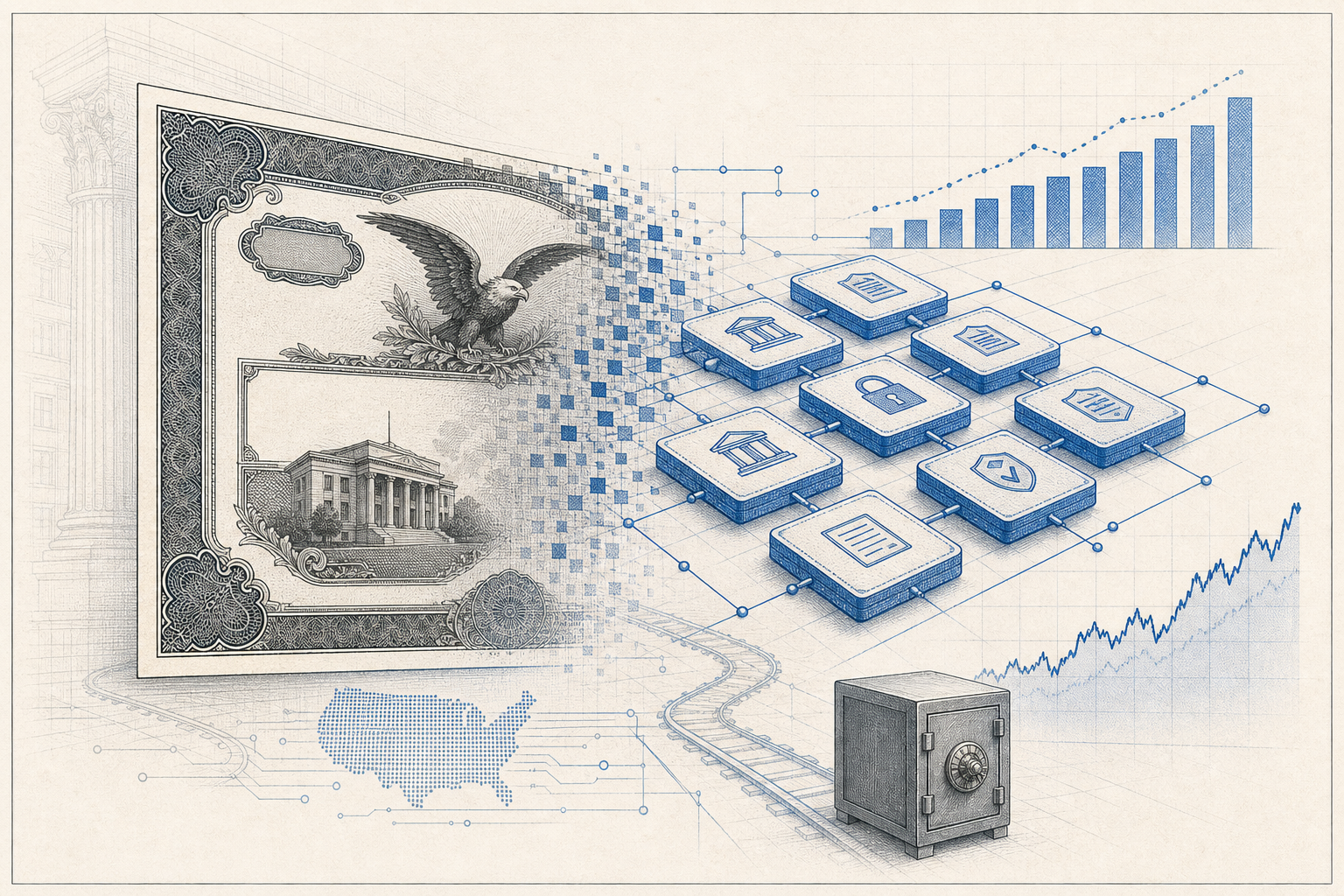
Ondo has taken a notable step in the race to bring public-market instruments onchain, launching tokenized exposures tied to BlackRock's iShares Core S&P 500 ETF and Micron Technology shares through a structure built around existing U.S. securities infrastructure. The significance is less about adding two more tickers to the growing tokenized-equities universe and more about the legal and operational model behind them. Instead of relying on an offshore wrapper or a synthetic representation, Ondo is positioning the launch as a live demonstration of how blockchain-based securities can be issued while the underlying assets remain inside familiar U.S. custody, transfer-agent, and broker-dealer rails.
The two initial instruments are tied to IVV, one of the world's largest S&P 500 ETFs, and Micron, a widely followed semiconductor name. According to reporting around the launch, the tokenized entitlements are minted on Ethereum through Oasis Pro TA, the SEC-registered transfer agent Ondo acquired last year. The underlying shares themselves remain in the traditional custody chain rather than being pulled into a separate offshore venue. Broadridge, whose systems are widely used across public-company administration and investor communications, is handling functions including proxy voting support, regulatory disclosures, and shareholder communications. That division of labor matters because it keeps core recordkeeping and governance tasks anchored to service providers that traditional market participants already use.
Ondo's own public materials make clear that this model is part of a larger effort to turn tokenized stocks and ETFs into a regulated access layer rather than a parallel market detached from the underlying assets. In its launch materials for Ondo Stocks, the company says its tokenized securities are fully backed by U.S. stocks and ETFs held at one or more U.S.-registered broker-dealers, alongside cash in transit where relevant. It also highlights daily attestations, a bankruptcy-remote special-purpose structure, and a first-priority security interest held by a third-party security agent for tokenholders. In practical terms, Ondo is trying to package the usability advantages of blockchains—continuous transferability, programmability, and global distribution—without discarding the protections that institutions expect from established securities-market infrastructure.
That approach lands at a useful moment for the tokenization sector. Much of the recent growth in onchain RWAs has come from Treasury products, money-market funds, and private credit, where the cash-flow profile is easier to map onto tokens and the compliance perimeter is more familiar. Public equities have always looked like the bigger long-term prize, but they are operationally harder. Ownership records, shareholder rights, corporate actions, disclosures, tax handling, transfer restrictions, and distribution rules all create friction that simple token wrappers do not solve on their own. By using a transfer agent, regulated custodians, and traditional servicing layers rather than replacing them, Ondo is effectively arguing that tokenization can advance by integrating with the existing stack instead of trying to route around it.
The choice of assets also looks intentional. IVV is a highly liquid, institutionally recognized ETF that gives broad S&P 500 exposure, while Micron is a single-name operating company with active trading, analyst coverage, and straightforward market visibility. Using one diversified ETF and one individual equity provides a cleaner proof point than launching with obscure names. It shows the model can support both index-style exposure and company-specific exposure under the same architecture. It also reduces the chance that the product is dismissed as a novelty built around illiquid instruments that would never attract serious demand from allocators, platforms, or structured-product builders.
There are still meaningful limits. Ondo's documentation states that access to these tokenized securities is subject to jurisdictional, onboarding, and investor-eligibility restrictions, and the company has been explicit that distribution does not simply mean open U.S. retail availability. Minting and redemption mechanics remain tied to market-liquidity realities even if transfers can happen onchain around the clock. And while SEC staff commentary has signaled how a third-party custodial model could fit within current rules, that is not the same thing as a fully settled market-wide framework for tokenized public securities. For the segment to scale, firms will still need clarity on secondary trading venues, cross-border access, transfer restrictions, disclosures, taxation, and how investor protections are enforced across wallets and intermediaries.
Even with those caveats, this launch is strategically important because it pushes the tokenization conversation beyond theory. For the past year, many tokenized-equity efforts have either emphasized global access without deep integration into U.S. market structure or leaned on broad promises that onchain finance would eventually absorb public securities. Ondo is testing a more incremental thesis: keep the underlying shares where regulators and institutions already know how to supervise them, then use tokens as the programmable interface. If that model proves durable, the implication for RWAs is material. Public equities and ETFs could begin to look less like a separate crypto experiment and more like the next product class to be distributed through the same onchain rails that already support tokenized Treasuries.
For RWA markets, the real signal is that infrastructure is starting to converge. Ondo built its early footprint around Treasury-linked products such as OUSG; now it is extending the same institutional playbook toward listed securities. If the industry can show that voting rights, disclosures, custody controls, and investor protections remain intact while settlement becomes more flexible and interoperable, tokenized public markets become much easier to underwrite. That would not eliminate the hard regulatory work still ahead, but it would narrow the gap between pilot projects and production-grade capital-markets infrastructure in a way the sector has been trying to demonstrate for years.