OFAC’s ISIS-K wallet sweep puts stablecoin compliance deeper into the enforcement stack
Washington’s latest sanctions update did more than blacklist a terror network. By appending 134 blockchain addresses to the ISIS-K entry and freezing the Tron-linked balances, the action showed how issuer-controlled stablecoin rails are becoming a live part of onchain financial enforcement.
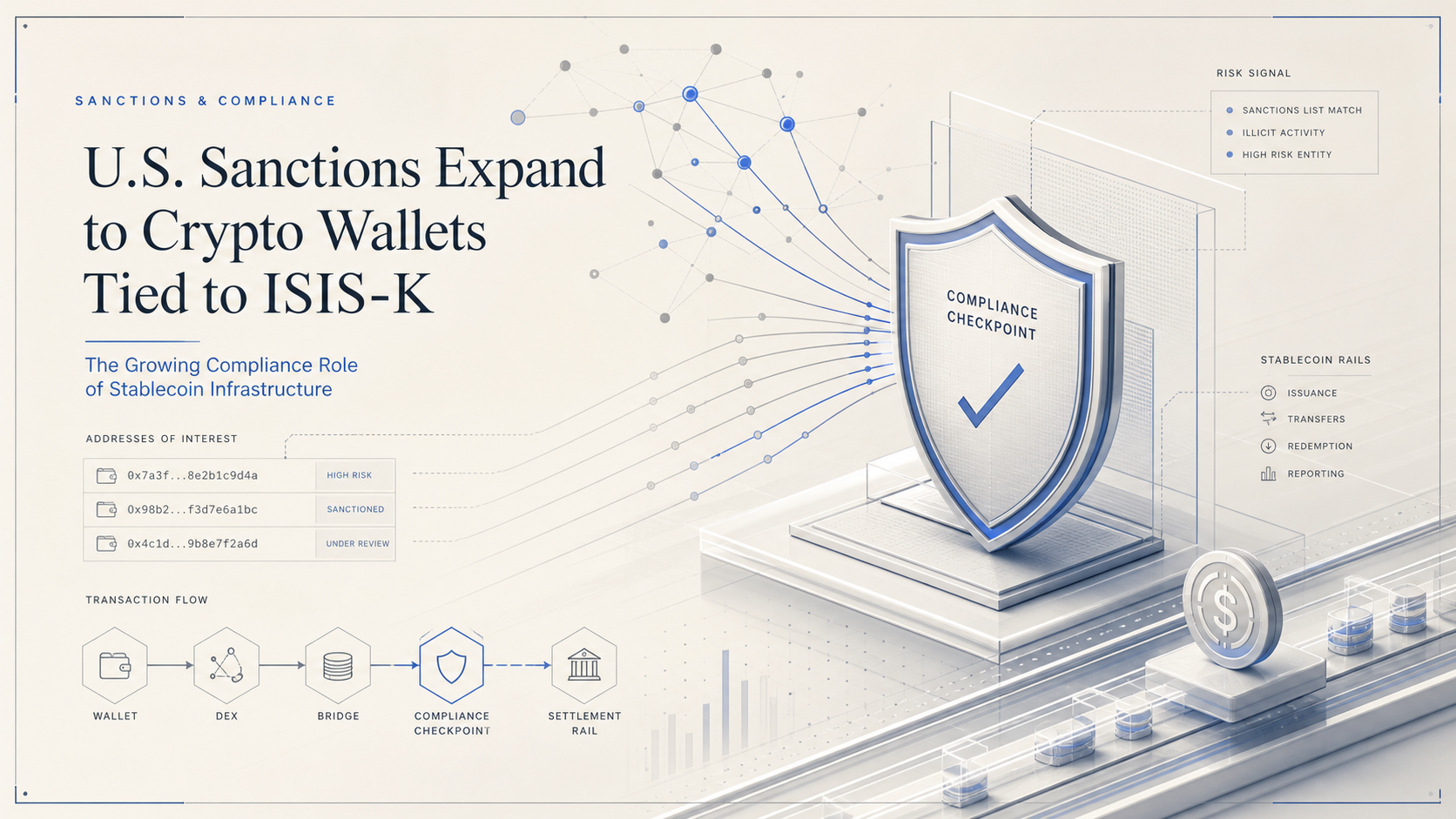
The U.S. Treasury’s latest sanctions update against ISIS-Khorasan was notable not just for the number of wallets it touched, but for what it revealed about how crypto enforcement now works in practice. OFAC updated the terrorist group’s entry on the SDN list with 134 digital asset addresses, including 131 on Tron and three on Monero. That kind of designation is more operational than symbolic: it gives compliance teams, exchanges, analytics firms and token issuers a concrete set of blockchain endpoints to screen against immediately. For the real-world-asset and stablecoin market, the message is straightforward. As more dollar-denominated value moves onchain, sanctions enforcement is no longer an edge case around crypto policy. It is becoming part of the infrastructure test for whether tokenized money can be trusted inside mainstream financial systems.
The official OFAC action page shows the update was made to the ISIL Khorasan entry rather than through a brand-new standalone sanctions announcement. In other words, Treasury is increasingly treating digital addresses as extensions of an already-designated entity, not as a separate class of financial object requiring a different enforcement framework. The update enumerated 134 addresses in total, and the asset mix matters. Tron dominated the list, while Monero accounted for the remainder. That breakdown highlights an increasingly important distinction for policymakers and market operators: public-chain activity can be traced and designated across multiple networks, but the downstream enforcement options vary dramatically depending on the asset and settlement layer involved.
Chainalysis’ analysis of the designation adds the clearest transactional context. According to the firm, the 131 Tron wallets linked to the group pulled in over $1.4 million from 2023 onward and routed upward of $880,000 back out. The company also said the wallets had exposure to mainstream services and that some of the designated addresses sent funds to Syria-based crypto exchangers. Chainalysis further tied the fundraising activity to al-Azaim Media Foundation, the group’s propaganda and distribution arm, which has historically solicited crypto donations across websites and messaging channels. Those details are important because they move the story beyond generic counterterrorism language and into a more concrete market-structure reality: blockchain fundraising networks can accumulate meaningful volumes, interact with recognizable intermediaries and persist for years before a sanctions update forces a cleanup across compliance systems.
What gives this action extra relevance for stablecoins is the role of issuer-controlled intervention once a designation is live. Reporting around the sanctions update said the balances on all 131 Tron addresses were frozen after the listing. Even without relying on that single event alone, Tether’s own public compliance record shows the mechanism is well established. The company said in 2025 that it assisted U.S. authorities in freezing and reissuing roughly $1.6 million in USDT tied to terrorism-financing wallets, and it has separately said its T3 Financial Crime Unit with Tron and TRM Labs has frozen more than $300 million in criminal assets globally. The implication is that stablecoin issuers are no longer just pass-through providers of tokenized dollars. They are increasingly functioning as controllable enforcement points inside onchain payments infrastructure.
That creates a sharp contrast between different kinds of crypto rails. A sanctions designation attached to a privacy coin address can warn counterparties and raise legal risk, but it does not offer the same issuer-level freeze lever that exists in centrally managed stablecoin systems. A Tron-based wallet holding USDT is a different case altogether because the asset sits inside a framework where blacklisting, freezing and coordinated law-enforcement response are technically possible. For critics of stablecoins, that reinforces the argument that tokenized dollars remain highly permissioned instruments despite circulating on public networks. For banks, asset managers and payment firms exploring tokenized cash products, however, that controllability may be precisely what makes these rails acceptable for larger-scale institutional use.
The broader RWA implication is that compliance functionality is becoming part of product-market fit. Tokenized deposits, fund shares and onchain treasury products all depend on regulators and institutional counterparties believing that financial controls survive the move onto blockchain rails. Screening sanctioned addresses is table stakes; being able to halt or contain flows when a sanctions event occurs is becoming just as important. The latest ISIS-K action will likely be read in that light by policymakers: not only as a counterterrorism measure, but as another real-world demonstration that dollar-linked tokens can be embedded into existing enforcement workflows faster than many critics expected. That may strengthen the policy case for some supervised tokenized-money models even as it sharpens debate over censorship, issuer power and due-process standards.
None of that makes the tradeoffs disappear. The same compliance tools that make stablecoins more usable for regulated finance also make them less neutral than fully bearer-style digital cash narratives suggest. Every additional example of freezing and blacklist coordination reminds the market that tokenized dollars inherit the governance of their issuers and, increasingly, the expectations of state oversight. But from an institutional adoption perspective, that is no longer a side note. It is central to the value proposition. OFAC’s latest wallet sweep shows that in onchain finance, enforceability is becoming part of the rails themselves — and stablecoin issuers are now firmly inside that enforcement stack.