Nuvei’s Payoneer deal brings stablecoin settlement closer to the center of global merchant flows
Nuvei’s $2.75 billion agreement to acquire Payoneer matters beyond scale: it combines merchant acquiring, cross-border payouts and emerging stablecoin tooling inside one payments stack. That makes the deal a live test of whether stablecoin rails can move from specialist crypto workflows into mainstream treasury operations.
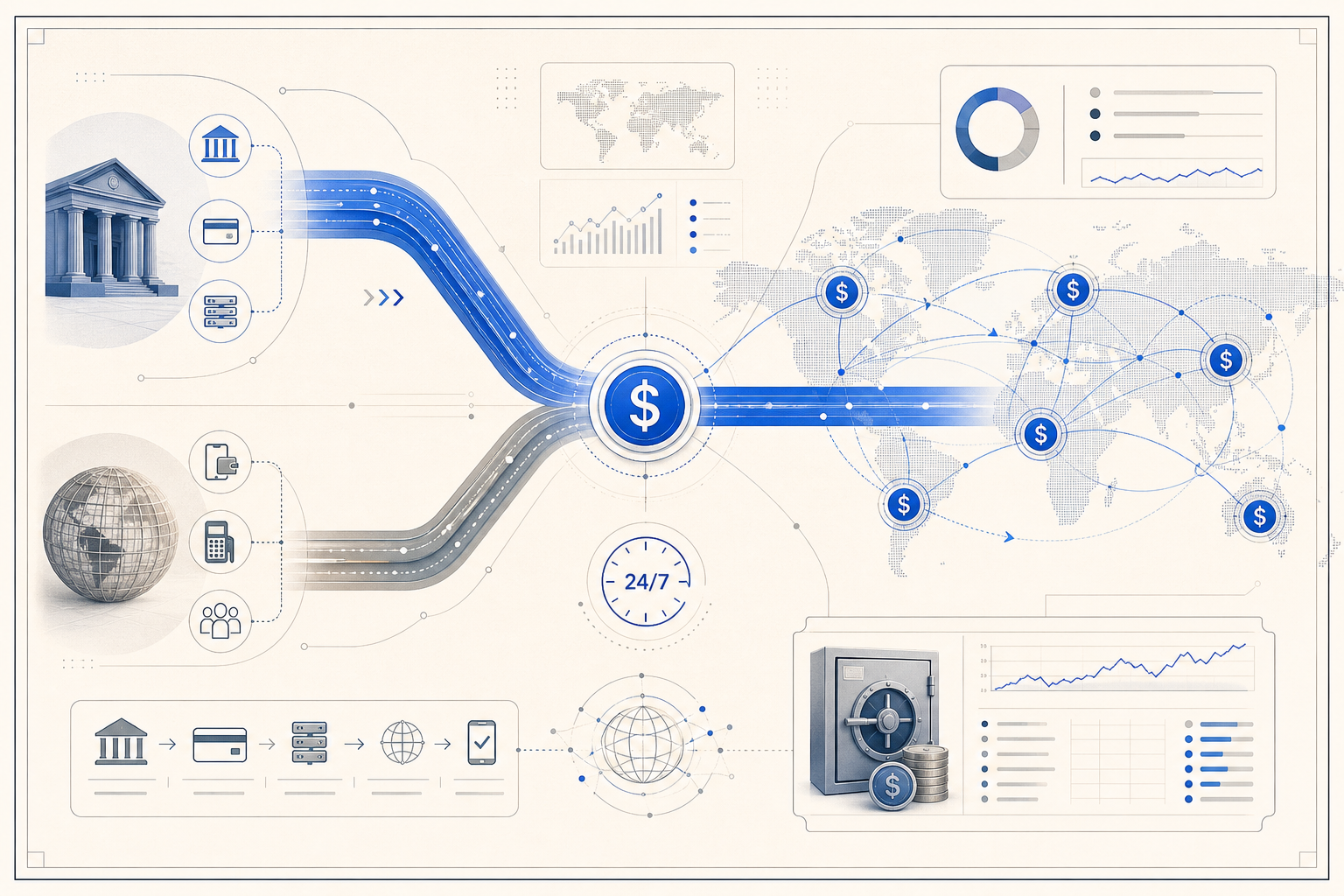
Nuvei’s agreement to acquire Payoneer for $2.75 billion is notable for more than consolidation in payments. The transaction would combine a large merchant-acquiring and acceptance network with one of the best-known cross-border payout platforms serving marketplaces, contractors and international sellers. For RWA and stablecoin watchers, the more important point is architectural: if the deal closes, one company would sit much closer to the full money movement loop, from accepting payments and holding balances to sending funds across borders and, increasingly, settling some of those flows on digital-dollar rails. That makes the transaction relevant to the next phase of tokenized payments infrastructure, where stablecoins are not a side product but part of how treasury and settlement stacks get rebuilt.
Nuvei said the combined company is expected to process more than $500 billion in annual payment volume, serve more than 2.4 million customers and generate roughly $3 billion in annual revenue. Those numbers matter because scale is one of the main missing ingredients in many stablecoin payment narratives. A stablecoin-enabled treasury workflow becomes much more consequential when it is embedded in a platform that already handles large merchant volumes, operates across more than 190 countries and territories, and controls both acceptance and payout touchpoints. In practical terms, the deal would give Nuvei broader reach into exactly the parts of the payment chain where stablecoins can be operationally useful: cross-border settlement, working-capital movement, partner disbursements and multi-currency balance management.
The strategic fit is easier to see when looking at what Nuvei has already built. In its own product material, the company has described a blockchain payment stack developed with Rain, BitGo and Visa for merchants in Latin America. That setup is designed to let businesses use stablecoins, including USDC, for cross-border B2B payments and settlement while relying on familiar card and network acceptance where needed. Nuvei also says it supports real-time stablecoin transactions, fiat-to-stablecoin conversion and settlement services, and that it connects to USDC across multiple blockchains. In other words, Nuvei has already moved past generic experimentation and into merchant-facing operational rails.
Payoneer, for its part, has been positioning stablecoins as an extension of its cross-border money movement franchise rather than as a retail crypto product. Its stablecoin product page frames the offering around receiving, holding, converting and sending value inside one business payments platform, with emphasis on always-on transfers and round-the-clock international operations. That language is important because it places stablecoins in a treasury and workflow context, not a trading context. Even if Payoneer’s stablecoin capabilities are still being rolled out, the company is clearly signaling that digital-dollar settlement belongs inside the same interface businesses already use for supplier payments, marketplace receipts and contractor disbursements.
Put together, the acquisition suggests a more mature stablecoin thesis than the one that dominated earlier cycles. The question is no longer simply whether stablecoins can move quickly or cheaply. The harder commercial question is which platforms can package them inside compliance, reconciliation, currency conversion, merchant servicing and payout orchestration. Nuvei and Payoneer each control different pieces of that stack. A merged platform would be in a better position to decide when stablecoins are the best settlement rail, when bank rails remain preferable and how to switch between the two without forcing merchants to rebuild internal processes from scratch. That interoperability layer is where a lot of real adoption will be won or lost.
There are still reasons to stay measured. An announced acquisition is not an integrated product, and stablecoin-enabled payment operations still have to clear regional licensing, compliance, counterparty and treasury-control requirements. Merchant demand is also uneven: some businesses want faster 24/7 settlement, while others care more about FX pricing, dispute handling or cash forecasting. The combined company will need to prove that stablecoin flows reduce friction in measurable ways, rather than adding another specialized rail that only works for a narrow class of customers. Execution will matter more than branding.
Still, the deal stands out because it points toward a more credible endgame for stablecoins in enterprise payments. Instead of existing at the edge of commerce, stablecoin functionality is being attached to large-scale platforms that already intermediate acceptance, balances and payouts. If that model works, tokenized dollars may become less visible as standalone products and more important as infrastructure under the hood. That would be a meaningful shift for the broader RWA market: not just tokenized assets as investments, but tokenized cash instruments becoming part of how global businesses actually move money.