EU officials are reopening MiCA around foreign stablecoins and tokenized payments
Europe's next MiCA review is taking shape around two practical gaps: how non-EU stablecoin issuers should be handled inside the bloc and whether tokenized payments and deposits need a clearer perimeter. With the July 1 licensing cutoff now in force, those questions are moving from theory to market structure.
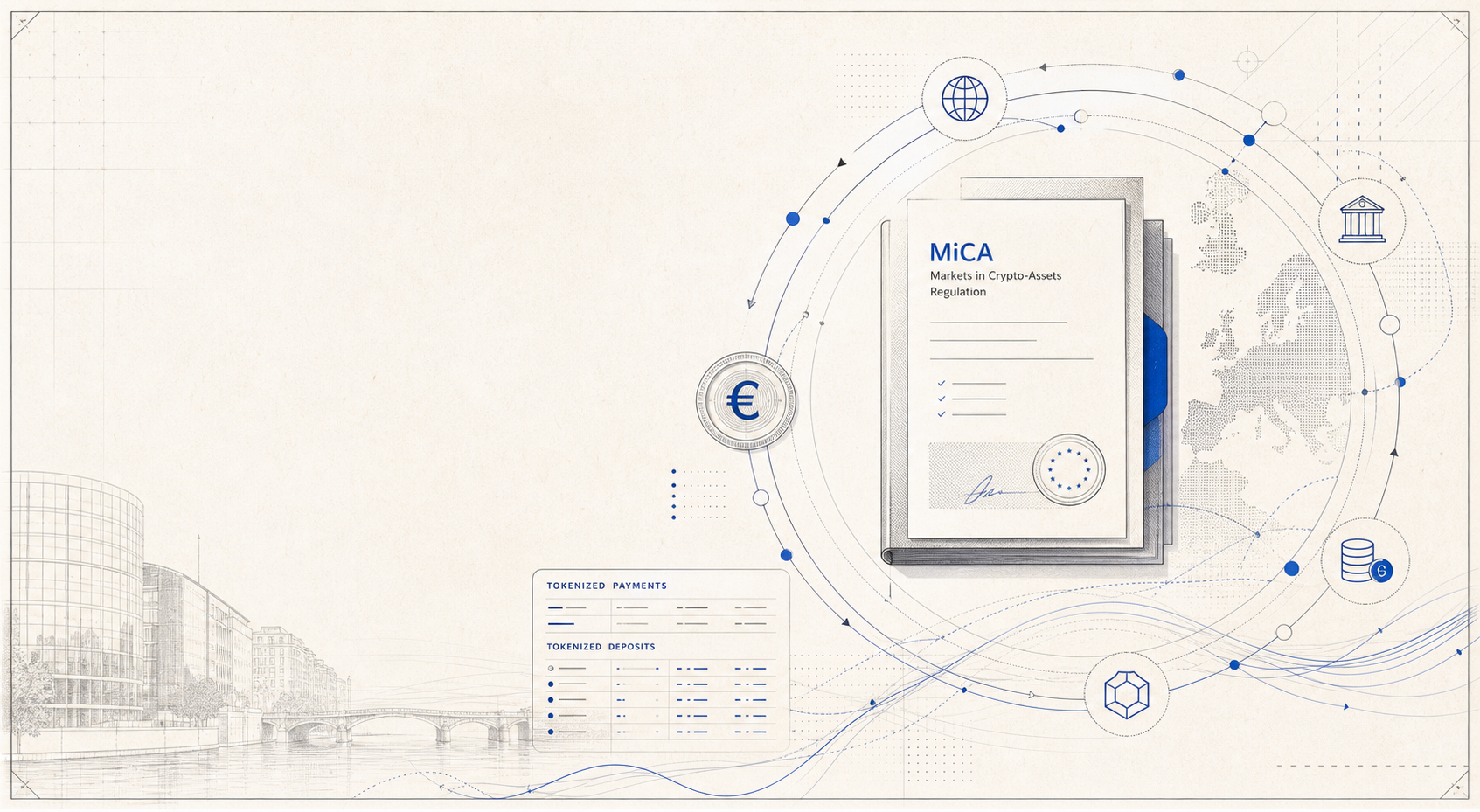
The European Union’s crypto rulebook is moving into its second phase. After spending the last year getting the Markets in Crypto-Assets framework into force, policymakers are now turning to a harder question: whether MiCA, as written, is enough for a market increasingly shaped by offshore stablecoin issuers and tokenized cash products that sit close to the banking system. Fresh reporting this week indicates officials are preparing to revisit the framework in 2027 with particular attention on foreign stablecoin issuers and the growing use of tokenized payments and deposits.
That matters because MiCA has just reached its first real implementation milestone. ESMA’s public MiCA materials note that the regulation’s transitional regime allowed existing crypto-asset service providers in many jurisdictions to continue operating only until 1 July 2026, or until they obtained or were denied a MiCA authorization. In other words, the bloc has only just moved from transition into the live authorization era for exchanges, brokers, custodians and other crypto intermediaries. Once rules move from consultation decks into production supervision, the edge cases become much more visible.
One of those edge cases is the cross-border stablecoin question. The latest market reporting says EU officials want to examine how the framework should apply to companies outside the Union that issue dollar-linked tokens used by customers and platforms inside Europe. That is not an abstract concern. Stablecoin activity in crypto markets remains concentrated in a relatively small set of dollar tokens, and many of the most important issuers, governance structures and reserve operations sit outside the EU. If Brussels concludes that distribution into the single market can no longer rely on today’s perimeter, exchanges, wallets, banking partners and payment firms may all face a more prescriptive compliance model.
MiCA itself already points toward that review. In the regulation text, the European Commission is required to present a report by 30 June 2027 on the application of the framework, with the option to attach legislative proposals. That review is explicitly broad. Among the issues listed in the law are decentralized finance, new means of payment, and whether an equivalence regime should be established for crypto-asset service providers and issuers of asset-referenced tokens or e-money tokens from third countries. Put simply, the legal hook for a more expansive second-round rulebook is already there.
The tokenized-payments angle is just as important as the stablecoin question. MiCA was designed around crypto-assets, service providers and the two main stable-value categories of asset-referenced tokens and e-money tokens. But the market has continued to evolve toward tokenized deposits, programmable cash instruments and settlement layers designed for treasury operations, brokered payments and capital-markets workflows. Those products often sit close to banking, electronic money and securities law, which means regulators have to decide whether the existing perimeter is clear enough or whether certain tokenized payment instruments need more tailored treatment.
For market participants, the practical implication is that Europe may be heading toward a stricter, more integrated framework rather than a lighter one. Firms that assumed MiCA was the final destination may instead find it is a baseline: first a passporting and authorization regime for CASPs, then a deeper pass at foreign stablecoin access, tokenized cash instruments and cross-border supervisory consistency. That would be especially relevant for platforms distributing dollar stablecoins to European users, banks exploring tokenized deposit products, and tokenization operators trying to combine payments functionality with regulated investment rails.
There is also a competitive dimension. U.S. stablecoin legislation is advancing at the same time that Europe is stress-testing its own framework in production. If American rules make it easier for large dollar issuers to scale internationally, EU policymakers will be under pressure to decide whether they want to accommodate those products through clearer third-country pathways, push for more localized issuance and reserve structures, or narrow how non-EU stablecoins can be used in the bloc. Any of those choices would shape liquidity, exchange listings, custody models and onchain settlement behavior across Europe.
The near-term takeaway is that MiCA’s rollout is not the end of Europe’s stablecoin rulemaking cycle. It is the start of a feedback loop between live market usage and the next legislative draft. For RWA and tokenized-finance builders, that makes 2026 and 2027 less about whether Europe has a framework and more about which parts of that framework will be widened to cover the forms of tokenized money that institutions are actually beginning to use.