MetaMask turns stablecoin balances into a spend-and-earn account with DeFi yield built in
MetaMask has launched Money Account, a self-custodial product that combines stablecoin balances, card spending and DeFi yield in one interface. The launch matters because it pushes the stablecoin stack closer to a daily-use money product instead of a settlement tool that sits off to the side.
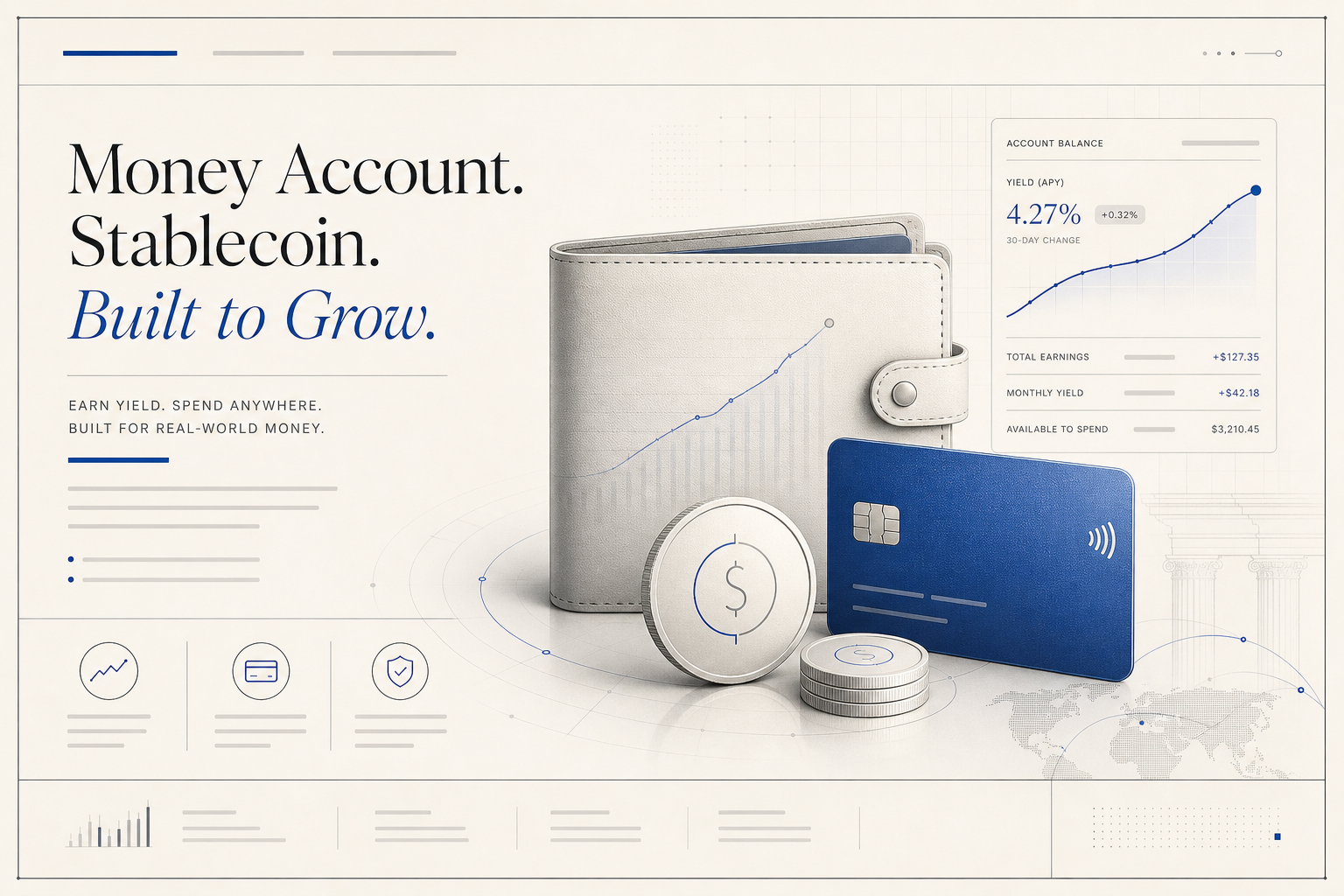
MetaMask has taken a clear step beyond the wallet category with the launch of Money Account, a new product that bundles stablecoin balances, card-based spending and onchain yield into a single self-custodial account. The immediate significance is not just another feature release. It is that one of crypto’s largest distribution points is now trying to package stablecoins as a usable money layer for ordinary financial activity, rather than as idle collateral or a bridge asset that users move between apps. If that model works, the next phase of stablecoin adoption may be shaped less by trading venues and more by consumer-facing interfaces that combine saving, payments and market access inside the same balance.
According to MetaMask’s June 30 launch announcement, Money Account runs on Monad and is powered by mUSD, the firm’s dollar-denominated stablecoin. Users who opt in can earn up to a 4% variable annual percentage yield, while keeping access to trading functions inside MetaMask rather than moving funds into separate yield products. The company is positioning the account as self-custodial, meaning the user still controls the assets instead of handing them to a centralized platform. That framing matters in the current market. Stablecoin issuers, wallets and exchanges are all trying to capture more of the financial relationship with the end user, but MetaMask is betting that convenience does not have to come at the cost of control over the underlying wallet.
The spending side is what makes the product more notable than a standard yield vault. MetaMask says the account connects directly to the MetaMask Card where that card is available, allowing balances to be spent at Mastercard-accepting merchants without a separate off-ramp step. The company also says supported stablecoins including USDC, USDT and DAI, along with certain yield-bearing variants, can be converted into mUSD at one-to-one parity without conversion fees on supported networks. Users can also buy into the balance with card rails and Apple Pay. Put together, that means MetaMask is trying to remove a longstanding friction point in crypto finance: users have traditionally needed one venue to hold assets, another to earn on them and another to spend them.
The yield engine underneath the account is still DeFi infrastructure, and that introduces the usual caveats. MetaMask says funds are deployed through third-party smart contract vaults operated by Veda, with risk curation handled by Steakhouse Financial. Morpho is the initial destination for the vault, while Aave markets are expected to follow. In practice, that means the headline yield is variable and ultimately depends on external protocol conditions, not a fixed bank-style promise. MetaMask’s own materials also note that smart contract and protocol risk remain part of the stack, and the company says the product is available only in eligible jurisdictions, with the UK and other restricted markets excluded at launch. So while the interface looks simpler, the underlying mechanics are still recognizably crypto-native.
That architecture says a lot about where the stablecoin market is moving. In the launch materials, MetaMask points to a stablecoin market above $320 billion in capitalization and cites annualized stablecoin-backed card spending of roughly $18 billion. The strategic read is straightforward: the sector is large enough that the next competitive edge is no longer basic issuance alone. The fight is now over who owns the user workflow around those dollars. Wallets want to become the default place where balances live. Payment cards want to normalize spending from onchain money. DeFi lenders want that same money routed into yield strategies in the background. Money Account is effectively a packaged answer to all three demands.
There is also a more structural implication for the wallet business itself. For years, crypto wallets mainly served as access points into other protocols, with limited ability to keep users engaged once they left the swap screen. Money Account is an attempt to reverse that model by turning the wallet into the operating environment. Instead of treating stablecoins as something to park and later redeploy, MetaMask is treating them as a continuously active balance that can earn, settle purchases and fund trades from the same place. That is a stronger commercial position, but it also raises the execution bar. To succeed, MetaMask will need the product to feel as seamless as fintech cash management while still preserving the transparency and controllability that self-custody users expect.
For RWA and stablecoin markets, the broader takeaway is that the product boundary is shifting. The important question is no longer only which issuer can mint the most trusted digital dollar, but which platform can wrap those dollars in enough utility to make them sticky. MetaMask’s launch suggests the next arena for competition will be yield-bearing transaction accounts built on public blockchain rails. If more consumer and institutional interfaces follow the same path, stablecoins will look progressively less like standalone tokens and more like programmable cash accounts with embedded settlement, credit routing and spending logic.