KB Kookmin prepares Kinexys-based dollar payments for trade clients
KB Kookmin Bank is preparing an August rollout of blockchain-based cross-border dollar payments for import and export businesses using JPMorgan’s Kinexys network. The move is notable because it pushes bank-led programmable settlement deeper into mainstream corporate treasury flows rather than keeping blockchain payments at the pilot stage.
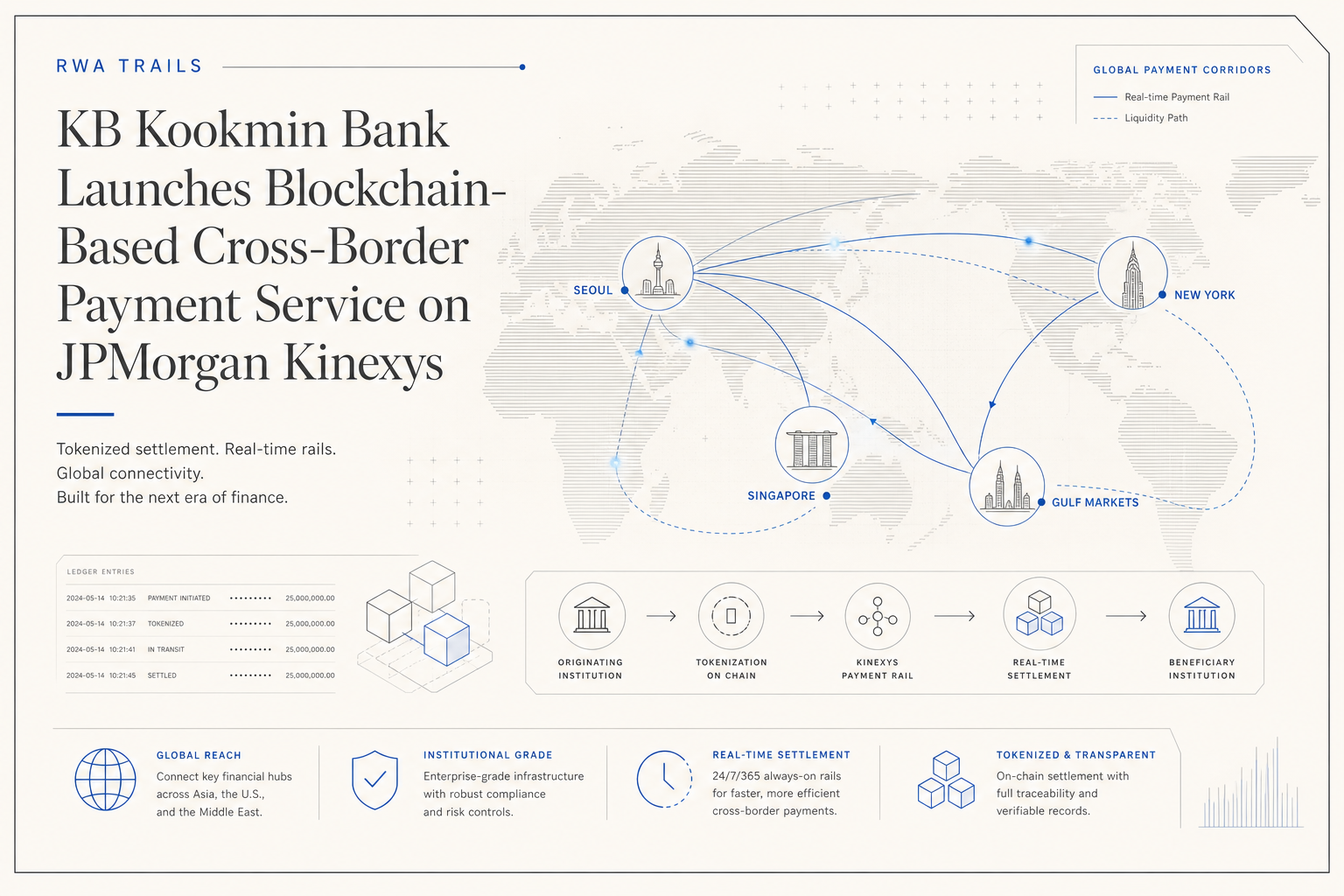
South Korea’s KB Kookmin Bank is preparing to launch a blockchain-based cross-border payment service for corporate trade clients in August, a step that would move one of Asia’s largest banking groups further into production use of onchain financial infrastructure. The planned service is aimed at importers and exporters rather than retail crypto users, which is what makes the development consequential for real-world assets. It points to blockchain rails being used not simply to issue tokenized instruments, but to handle the less glamorous and more operationally important work of moving commercial money across borders with tighter settlement timing and better payment visibility.
According to the source reporting on the rollout, KB Kookmin will begin with US dollar payment corridors covering 10 countries, including the United States, Singapore, Saudi Arabia and the United Arab Emirates. The service is expected to connect with the existing SWIFT network instead of asking clients to abandon incumbent payment messaging altogether. That combination matters. For many banks and corporate treasurers, the practical route into tokenized finance is not a wholesale replacement of legacy infrastructure, but a layered model in which blockchain-based execution, reconciliation and liquidity tools sit alongside established correspondent banking and FX workflows.
JPMorgan’s own Kinexys materials help explain why that model has become credible enough for a large commercial bank to adopt. The bank describes Kinexys as a blockchain platform built for institutional payments, programmable money movement, deposit accounts, onchain foreign exchange and tokenization services. On its public product pages, JPMorgan says Kinexys has handled more than $3 trillion in transaction volume since inception and more than $7 billion in average daily transaction volume. Those figures do not prove immediate scale for KB Kookmin’s launch, but they do show that the underlying network is no longer being positioned as an experimental lab environment.
A separate JPMorgan client case study offers a useful benchmark for the type of treasury workflow this infrastructure is designed to support. In that example, BMW Group used Kinexys programmable payments and onchain FX capabilities to automate a euro-to-dollar transfer between Frankfurt and New York after preset conditions were met. JPMorgan said the transaction combined automated balance checks, conditional deposits, near real-time FX execution and transfers between blockchain deposit accounts, all completed outside traditional settlement windows and without manual intervention. That does not make KB Kookmin’s service identical, but it does demonstrate the operational template now available to banks that want faster trade-related money movement without discarding familiar banking controls.
Scale on the banking side is another reason this launch is worth watching. KB Financial Group’s latest English factbook reports total assets of roughly KRW 866.9 trillion for the first half of 2026, underscoring that this is not a niche digital-only institution testing a narrow proof of concept. When a bank of that size puts a blockchain-linked payment product in front of business customers, even a limited initial corridor set can have signaling value across the regional banking market. It suggests that tokenized and programmable payment infrastructure is being evaluated as a treasury and transaction-banking tool, not just as a capital-markets side project.
The broader RWA implication is that bank-issued and bank-connected digital money rails are starting to converge with the operational logic that made stablecoins attractive in the first place: always-on movement, clearer settlement status, tighter liquidity management and fewer manual handoffs. The distinction is still important. Stablecoins are typically bearer-style digital instruments that circulate across public blockchains, while platforms such as Kinexys are built around permissioned institutional networks and deposit-linked banking relationships. But from the perspective of a finance team trying to reduce payment friction, the competitive question is increasingly about which architecture delivers speed, control, compliance and interoperability at production scale.
For now, the immediate milestone is modest but meaningful: a live corporate payment service, focused on dollar trade flows, running through a large Korean bank on top of an established institutional blockchain network. The next things to watch are whether corridor coverage broadens beyond the initial 10 countries, whether additional currencies are added, and whether other regional lenders respond with similar programmable-payment offerings. If those pieces follow, the story will not be that blockchain entered banking in theory. It will be that tokenized settlement infrastructure quietly became part of the day-to-day plumbing for cross-border commerce.