KB Kookmin moves corporate dollar settlements onto JPMorgan’s Kinexys network
KB Kookmin Bank is preparing a Kinexys-based cross-border payments service for import and export clients, making it the first Korean financial institution to use JPMorgan’s blockchain payment network for that workflow. The launch shows how bank-run digital money rails are moving from pilot language into live corporate treasury operations.
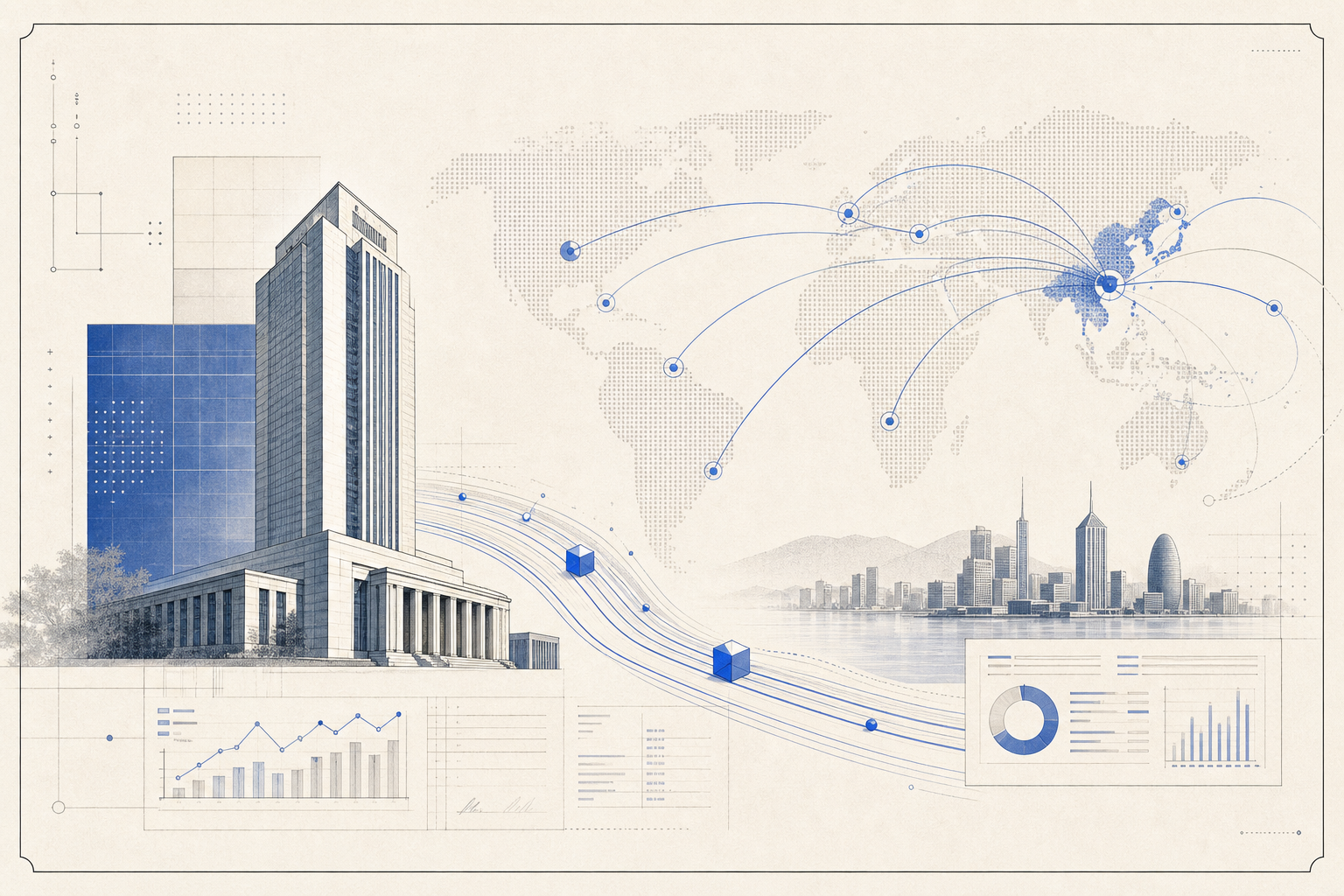
Cross-border payments infrastructure is becoming one of the clearest proving grounds for tokenized money, and KB Kookmin Bank’s latest move points to how that shift is entering live corporate banking rather than staying inside lab environments. The South Korean lender said it plans to launch a blockchain-based payment service for import and export companies next month using Kinexys by J.P. Morgan, the bank-run network formerly developed under JPMorgan’s Onyx effort. For RWA markets, the significance is not only faster messaging. It is that a mainstream bank is pushing blockchain settlement deeper into the operating layer where corporate cash, FX timing and trade flows actually meet.
The basic structure is concrete enough to matter. Reporting from South Korea and details published by the bank indicate the service will be offered through KB Kookmin’s domestic network and its Singapore branch, with U.S. dollar remittances prioritized at launch. The initial corridor set spans ten countries including South Korea, the United States, Singapore, Saudi Arabia, India, Thailand, Qatar, the United Arab Emirates, Bahrain and South Africa. That footprint makes the announcement more than a symbolic integration. It positions the product as a working tool for companies that need to settle real import and export obligations across time zones where legacy banking cutoffs still create friction, trapped liquidity and manual treasury work.
JPMorgan’s own Kinexys materials help explain why banks are leaning into this model. The platform markets blockchain deposit accounts as a way to give clients continuous visibility over balances, programmable movement of funds and near-instant settlement within the bank’s framework. Its on-chain FX product description makes a similar pitch around 24/7 currency conversion and programmable automation. In practice, that means the value proposition is less about bypassing banks than about rebuilding bank money so it can move with the same persistence and system-level interoperability that global corporates increasingly expect from digital infrastructure. For a bank like KB Kookmin, plugging into that stack offers a way to extend service hours and improve cash coordination without asking clients to step outside regulated banking channels.
That matters because the competitive pressure is no longer theoretical. Stablecoins have already trained businesses and trading firms to expect around-the-clock dollar movement, and tokenized deposits are emerging as the banking sector’s answer to that demand. The distinction is important. Stablecoins are portable bearer instruments that can circulate outside the deposit system, while deposit-token or blockchain-account models try to preserve the economics and supervision of bank liabilities while making them programmable and continuously transferable. KB Kookmin’s rollout sits firmly in the second camp. It suggests that at least some large banks now see blockchain-based payments not as a crypto adjacency, but as a necessary defense of their role in international treasury services.
The South Korean angle adds another layer. The country has become one of the more active large financial markets in testing how regulated institutions can use blockchain rails for payments, tokenized assets and digital money without abandoning the conventional banking perimeter. Recent work across deposit tokens, won-linked stablecoin discussions and tokenized market infrastructure has already shown that Korean institutions are thinking in terms of practical deployment, not abstract experimentation. In that context, KB Kookmin’s Kinexys connection looks like a direct attempt to secure operational relevance in a world where clients increasingly care about settlement speed, FX precision and always-on access to liquidity.
There are still clear limits. The launch is focused on corporate payment flows, not a general consumer product, and it begins with U.S. dollar remittances rather than a fully open multi-currency network. It also depends on a bilateral and networked banking model, which means interoperability will remain narrower than the public-blockchain stablecoin universe unless more institutions join similar rails. Even so, those constraints do not weaken the signal. They show where adoption is becoming real first: in bounded, high-value treasury workflows where banks can quantify the value of fewer cutoffs, better balance visibility and more automated settlement logic.
For RWA markets, the broader implication is straightforward. Tokenized securities, funds and trade-linked assets need a cash leg that can operate with the same speed and time-zone flexibility as the assets themselves. If banks can modernize cross-border settlement through networks like Kinexys, they strengthen the case that regulated deposit-based money can remain central to onchain finance rather than ceding the field entirely to stablecoin issuers. KB Kookmin’s rollout does not settle that contest, but it does mark another step toward a market structure where bank-run blockchain money is no longer a side project. It is becoming part of the production treasury stack.