Hyundai pushes stablecoin treasury flows from pilot theory toward operating reality
Hyundai has begun moving internal cross-border funds over blockchain rails, using a live USDT transfer between its U.S. and Mexico operations as a test of whether stablecoins can outperform legacy treasury plumbing. The next phase matters even more: a Europe pilot with Circle and Visa will test whether corporate FX and local-currency settlement can move onto production-grade digital money rails.
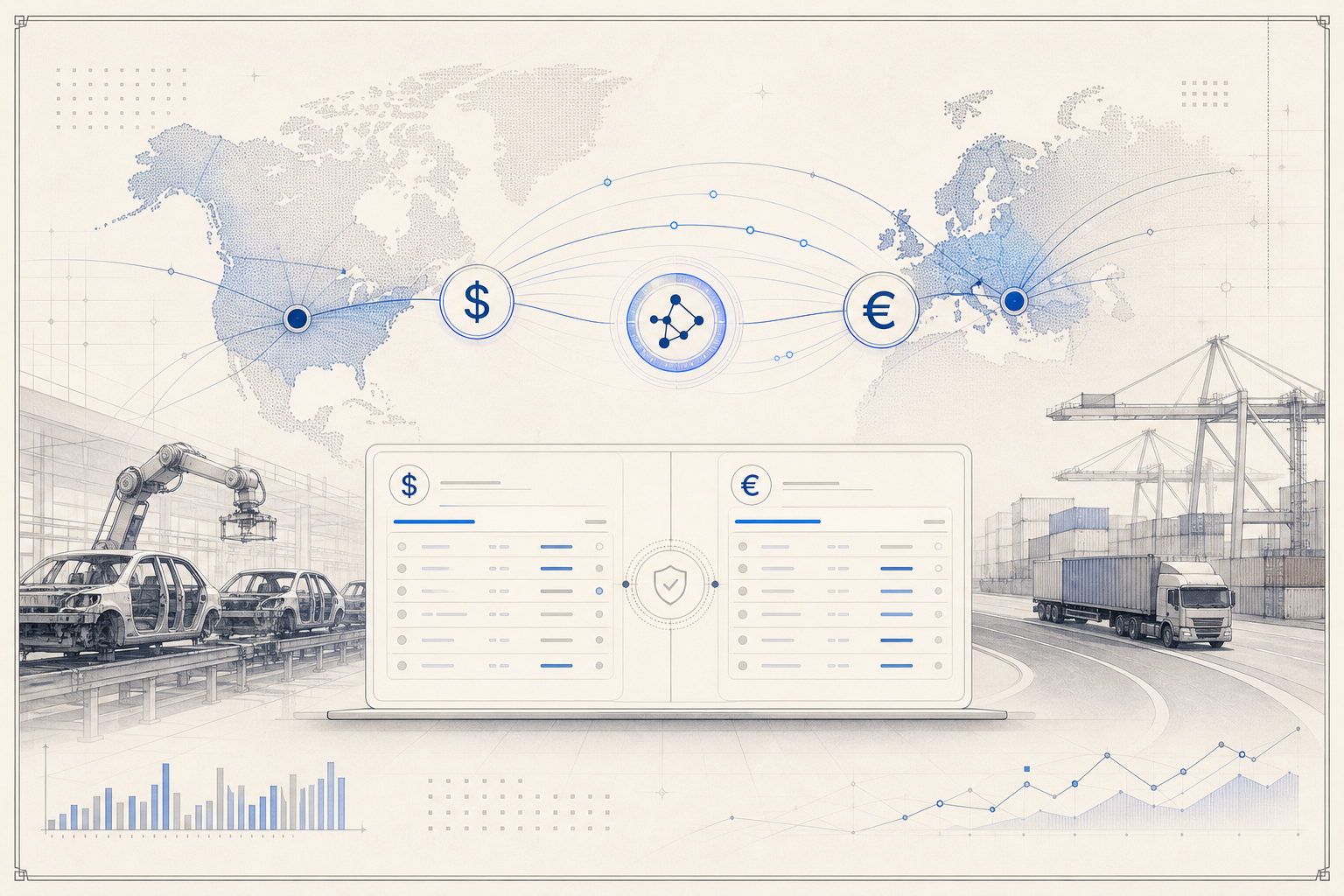
Hyundai has taken one of the cleaner steps yet in turning stablecoins from treasury talking point into operating infrastructure. The automaker has begun using a blockchain-based internal remittance workflow for cross-border fund movements between subsidiaries, starting with a live transfer from its U.S. business to its Mexico operation. The first production-style test used Tether’s USDT on Avalanche to move $20,000, with the funds converted from dollars into stablecoins and then back into dollars on the receiving side. For RWA and onchain-finance builders, that matters less because of the transfer size than because the workflow touches a real corporate treasury corridor rather than a lab environment.
What makes the move notable is the combination of a public blockchain, a large industrial operator and an explicitly internal treasury use case. According to the source reporting, Hyundai Card is leading the project and measured average transfer completion at roughly seven minutes, versus the three to four hours the group typically faces through conventional banking channels for this corridor. That comparison should not be read as a universal benchmark for every cross-border payment, because banking cutoffs, correspondent routing and entity structures vary widely. But it does illustrate the operating case that is driving stablecoin adoption inside large companies: treasury teams increasingly care about time certainty, intraday liquidity and lower operational friction as much as they care about raw transaction cost.
Independent primary materials from the infrastructure providers help explain why this pilot is plausible. Tether’s public transparency materials list Avalanche among the supported networks for USDt, confirming that the chain already sits inside the token’s live distribution footprint. Circle’s current USDC product materials also describe stablecoins as tools for near-instant, low-cost global payments and note native issuance on Avalanche alongside a wide set of other networks. Those documents do not verify Hyundai’s program by themselves, but they do show that the token and network stack referenced in the reported rollout are established payment rails rather than speculative components assembled for a headline.
The more strategic signal may be in what comes next. Hyundai’s reported second-stage pilot, scheduled for Europe later this month, is set to evaluate local-currency transfers and foreign-exchange costs with Circle and Visa. That raises the story above a single USDT remittance test. Visa’s own stablecoin product materials now frame cross-border money movement, settlement and enterprise integration as active commercial priorities, while Circle is positioning USDC as a regulated digital dollar for 24/7 business payments and institutional liquidity. If Hyundai proceeds with a Europe corridor using that stack, the project would move closer to the model many treasury teams actually want: stablecoin rails underneath, regulated counterparties around the edges, and a familiar payments brand helping bridge the last mile into enterprise workflows.
There is also an important distinction between crypto-native payments activity and this kind of corporate treasury deployment. A transfer between group entities is not consumer adoption, and it is not the same thing as a company holding volatile tokens on its balance sheet. Instead, it looks more like a controlled test of programmable settlement rails for internal cash movement. That fits a broader RWA pattern in which institutions are not starting with tokenized everything; they are starting with narrow operational problems such as moving dollars, coordinating liquidity windows, managing FX friction and extending settlement beyond bank operating hours.
For the stablecoin market, Hyundai’s move reinforces a trend toward segmentation. USDT remains deeply useful as a globally liquid settlement instrument, especially where speed and availability matter. USDC, meanwhile, is increasingly being positioned for regulated enterprise and banking-adjacent use cases. Visa’s involvement in the next pilot phase suggests another layer of convergence: the winning stablecoin stacks may not replace incumbent payment networks outright, but instead plug into them where compliance, FX routing and enterprise distribution are already strong. That is exactly the kind of hybrid architecture many real-world asset products are also converging toward.
The main question now is whether Hyundai can scale from a successful corridor test to repeatable treasury operations across more entities, currencies and controls. Production treasury workflows require policy approvals, auditability, sanctions screening, accounting treatment and reliable redemption paths, not just fast block times. Still, this is the kind of implementation the market has been waiting for: a large non-crypto multinational using stablecoins to solve a mundane but expensive treasury problem. If more industrial groups follow that path, stablecoins will look less like adjacent crypto products and more like the cash layer of onchain finance.