Stablecoin Rulebook Nears Its Effective Date as U.S. Agencies Slip Past the GENIUS Act Deadline
U.S. stablecoin oversight is moving into a tighter timetable after the GENIUS Act’s one-year rulemaking deadline passed without a full set of public final regulations. That leaves issuers, banks and state supervisors preparing for a January 2027 statutory start date with parts of the federal framework still in proposal form.
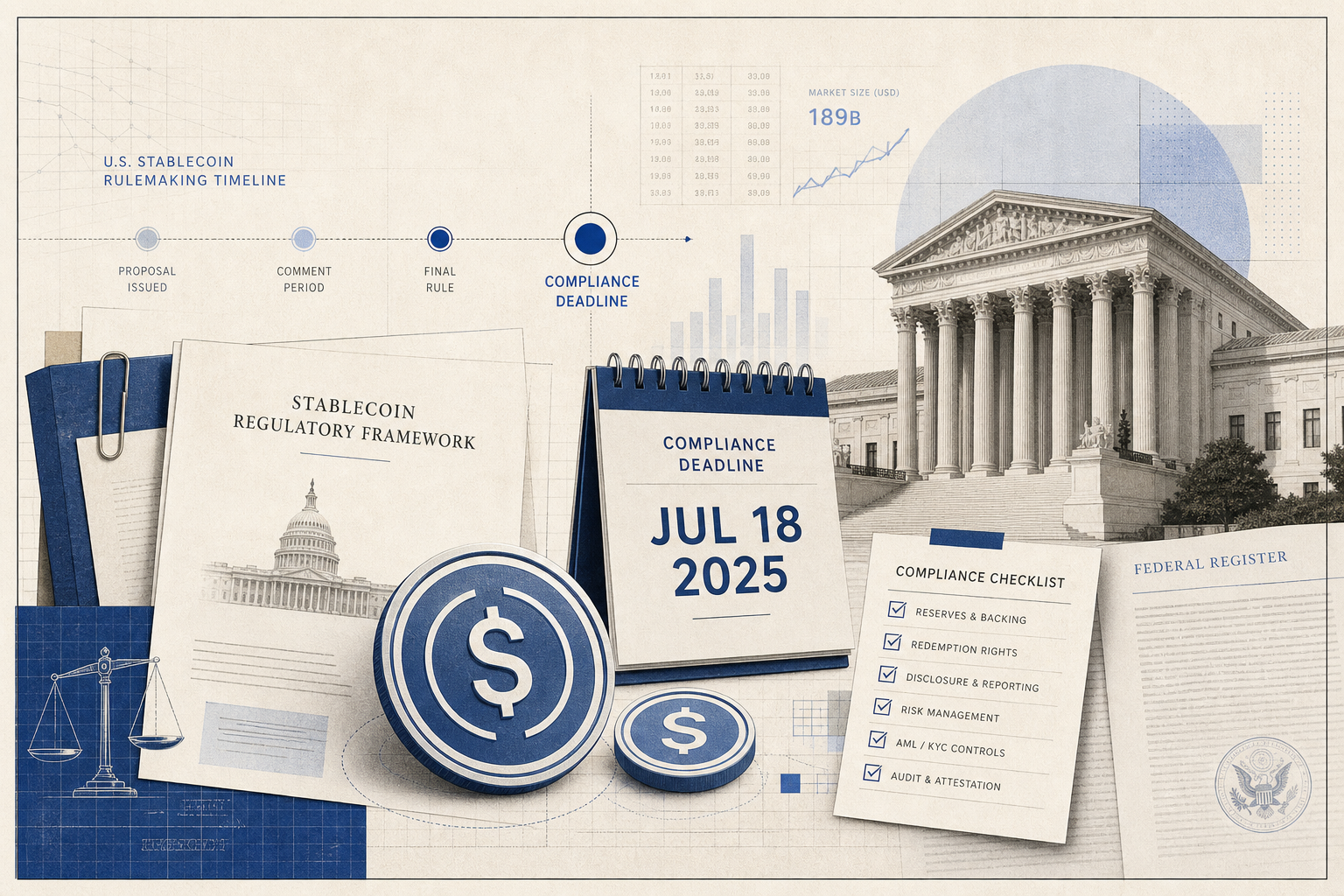
The U.S. stablecoin market has reached an awkward point in its policy cycle: the law is on the books, the implementation clock is running, and the agencies responsible for turning statutory language into operating rules are now behind the timetable Congress laid out. Public reporting on July 18 indicated regulators had missed the GENIUS Act’s one-year deadline for final stablecoin regulations, even though the legislation’s broader compliance schedule continues to advance. For issuers and financial institutions, that means the conversation is shifting from whether a federal stablecoin framework exists to how much of the practical rulebook will be in place before the market is expected to use it.
The core timing pressure comes directly from the enrolled text of the Guiding and Establishing National Innovation for U.S. Stablecoins Act. Section 13 says each primary federal payment stablecoin regulator, the Treasury secretary and state stablecoin regulators must promulgate regulations within one year of enactment through notice-and-comment rulemaking. Section 20 sets the law’s effective date as the earlier of 18 months after enactment or 120 days after final implementing regulations are issued. Because that outside date lands on Jan. 18, 2027, the statute still creates a hard arrival point for the framework even if agencies do not accelerate the clock with earlier final rules.
That distinction matters because the market does not operate on statutory headlines alone. Stablecoin issuers, bank subsidiaries, custodians, payment companies and state supervisors all need detailed instructions on reserve treatment, redemption mechanics, reporting, anti-money-laundering controls, sanctions procedures and supervisory coordination. A law can establish the perimeter, but institutions still rely on rule text to understand what examiners will expect and how products can be structured without triggering avoidable compliance risk. In practice, a missed rulemaking milestone does not stop activity, but it does narrow the planning window for everyone trying to build under the new regime.
The FDIC’s own public record shows why the rulebook still appears incomplete. In a 2026 press release, the agency said its board approved a notice of proposed rulemaking for Bank Secrecy Act and sanctions compliance standards applicable to FDIC-supervised permitted payment stablecoin issuers. The proposal would require compliance with AML, counter-terror financing, sanctions and related reporting obligations, and the FDIC opened a 60-day comment period after Federal Register publication. That is meaningful progress, but it is still proposal-stage work rather than a finished federal implementation package.
The gap is especially important for the mix of issuers likely to sit inside the GENIUS framework. Bank-affiliated issuers need clarity on how prudential supervision will overlap with payments activity. Nonbank issuers need to know how licensing, disclosures, examinations and operational controls will be sequenced. Foreign stablecoin issuers face a separate registration and monitoring path under the act, which raises a second-order question for globally distributed dollar tokens: how quickly U.S. requirements can be translated into exchange support, secondary trading policies and market access decisions across jurisdictions. The answer affects everything from domestic payments products to the cross-border circulation of major dollar-backed tokens.
For the existing stablecoin market, the timing issue is not just legal housekeeping. USDC and PYUSD are the kind of branded dollar instruments most likely to be discussed through the lens of regulated U.S. issuance pathways, while USDT remains central to global liquidity and cross-border crypto settlement even though its regulatory profile differs from domestic issuers. If agencies finalize rules late, firms may have less room to adjust reserve operations, disclosures, governance and distribution arrangements before the statute’s outside effective date arrives. That does not mean the market freezes; it means the cost of waiting rises as the calendar moves closer to 2027.
There is also a broader policy signal in the delay. Washington has spent the past year presenting stablecoin legislation as a way to bring dollar-linked tokens into a more explicit supervisory architecture without choking off adoption. Missing the self-imposed implementation cadence risks undercutting that message at the exact moment banks, fintechs and asset issuers are deciding how seriously to invest in new products. The more the framework tilts toward late-stage interpretation rather than published rules, the more executives will defer launches, rely on conservative legal assumptions or prioritize jurisdictions where licensing pathways feel more operationally settled.
The immediate takeaway is not that the GENIUS Act has failed or that the U.S. stablecoin market is suddenly unworkable. It is that the balance of risk has shifted from legislative uncertainty to execution uncertainty. Congress supplied the mandate, and at least some agencies have begun translating it into formal proposals, but the remaining job is still substantial. Unless regulators close the gap quickly, the industry will spend the next several months building toward a federal stablecoin regime whose effective date is visible, but whose final operating manual is still being written.