One year after the GENIUS Act, the U.S. stablecoin market is still trading ahead of the rulebook
A year after Washington enacted the GENIUS Act, the U.S. has a statutory stablecoin framework but not a finished operating manual. That gap is already shaping how issuers, banks and platforms position for the next phase of dollar-token competition.
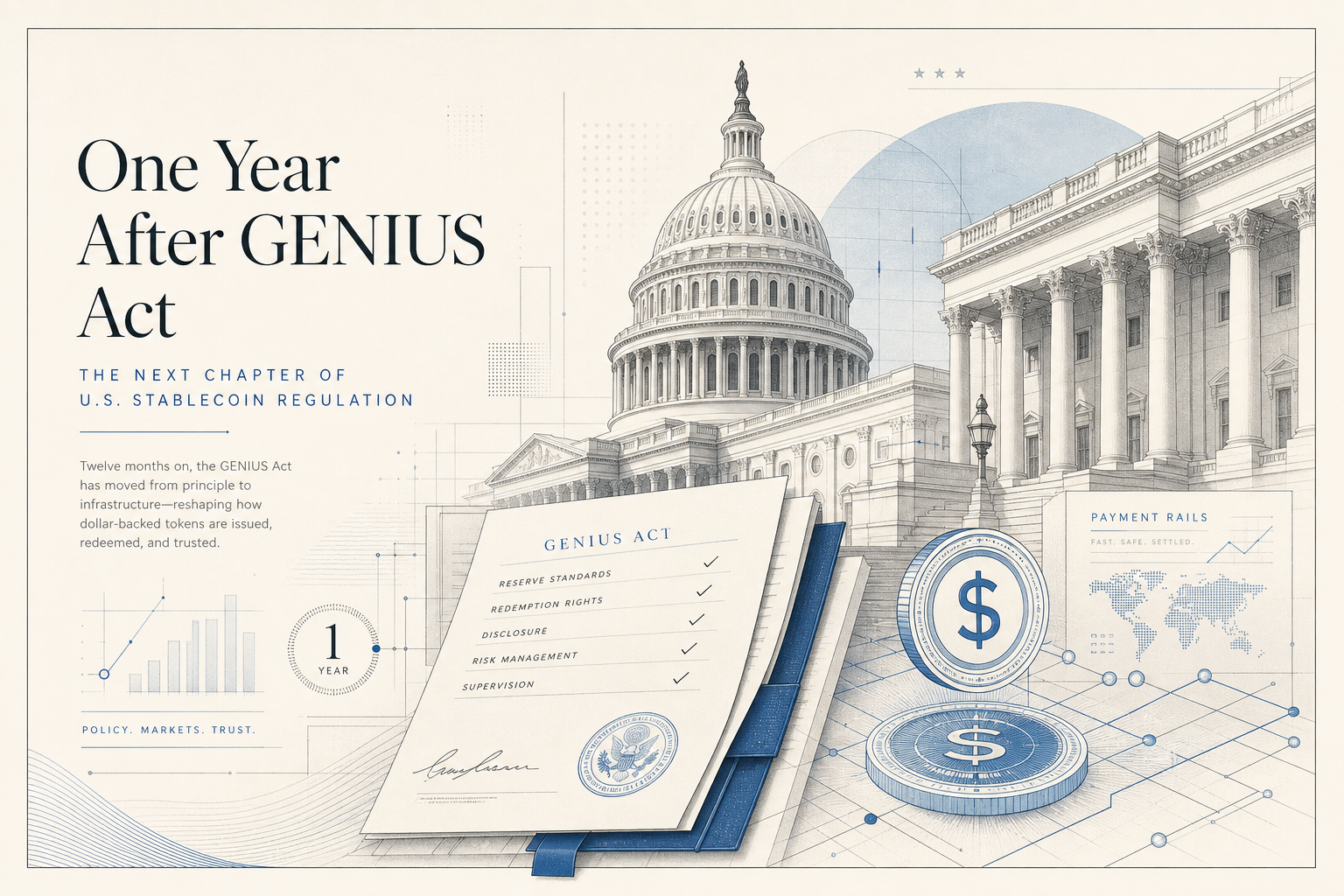
A year after the GENIUS Act became law, the U.S. stablecoin market is in an unusual middle phase: the political argument over whether Congress should create a federal framework has largely been settled, but the supervisory machinery that will determine who can scale under that framework is still being assembled. That distinction matters. Stablecoin markets do not wait for final rulebooks before repricing risk, and over the past year the center of gravity has already started shifting toward issuers, banking partners and distribution channels that look easiest to fit inside a more bank-like federal regime. The result is a market that is behaving as if the rules are real, even while many of the most consequential implementation details are still moving through the regulatory process.
The core architecture is no longer in doubt. The White House’s fact sheet marking the signing of the law framed the GENIUS Act as the foundation for a national stablecoin regime and positioned it as part of a broader effort to keep dollar-based digital money inside U.S. regulatory reach. The broad design is familiar by now: tighter expectations around reserves, governance, operational resilience and compliance, with day-to-day interpretation left to supervisors. That handoff from Congress to agencies is exactly where the current bottleneck sits. The law answered the headline question of whether payment stablecoins would be recognized in federal policy; it did not instantly answer how aggressively agencies would supervise issuers, how quickly approvals would move, or where the line would be drawn between acceptable reserve conservatism and business-model flexibility.
That is why the first anniversary of the statute matters less as a commemorative milestone than as a market signal. In the past year, the Office of the Comptroller of the Currency and the Federal Deposit Insurance Corporation have both moved through proposal-stage work tied to stablecoin oversight. Public materials referenced in recent regulatory discussions show agencies are now drilling into custody, liquidity, capital, customer identification and operational controls rather than debating the basic premise of the sector. In practical terms, that means the competitive race has shifted from lobbying for legal recognition to preparing for examination-grade compliance. For large issuers and their banking counterparts, the strategic question is no longer whether Washington will impose standards, but which institutions can satisfy those standards with the least friction when final rules arrive.
That favors issuers with the strongest transparency narratives, cleaner reserve positioning and the deepest access to regulated distribution. It also raises the pressure on firms whose historical growth came from offshore liquidity, looser disclosures or exchange-centric adoption rather than direct alignment with U.S. supervisory expectations. Even before every implementing rule is finalized, exchanges, custodians, fintechs and enterprise treasury teams have to make forward-looking decisions about what they will list, integrate and hold. Few of those institutions are likely to wait until the last possible deadline to reduce legal or compliance ambiguity. In that sense, unfinished rulemaking is not neutral. It creates an interim sorting process in which compliance credibility becomes a commercial advantage well before agencies publish the last page of guidance.
The anniversary also lands while Congress is still trying to move the broader market-structure agenda. Recent policy reporting points to continued work around the Digital Asset Market Clarity Act, with unresolved debate over ethics provisions and the broader shape of crypto market oversight. That matters for stablecoins because the GENIUS Act may be the first major federal crypto law, but it is not a complete map of how digital asset activity will be supervised across trading, custody, brokerage and capital formation. Stablecoins can move faster than the rest of the sector because lawmakers increasingly view them as payments infrastructure and as an extension of dollar distribution. But the absence of a settled market-structure framework means firms are still building against a partially completed regulatory perimeter.
For RWA markets, this is more than a stablecoin story. Tokenized funds, onchain treasuries and other institutional products increasingly rely on stablecoins as settlement cash, collateral rails or user on-ramps. A clearer U.S. regime for dollar tokens reduces one layer of uncertainty for the broader tokenization stack, especially for operators trying to serve institutions that care as much about redemption mechanics and supervisory posture as they do about blockchain throughput. If stablecoin supervision becomes more legible, it strengthens the foundation for onchain capital markets products that need dependable cash legs. If it remains slow or fragmented, tokenized asset markets can still grow, but they will do so with more friction around treasury management, platform eligibility and cross-border distribution.
The most important takeaway from year one is that U.S. stablecoin policy has crossed from theory into implementation risk. The statute is already doing work: it is changing incentives, forcing internal readiness programs and narrowing the range of business models that institutions expect will survive at scale. But the market has not yet reached the stage where federal rules are fully settled and competitive positions are locked in. Until agencies finish the operating manual, the next winners in dollar tokens will likely be the firms that can behave as though the exam has started before the regulators announce that the syllabus is final.